Showing posts with label fredric march. Show all posts

Wednesday, September 26, 2018

Thoughts on the previous versions of A STAR IS BORN - the 1937 version


With the forthcoming release of the latest incarnation of A STAR IS BORN, I thought I would go back and watch the prior versions to see which had fared better over time, and how the story has subtly shifted to reflect changing mores. In all of the movies, the story is broadly the same (SPOILERS FOLLOW!): a young talented woman dreams of becoming a star. She catches the attention of a famous older man who has already achieved that fame, and has indeed become jaded by it, falling into a cynical alcoholism. But whatever his own cynicism toward the industry, he believes in the ingenue's talent and wants her to attain that uncomplicated success that he hasn't been able to achieve for himself. They fall in love. She becomes successful. They marry.  In a pivotal scene, he drunkenly embarrasses her but she remains loyal to him, even to the point of being willing to give up her career to nurse him back to health. He cannot bear for her to make this sacrifice and commits suicide to allow her to be free.  In the famous final scene of the film, she arrives at her latest premiere, announcing herself as "Mrs Norman Maine" in his honour. At least this is what happens in the first two versions of the film - we'll discuss how the third version deviates from it later.

The original 1937 version of A STAR IS BORN remains my favourite and - to my mind - still holds up as a straightforward tragic drama and investigation of the corrupt Hollywood machine. The film's credentials are impeccable. It was directed by William A Wellman (THE PUBLIC ENEMY), based on a screenplay by THE Dorothy Parker, Alan Campbell, Robert Carso. The evocative score was composed by Max Steiner (CASABLANCA) and its technicolor photography was ground-breaking - achieving a more naturalistic feel than its predecessors and winning DP W Howard Greene (THE ADVENTURES OF ROBIN HOOD) the first ever Oscar for a technicolor film.  In front of the lens, the film stars Fredric March (THE BEST YEARS OF OUR LIVES) as the tortured actor Norman Maine and the sweetly sincere Janet Gaynor as his discovery, Esther Blodgett.

What I love about this version is that there's a real pathos in Fredric March's performance and while Gaynor is earnest she never looks like a pushover.  In fact the opening scene of this film has a rather gothic old relative warning her that she'll have to make sacrifices for fame, and though wide-eyed, Esther always seems open-eyed too.  This makes her marriage to Norman all the more heroic.  What's more shocking is his decision to take such an extreme decision at the end of the film.  It's as though he knows she'll never leave him so he has to leave her and allow her to flourish.  In that sense, it's the ultimate sacrifice.  What I also love about this is that the pure nobility of the act contrasts with what has also been a film about the fickle manipulation of Hollywood - the press agents, the paparazzi, the fakery.  And so there's an irony that these two lovers have married under their real names - deemed to ugly to be used in Hollywood -and that even when "Vicky" declares herself to "Mrs Norman Maine" she isn't really at all. Even that is a Hollywood construction. It makes the ending satisfyingly ambiguous or bittersweet.  She has become what he hoped, and what she hoped for herself, but she has necessarily compromised herself in the process, as the old woman warned her at the start. 

The 1937 version of A STAR IS BORN has a running time of 111 minutes. It won the Oscar for Best Original Story and an honorary award for its photography.

Sunday, November 21, 2010

Greta Garbo retrospective - ANNA KARENINA (1935)

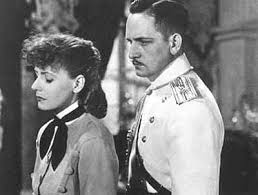
Anna Karenina is my favourite novel. There are novels that I think are better written, though not many, and those that I admire more. But Anna Karenina has my heart, and I read it typically twice a year. When you love a book so passionately - when you have visualised every scene and every character - it becomes incredibly hard to give another person's vision a fair viewing. And so, in general, I have avoided watching the many film and TV adaptations of the novel*. However, I have recently been rewatching a lot of Greta Garbo's films on my many train journeys to Paris, including her 1935 ANNA KARENINA directed by Clarence Brown.


Anna Karenina is a beautiful society woman who's love for her son compensates for her marriage to a staid and self-satisfied man.  She is pursued by the dashing Count Vronsky, and knowing what is at stake, refuses his advances at first. When she gives in she sacrifices her place in society and access to her son.  Worst of all, cut off from the air of society, Vronsky becomes clasustrophobic and Anna becomes insecure and paranoid with tragic consequences. This story is set against that of Anna's sister-in-law Kitty, who's heart is broken when Vronsky leaves her, but is courted by the fascinatingly ill-at-ease, philosophically mired aristocrat Levin.

This movie adaptation is just 95 minutes long and much is sacrificed to get the movie down. The story of Kitty and Levin is given very short shrift, as well as anything more dark and searching in Levin's philosophical quest. This is of particular pain to those who, like me, think that Levin is the true hero of the tale. When it comes to the story of Anna and Vronsky, Garbo is of course, perfectly cast. Her magisterial beauty makes Vronsky's reckless behaviour unsurprising, and her ability to play against that, and show deep vulnerability and doubt, is deeply affecting. It might be a cliché, but in the final scenes, when we see Anna in the extremity of suffering, one can't help thinking that only a silent movie heroine would know how to convey such complexity and depth of emotion as Garbo does.

I also rather like the direction. Brown was apparently Garbo's favourite director and he took her from silent films such as FLESH AND THE DEVIL into her first talking feature, ANNA CHRISTIE and beyond. Of what I'd seen of his earlier films, Brown was not a director with visual flair - rather leaving his camera static to observe a beautifully framed tableaux the better to fix our attention on Greta Garbo's face. But ANNA KARENINA starts with a tour-de-force scene in which he shows Count Vronsky in his element - at a lavish officer's dinner. It isn't a scene that exists in the novel, but perfectly captures the decadence of that era and the capacity for self-indulgence that Vronsky will display. It also foreshadows the tragedy that will occur when Vronsky is cut off from the oxygen of these society events. The officers are tucking in to luscious food, almost like unruly schoolchildren, and then, we realise, this has only been a starter! As they are called to dinner, the officers start singing and line up at a long banqueting table, richly laden with yet more luscious food. The camera tracks back slowly down the length of table, at food rather than officer height, and the effect is powerful and overwhelming. Truly brilliant film-making. This understanding of the fact that much of Russian high society at that time was about creating spectacle carries through into the first ball-room scene, in which a mazurka is staged. William Daniels photography is once again superb, and as we see high society indulging in emotional games in their lavish frocks, there is no mistaking that this is a David O Selznick film with all the MGM glitz and glamour that that entails.

So, there is much to like in ANNA KARENINA - Brown's visuals and Garbo's performance. But for me this can never quite be a great film because of the liberty taken with the text by screen writers Clemnece Dane and Salka Viertel (QUEEN CHRISTINA) and in particular the downplaying of Levin-Kitty as a counter-point to Anna-Vronsky. Doctor007 thinks I am being unfair on this point - and that the movie stands up perfectly well on its own terms. Maybe he is right, but I am far too enmeshed in the novel to be able to make that separation.

*Anglo-Saxon versions began with J Gordon Edwards' 1915 Anna starring Betty Nansen, Edward Jose and Richard Thornton; and Julien Duvivier's 1948 film, produced by Alexander Korda and starring Vivien Leigh as Anna, Ralph Richardson as Karenin, Kieron Moore as Vronsky with a score by Constant Lambert and a score by Cecil Beaton. More recently, Bernard Rose's 1997 Anna starring Sophie Marceau, Sean Bean, Alfred Molina, James Fox and Danny Huston.

Russian Anna's include Tatyana Lukashevich's 1953 version starring Anna Tarsova; Aleksandr Zarkhi's 1967 movie starring Tatyana Samoljlova as Anna; and Margarita Pilikhina's 1974 film, with Maya Plisetskaya as Anna and Alexander Godunov (Karl in DIE HARD) as Vronsky. German Anna's include Friedrich Zelnik's 1919 Anna starring Lya Mara and there are versions from France, Italy and Hungary from the silent era.

ANNA KARENINA played Venice 1935 where it won the Mussolini Cup for Best Foreign Film (shudder) and was released in 1935 and 1936.