Showing posts with label peter elkind. Show all posts

Saturday, March 12, 2011

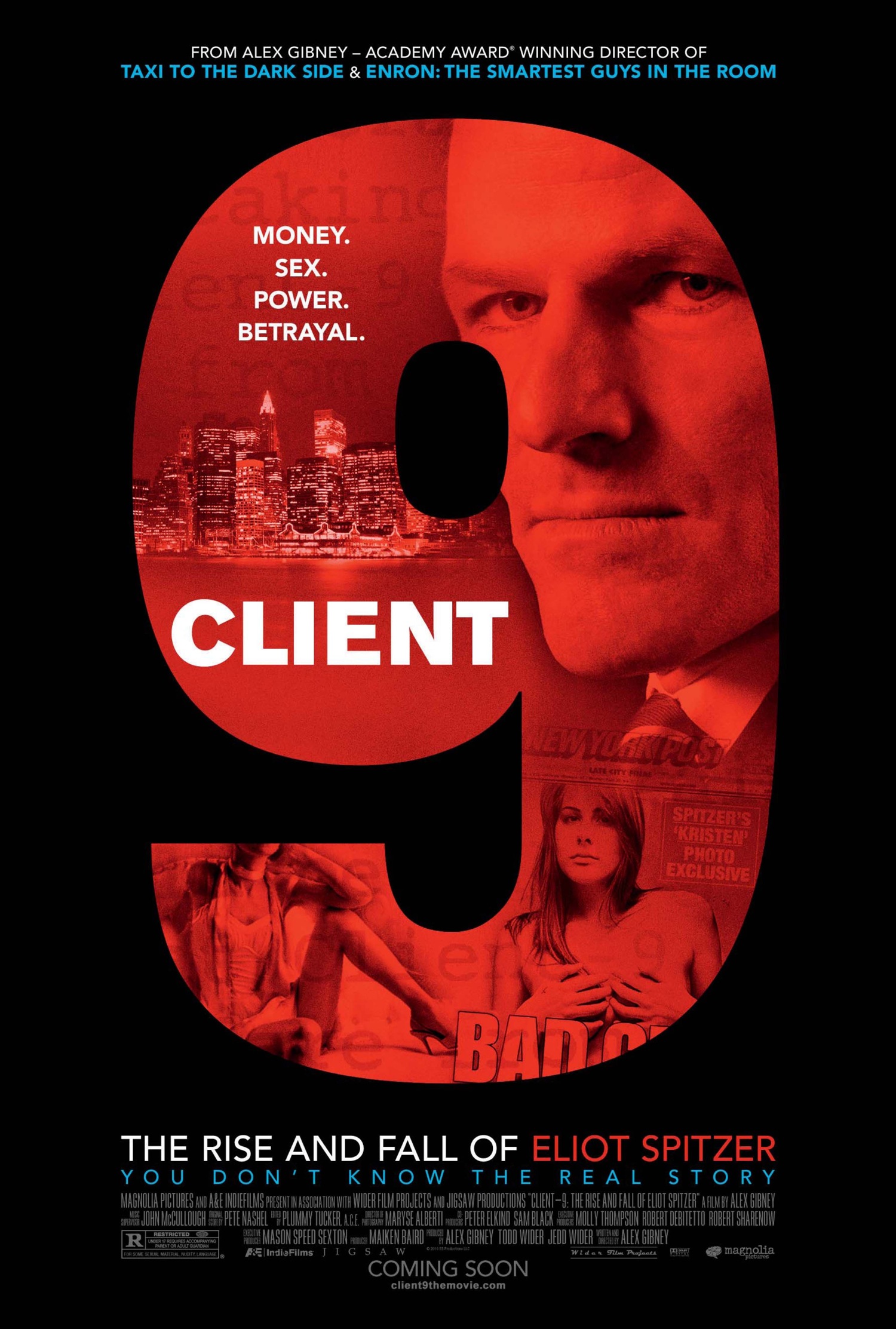
CLIENT 9: THE RISE AND FALL OF ELIOT SPITZER

Documentarian Alex Gibney (ENRON: THE SMARTEST GUYS IN THE ROOM, TAXI TO THE DARK SIDE) has a convincing but controversial thesis. That the enemies Eliot Spitzer made on Wall Street as New York Attorney-General, and in Albany as New York State Governor, combined to bring him down - exploiting his use of prostitutes with a FBI inquiry that was maliciously leaked to the press. Spitzer himself comes across as less melodramatic. He takes ownership of his mistakes, though unwilling to be drawn on the psychology behind them. He is also less than candid about how pugnacious he truly was as Attorney-General and State Governor. He comes across as an idealistic man who resorted to a thug-fight, and naively seems surprised that the people he bruised would resort to the same vicious tactics to exploit his mistakes. Spitzer is not a man one necessarily warms to, but was essentially right to throw a searchlight on Wall Street. And it says something that he was willing to give Alex Gibney an interview. 

The people who come off far worse than Spitzer are those Spitzer opposed - notably Frank Langone and Hank Greenberg - titans of Wall Street who resented Spitzer's legal cases against their fraudulent behaviour - fraud that has since been exposed in the 2008 financial crash. They come across as venal, smug, and crowing over his defeat. By comparison, Spitzer's political opponent, New York Senator Joe Bruno, since convicted of fraud, comes across as a mere second-tier fraudster. The prostitute, "Kristen" or Ashley Dupree, also comes off as a slick media-manipulator, eager to cash in on her new-found fame, enabled by the right wing media who love nothing more than to keep her in the public profile and thus keep Spitzer's name tarnished. 

The biggest surprise of the documentary was the prostitute that Spitzer sought out most frequently and who appears in the doc played by an actress to protect her identity. She comes across as smart, empowered, with enough integrity to spurn the media and just get on with her life. I guess it says something about the modern-day corruption of the politico-economic establishment when a whore is the most sane, selfless and intelligent voice in the room. 

The resulting documentary is an even-handed tale of hubris and nemesis. Spitzer made his own mistakes, but the people he pissed off took full advantage. Does it need to be two hours long? It certainly lost pace in the second hour. Does it need to be seen on the big screen? No. Gibney produces very high quality work, but this could easily be seen on the small screen. But for all that, this is a film that tells its story meticulously, has the air of truth about it, and educated me about the intricacies of Spitzer's downfall. Although I had followed his case closely at the time, it was fascinating to see a well researched documentary take us through the planted media stories and behind the scenes. 

CLIENT 9: THE RISE AND FALL OF ELIOT SPITZER played Toronto 2010 and went on release in the US and Canada last November. It is currently on release in the UK and has been released on Region 1 DVD.

Friday, May 12, 2006

ENRON: THE SMARTEAST GUYS IN THE ROOM - great story, okay documentary

ENRON: THE SMARTEST GUYS IN THE ROOM is a documentary that does not excite cinematically. It tells a compelling and important story in a very pedestrian manner. There are no exciting revelations beyond the initial expose of the story in the pages of the financial press in 2001. There is no reason to see this at the cinema rather than on DVD or on TV. That is not to denigrate the subject matter. Like I said, this is an important story, and at 2 hours, watching this documentary is as good and as quick a way to get a handle on it as any other.

In a nutshell, the story is as follows. ENRON was one of the biggest and most successful companies in the US. It paid its employees largely in stock options - claims on stock that can be cashed in at some future date. What this means is that employees - especially those at the top who have the most options - have an interest in keeping the stock price high. How do you that? Well, in two ways. First, you publish quarterly results, which should be a clear record of historic performance. The stock price should therefore reward good past behaviour. Second, you can personally impress stock market analysts (essentially people who review companies), with promises of future good behaviour. In this way, they will recommend that investors buy your stock, further boosting the price.

Now ENRON systematically manipulated the share price on both counts. They manipulated the historic record of profitability shifting Enron's debt and badly-performing assets into little offshore companies owned by the CFO, Andy Fastow or by selling them temporarily to very very friendly investment banks. If you temporarily shift all the bad stuff out of the company during reporting season, no surprise, all that's left is the good stuff, and that makes for great profits reports! In addition, ENRON boosted actual historic profits by allowing its energy traders to exploit loopholes in the deregulated California electricity market. At one point, ENRON traders were getting ENRON power plants to shut down in order to force rolling black-outs and boost the price of power.

On the second count, ENRON talked large about Big Ideas that were going to generate the proverbial phat cash. Not only did this impress the stock analysts but, thanks to an accounting technique called mark-to-market, ENRON was able to report these hypothetical future earnings as real, actual, in the cash-register, money. When those ideas failed to bear fruit, it was only a matter of time before the house of cards would come crashing down. At this point, a number of senior executives starting cashing in stock options at the top of the wave, netting huge sums. At the same time, they kept telling ordinary working class employees to keep investing in ENRON stock, knowing full-well that that stock was likely to plummet in value when the truth got out. And that’s exactly what happened. ENRON went bust and employees lost their jobs and their pensions in one nasty hit.

Clearly this is an important story. I always understood why it made sense for companies to issue options – the theory is that they tie employees’ interests into the good performance of the company. But for the employee, who is already dependent on the company for their current earnings, it smacks of putting all your financial eggs in one basket. If times are tough, your company might sack you, so shouldn’t you be invested in an industry that is counter-cyclical to yours? And as the documentary makes clear, the collapse of ENRON had ramifications well beyond the financial markets or the pockets of the employees – whether or not you like Gray Davis, it’s hard not to feel sorry for a man who lost his job because of a bunch of out-of-control traders.

Like I said, this documentary is a decent primer on the ENRON scandal, and makes for compelling viewing if you didn’t know much about it before. But for those of us who have worked in the financial or professional services industries, and know at first hand the conflicts of interest involved in supposedly objective stock analysts, accountants, auditors and lawyers who are also reliant on fee income from broking, banking and consultancy, there isn’t much new here.

ENRON: THE SMARTEST GUYS IN THE ROOM premiered at Sundance 2005 and was released in the US and Australia last year. It is currently on super-limited release in the UK. I know of no release date for Germany, Austria or France.