Sunday, January 30, 2011

BRIGHTON ROCK (2010) - A noble failure


When writer-director Rowan Joffe introduced the preview screening of BRIGHTON ROCK at the BFI last night, he was apologetic. He apologised for daring to take on the Boulting Brothers' classic adaptation, but argued that his movie was borne out deep respect and love of Graham Greene's novel. In the production notes he went further, arguing that Greene's novel was so great, that it DESERVED more that one interpretation. I thought this was a rather odd introduction. Good art should never apologise for itself. And how can one separate the novel from the film in the case where the novelist actually wrote the screenplay?

At any rate, taking Joffe at his word, this is what is likely to happen in any broadly faithful version of Brighton Rock. A violent teenage racketeer called Pinkie murders Fred Hale, a member of the most powerful gang in town. He has to seduce an innocent young girl called Rose in order to find out if she really does know who did it, and prevent her squealing to the police. And while he's trying to placate this needy innocent girl, despite his inward disgust at her masochistic nature, he's trying to out-wit the local gang-boss, Collioni, and avoid the interfering meddling of Fred Hale's friend, Ida. The tone of the film should be menacing, unnerving, sometimes terrifying, but always taut. And running in the background is a debate about the nature of good and evil. Is Ida's simplistic categorisation of herself as good and Pinkie as evil, through and through, like the lettering in the stick of rock, true?  Or is Grace far more complicated and far more grand than her vulgar mind can fathom?

So how does Rowan Joffe's adaptation stack up? To start with the positive, it is a handsomely made film with beautifully observed production design. It takes us from the peeling walls of Kite's house via the faded grandeur of Ida's tea-rooms to the glossy, pretentious interiors of Collioni's Cosmpolitan hotel. DP John Mathieson's (ROBIN HOOD, GLADIATOR) photography captures that watery sunshine of the British sea-side and there is a beautifully lit climax on the cliffs. As for the acting, Andrea Riseborough (NEVER LET ME GO) is an effective Rose, making her delusional belief in Pinkie believable and heart-breaking. She is ably supported in the minor roles by a fine cast, with British actors of the quality of Phil Redmond (ANOTHER YEAR), Sean Harris (24 HOUR PARTY PEOPLE) and Steve Evets (LOOKING FOR ERIC) playing Spicer, Hale and Rose's father respectively. Moreover, there is an air of earnest respect and delicate care that overlays the entire project. Joffe claims he loves the novel and is respectful of the original film. Well, you can feel that.

And maybe that's the problem. Because this film just never takes off. It feels turgid. There is no pace, no sense of menace, and for all the nightmare visions of Pinkie at the end of a rope and scenes of Rose praying, no real sense of the stakes - whether literal or metaphysical. The film feels too safe, too sunlit, too designed somehow. It's as though the effort of getting the 1964 costume designs just right - the perfectly appointed suite in the Cosmpolitan Hotel - has resulted in a series of beautifully framed still shots. But where is the seedy menace of Greeneland? I simply wasn't scared of Sam Riley's Pinkie.

If we're looking for culprits, I guess the decision to set the film in 1964 rather than the late 30s would be one. The "pop" clothes and music, the mods and rockers, are a distraction, and far less menacing than the lurid clair-voyants and fair-gound freakishness of the original film. Maybe the youth angst theme is just to temporary - too situated - for a film about mortal sin. I also think some of the performances are too broad and perhaps the writing too reductive. Helen Mirren's Ida is shorn of the 1947 Ida's vulgarity. She comes off as a simplistic "tart with a heart" - and the use of these simplistic tropes is something I noticed, and disliked, in Rowan Joffe's script for the awful George Clooney thriller, THE AMERICAN. Andy Serkis' Collioni is a caricature - and maybe there is some sense in which those glamorous Italian mobsters are self-consciously caricatures - but you don't get the feeling that Joffe and Serkis are playing with that level of sophistication here. 

Just as some of the performances are very broad, the movie also has an incredibly intrusive over-worked orchestral score by Martin Phipps, never ceasing to bring out the Catholic material with its use of religious texts. In fact, the treatment of the movie's religious content is altogether reductive and crude.  Do we really need Pinkie's wooden bedroom to have the paint-stripped in just the pattern to reveal a cross? Do we really need Pinkie and Rose's first kiss to be shot from over-head, Pinkie holding her uncomfortably by the hands in a kind of martyred crucifix pose? Do we really need to see Rose in Church praying before an altar, shot from above the head of Christ? This ham-fisted handling of the religious content is best seen in his choice of final scene - the true test of any screenwriter claiming that he has adapted the book out of love. Admittedly, it was a test that Greene himself partly failed, but that is no excuse.

BRIGHTON ROCK played Toronto and London 2010 and will be released in the UK and Finland next Friday. It opens in Germany on April 21st.

Saturday, January 29, 2011

Pantheon movie - BRIGHTON ROCK (1947)

This review reveals the plot of both the novel and the film.

Full disclosure: I am the cliché. I converted to Roman Catholicism at Oxford and transferred the zeal of the convert into an obsession with the writings of the two most famous Catholic converts - John Henry Newman (now on his way to Sainthood) and Graham Greene (whose works appeared on the now thankfully defunct Index Librorum Prohibitorum). Greene's honest portrayal of the difficulty of reconciling Catholicism with humanism - his rejection of simplistic certitude, even though that was what his Church seemed to demand of him - resonated deeply with me. And so, as many other readers, I started off, predictably, with his novels, especially the "Catholic novels" - Brighton Rock, The Power and the Glory, The End of the Affair, The Heart of the Matter, Monsignor Quixote....It developed into a solid collection of literary criticism of Greene's work, thence into biographies and came full circle, reading Greene's superbly analytical criticism of others, not to mention his substantial body of film reviews. Finally, I came to the films. Of the works he scripted, THE THIRD MAN is simply untouchable and perfect. Taut, harsh, unsentimental. Of the films adapted from his novels, surely the greatest is the one he himself adapted (reworking Terence Rattigan's initial screenplay), The Boulting Brothers' 1947 version of BRIGHTON ROCK.

The novel was based in a world that Greene was fascinated by and closely observed - Brighton's underworld of black marketeers, Italian gangsters and sawdust bars. What was fascinating was the Greene depicted Brighton's public face as being no less vulgar, menacing and and disgusting than its underworld. Greene barely concealed his contempt for day-trippers looking for superficial, transient pleasures. Their faults are magnified in the character of Ida Arnold - a vulgar woman, completely of her time and locale. Ida drinks, flirts, visits clairvoyants, and has that complete and utter moral certainty and righteousness that fills the pages of the Daily Mail. She stands in contrast with Greene's anti-hero, the teenage gangster, Pinkie Brown. Pinkie Brown is a man out of time - by virtue of his Catholicism, which makes him "other" in Anglican England - but also because he is emotionally sterile - disgusted by sentiment and sex. He wanted to be a priest not because he felt a calling, but because he thinks that being a priest will allow him to live as a neuter - as nothing. This is the nihilistic outlook embodied in T.S.Eliot's early poetry.

The novel plays itself out as a battle between Ida's simplistic superficial morality and Pinkie's grander conception. He can be demonic, yes, but he also has grasped more firmly what true grace is, and so has a glimmer of a chance of something greater. Pinkie commits murder, but doesn't drink. He seduces the innocent young waitress, Rose, and marries her, simply to prevent her from giving evidence against him. He hates Rose because he hates her wilful naivety and because he finds her loving him absurd. It is absurd. But it is also frightening for him. Because, as in all sado-masochistic relationships, Pinkie realises that it's Rose who has the power. And so he tries to blot her out in the most complete manner - by making her commit suicide. He is not merely removing the threat to himself (the dead cannot give evidence), but removing her absolute faith. By tempting her into committing a mortal sin, he is killing innocence itself. Of course, the irritating, do-gooding interventions of Ida Arnold save Rose from suicide and damnation, and Pinkie is killed instead. But Pinkie is triumphant in the end. For the more charitable, the parish priest holds out the hope of grace and mercy, even for the murderer and seducer. For the less charitable, Pinkie's triumph is that he will ultimately destroy Rose's innocence from beyond the grave, thanks to a malicious recording he left her, telling her that he hates her. The end of the novel is utterly chilling. And for a novel that is widely seen as a "Catholic novel" it seems to dash away Hope and easy religious answers. There are no trite miracles. No easy fixes.


The Boulting Brothers' 1947 film of the novel is a tour-de-force of British noir - far surpassing their later social satires (LUCKY JIM, I'M ALRIGHT JACK) in visual style, if not in substance. From the opening chase scene, and the murder of Fred Hale, the movie is fast-paced and menacing. Brighton is menacing - both the grim under-world and the lurid sea-side attractions. DP Harry Waxman (THE WICKER MAN) and cameraman Gil Taylor (later DP on DR. STRANGELOVE) light everything with stark contrasts and frame scenes from unsettling angles. The point-of-view shots are un-nerving - often taking the audience through someone's hands to the scene beyond, as every scene is one of potential strangulation. That's how we first see Pinkie - a close-up on his hands playing with twine, as if to strangle. Richard Attenborough's performance as Pinkie is superlative - the contrast between his innocent baby-face (he was only 23 and looks 17) and the coolness with which he commits murder and the ease with which he picks up Rose. And, much as Greene reputedly didn't appreciate her performance, Hermione Baddeley is suitably crude and intrusive as Ida - an essential characteristic in confirming our sympathy for Pinkie, despite his heinous crimes.

There are two key changes from the novel. First, it's Catholic debate is essayed more lightly and subtly than in the book. But this is surely the right move. After all, without using an intrusive voice-over for internal monologue, it's hard to see how the Catholic angle could've been explored more explicitly without seeming heavy-handed. The second change is the ending. Where the novel has Rose walking home to listen to Pinkie's vicious record, the film ends with Rose in a convent, listening to a record which, thanks to a scratch that cuts short the monologue, allows her to believe that Pinkie did love her. Her Catholic faith is in tact, she can believe that she did "change him", and all this because of, we are supposed to believe, Divine Mercy. For years, I hated this ending, until I realised that actually one could choose to read it as the bitterest and most ironic ending of all. After all, is it more cruel that Rose has her illusions shattered, or that she lives on completely deluded? Still, this seems like a second-rate shabby sort of fix. Worst of all, one cannot blame Rattigan or the Boulting Brothers for this easier, more commercial ending, because it was Greene himself who changed it, apparently to appease the censors. Greene has been quoted as noting: "Anybody who had any sense would know that next time Rose would probably push the needle over the scratch and get the full message." I don't think that's right. I think you can't have it both ways. Either the end is sugary, or she is deluded. The evasion at the end weakens what is otherwise a sublime picture.

BRIGHTON ROCK was released in 1947.

Friday, January 28, 2011

HOW DO YOU KNOW

HOW DO YOU KNOW is a truly execrable relationship drama that was, for some reason, marketed as a light-hearted romantic comedy. Reese Witherspoon plays a pro soft-ball player cut from the national team as she turns thirty - a move that sends her into a life crisis.  She simply doesn't know whether she wants to be a normal girl with a boyfriend and eventually a baby, let alone who she wants to be with. The choices are Owen Wilson's wealthy but promiscuous pro sportsman and Paul Rudd's earnest but hapless failed businessmen. Hardly a great set of options.  Cue lots of sex with the pro sportsmen, lots of wannabe quirky-cute conversations with the failed businessmen, and a lot of really really boring scenes in which unlikeable narcissists ruminate on how shitty their lives are, all the time in perfectly designed rooms with perfectly quaffed hair.  Witherspoon is mawkish; Rudd is mawkish; and Wilson plays that charming rogue character he always plays.  But no-one is more ill-used than Jack Nicholson.  Where's the emotional insight and wry wit of James L Brooks' AS GOOD AS IT GETS?  Where's the real heart of James L Brooks' THE SIMPSONS.  Poor, poor, poor.

HOW DO YOU KNOW is on release in the US, Canada, Denmark, Germany, Switzerland, Austria, Egypt, France, Ireland, Spain and the UK. It opens in February in Estonia, Australia, Kazakhstan, Peru, Russia, Bulgaria, Japan, the Netherlands, Italy, Argentina, Hungary, Israel, Iceland and Lithuania. It opens in March in Belgium, Kuwait, Malaysia, Portugal, Singapore, the Philippines, Poland and Norway. It opens on April 29th in Brazil.

Wednesday, January 26, 2011

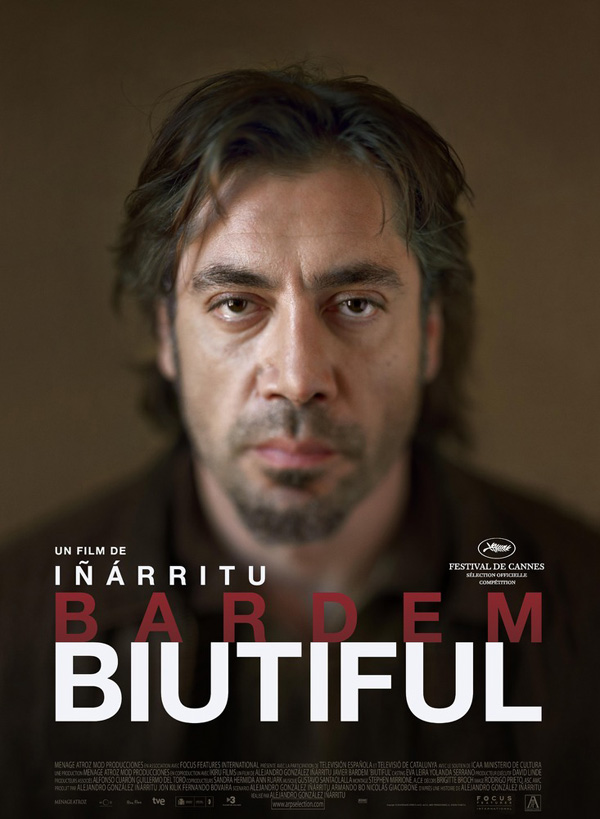
London Film Fest 2010 - Day 15 - BIUTIFUL


Alejandro González Iñárritu's last film, BABEL, prompted one of the most excoriating reviews published on this site, as guest reviewer Nikolai, mocked its pomposity and pretension.  I was completely in agreement: it seems to me that ever sense his breathtakingly raw and powerful debut, AMORES PERROS, Iñárritu has done little more than create boring, overly-complicated, emotionally sterile films - beautifully shot maybe - but turgid and unwatchable.  Sadly, BIUTIFUL is no exception to this rule. Watching it feels like being in a lecture hall with a dusty old professor explaining why his theory is very, very clever, and earth-shatteringly important, and achingly sad.  As the minutes pass you get more and more resentful and start wishing for something altogether less earnest and more, well, entertaining.  And the tragedy is that Iñárritu is wasting his talent - his talent for creating arresting visuals, for being totally in control of the screen - and wasting Javier Bardem's talent too. For Bardem, arguably the finest Spanish language actor working today, and one of the best in any language, turns in an award-worthy performance in the lead role.  But to what end?

Bardem plays a man called Uxbal - a man dying of cancer, with little time left and many problems to solve. He is father to two children, still in love with their mother, but unable to trust her with their care given that she is an alcoholic.  So, he tries to amass a small amount of money in order to bribe a seeming stranger into caring for them after he has died. In order to do this, he exploits his gift of people able to speak to the dead, and cuts so many corners in his job as middle man for a gang of Chinese sweatshop owners, that he puts others lives at risk.  The moral quagmire is real and Bardem beautifully portrays a man feeling guilty for selfishly trying to protect his kids - and at the same time knowing that his attempts are essentially futile.  And as the movie grinds into its final stages, we should be moved to tears by his children's plight.  The problem is that our senses are deadened by the socio-political hectoring of the director - Iñárritu's pathological need to inspire liberal angst at the dangerous lives of illegal immigrants and children raised in poverty.  He wants us to feel, but ends up turning us off. And that is the greatest tragedy of all.

BIUTIFUL played Cannes, Telluride, London and Toronto 2010. It was released in 2010 in France, Mexico, Norway, Sweden, Spain, Israel, Denmark and the USA. It is currently on release in Greece, Brazil and Finland and opens this weekend in the UK, Turkey and Portugal. It opens on February 4th in the Czech Republic, Estonia and Italy. It opens on February 9th in Indonesia; on March 10th in Germany and on March 18th in Iceland. It was nominated for a Golden Globe for Best Foreign Language film but lost. It has also been nominated for an Oscar for Best Foreign Language film and Javier Bardem has been nominated for Best Actor.

Tuesday, January 25, 2011

Oscar nominations in full....


Person/film I think WILL win in blue; SHOULD win in red (if different to WILL); UNWORTHY of a nomination in green. Let the high stakes wagers begin!


BEST FILM: Black Swan; The Fighter; Inception; The Kids Are Alright; The King's Speech; 127 Hours; The Social Network; Toy Story 3; True Grit; Winter's Bone;


BEST DIRECTOR: Darren Aronofsky, Black Swan; David O Russell, The Fighter; Tom Hooper, The King's Speech; David Fincher, The Social Network; Joel and Ethan Coen, True Grit.


BEST ACTOR: Javier Bardem, Biutiful; Jeff Bridges, True Grit; Jesse Eisenberg, Social Network; Colin Firth, The King's Speech; James Franco, 127 Hours.


BEST SUPPORTING ACTOR: Christian Bale, The Fighter; John Hawkes, Winter's Bone; Jeremy Renner, The Town; Mark Ruffalo, The Kids Are Alright; Geoffrey Rush, The King's Speech.


BEST ACTRESS: Annette Bening, The Kids Are All Right; Nicole Kidman, The Rabbit Hole; Jennifer Lawrence, Winter's Bone; Natalie Portman, Black Swan; Michelle Williams, Blue Valentine.


BEST SUPPORTING ACTRESS: Amy Adams, The Fighter; Helena Bonham Carter, The King's Speech; Melissa Leo, The Fighter; Hailee Steinfeld, True Grit; Jackie Weaver, Animal Kingdom.


BEST CINEMATOGRAPHY: Matthew Libatique, Black Swan; Wally Pfister, Inception; Danny Cohen, The King's Speech; Jeff Cronenweth, The Social Network; Roger Deakins, True Grit.


BEST ORIGINAL SCREENPLAY: Danny Boyle and Simon Beaufoy, 127 Hours; Aaron Sorkin, The Social Network; Michael Arndt, Toy Story 3; Joel and Ethan Coen, True Grit; Debra Granik and Anne Rosellini, Winter's Bone.


BEST ORIGINAL SCREENPLAY: Mike Leigh, Another Year; Scott Silver and Pal Tamasy, The Fighter; Christopher Nolan, Inception; Lisa Cholodenko and Stuart Blumberg, The Kids Are Alright; David Seidler, The King's Speech.


BEST ANIMATED FILM: How To Train Your Dragon; The Illusionist; Toy Story 3; Alice in Wonderland;


BEST FOREIGN LANGUAGE FILM: Biutiful, Dogtooth, In A Better World, Incendies, Hors-La-Loi.


BEST ART DIRECTION: Alice in Wonderland; Harry Potter and the Deathly Hallows; Inception; The King's Speech; True Grit.


BEST COSTUME DESIGN: Alice in Wonderland, I am Love, The King's Speech, The Tempest, True Grit.


BEST DOCUMENTARY: Exit Through The Giftshop; Gasland; Inside Job; Restrepo; Waste Land.


BEST DOCUMENTARY SHORT: Killing In The Name; Poster Girl; Strangers No More; Sun Come Up; The Warriors of Qiuqang.


BEST EDITOR: Pamela Martin, The Fighter; Tariq Anwar, The King's Speech; Jon Harris, 127 Hours; Angus Wall and Kirk Baxter, The Social Network.


BEST MAKE-UP: Barney's Version, The Way Back, The Wolfman, How To Train Your Dragon.


BEST ORIGINAL SCORE: John Powell, How To Train Your Dragon; Hans Zimmer, Inception; Alexandre Desplat, The King's Speech; A. R. Rahman, 127 Hours, Trent Reznor and Atticus Ross, The Social Network.


BEST ORIGINAL SONG: Comning Home from Country Strong; I See The Light from Tangled; If I Rise from 127 Hours; We Belong Together from Toy Story 3.


BEST ANIMATED SHORT: Day and Night; The Gruffalo; Let's Pollute; The Lost Thing; Madagascar, Carnet de Voyage; The Confession; The Crush; God of Love; Na Wewe; Wish 143.


BEST SOUND EDITOR: Inception; Toy Story 3; Tron: Legacy; True Grit; Unstoppable.


BEST SOUND MIXING: Inception; The King's Speech; Salt; The Social Network; True Grit.


BEST VISUAL EFFECTS: Alice in Wonderland; Harry Potter and the Deathly Hallows Part 1; Hereafter; Inception; Iron Man 2.

Friday, January 21, 2011

Random DVD Round-Up 4 - JONAH HEX

JONAH HEX should've been superb in the way that SOLOMON KANE was superb.  Based on pulp comics written by John Albano and illustrated by Tony DeZuniga, Jonah was a late ninteenth century bounty hunter in the Old West, sold to the Apaches by his father, his face disfigured by scars in  a tribal ritual, bound to protect the innocent, and battling alcoholism.  Jonah had no superpowers or skills other than being a damn fine shooter, and was the classic lone anti-hero.

The movie version of Jonah Hex abandons the simplicity of the original. It's as if the scriptwriters, Neveldine, Taylor (of CRANK fame) and William Farmer, just didn't trust the source material to be exciting enough, although as the former have disowned the script, perhaps the original was more coherent and faithful? Whatever the truth, the film version of Jonah Hex is given superpowers - he can speak to the dead - and his disfiguring scars aren't from an Apache battle but from being branded by his nemesis, evil Confederate general, Quentin Turnbull. The plot is also shoe-horned into contemporary political allegory, with Turnbull a kind of anti-Unionist terrorist determined to blow up the White House, and Jonah hired by President Grant to stop him.

The result is a short film (it's barely an hour and ten minutes long sans credits) that feels mashed up in the editing booth - over-stuffed with characters and allegory - and never given the time to breathe and establish itself. Josh Brolin's Jonah Hex is suitably brooding, but John Malkovich must go down as the most environmentally sustainable actor of all time, recycling his typical baddie tropes as Turnbull. Megan Fox looks sultry but is given little else to do as Hex's love interest, and actors of the calibre of Michael Sheen are wasted in small roles. It is a film destroyed in re-writes and conflicting visions - an unloved bastard of a film - and a crying shame.

JONAH HEX was released in summer/autumn 2010 and is now available to rent and buy.