Showing posts with label eddie redmayne. Show all posts

Wednesday, October 26, 2022

THE GOOD NURSE*****


THE GOOD NURSE is a quietly brilliant investigative drama about the real-life prolific serial killer Charles Cullen. He was a nurse in New Jersey who probably murdered hundreds of patients by contaminated their IV bags. The good nurse of the title is Amy Loughren, who worked night shifts with Cullen, and helped bring him in despite struggling with severe illness, being a single mum, and the obstructions of yet another hospital's administrative team trying to palm Charlie off.

The result is a film that is focussed on Amy and her battles, in a screenplay of deep empathy and subtlety from Krysty Wilson-Cairns (1917, LAST NIGHT IN SOHO). It's also a film that focusses on the flaws in the hospital system that allowed Charlie to be detected - or at least suspicions raised - but for those hospitals to merely sack him and allow him to move on to his next set of victims. It reminded me of the Catholic Church, where sex offenders were knowingly moved on to new parishes rather than being dealt with openly for fear of (among other things) the legal and financial implications. 

What we don't get from this film is Charles Cullen's life story. There is no attempt to explain why he became a prolific serial killer or what his motivation was. He remains a mystery.  That may irk some of the more sensationalist viewers, but it's the right angle I feel. It also echoed another recent Netflix film, SHE SAID, in not shying away from what it means to be a working mother, and focusing on the toll that child-rearing takes on professional women. This seems like a new and welcome trend. 

I also love how the director, Tobias Lindholm, avoids any sensationalism in a film that exists in muted night-time tones of blue and grey, and where the actors barely speak above a whisper. The restraint that Lindholm shows reflects some of the ways in which he directed his episodes of the TV show Mindhunter, but with performances even more dialled down.  Jessica Chastain, fresh from her Oscar-winning larger-than life performance as Tammy Faye Baker, couldn't be smaller and quieter and gentler as Amy Loughren. And Eddie Redmayne is incredibly contained as Cullen, reminding me of his quiet and almost vanishing performance as a murderer in the seldom-watched and even less well-reviewed SAVAGE GRACE.  This makes the moment when Cullen does lose his temper in an interrogation room the more forceful.

The result is a film of slow but mounting dread and tension. A film that moves quietly and deftly to its conclusion, and provokes us to ask not what makes a serial killer, but what makes the system that protected him.

THE GOOD NURSE is rated R, has a running time of 121 minutes, played Toronto and the BFI London Film Festival, and was released on Netflix today. 

Friday, October 16, 2020

THE TRIAL OF THE CHICAGO 7


Aaron Sorkin follows up his directorial debut MOLLY'S GAME with a movie whose subject is far more in his wheelhouse, and what an energetic, pointed, anger-making film he has created in THE TRIAL OF THE CHICAGO 7.  Its concerns are those that Sorkin has explored throughout his career:  the liberal fight against injustice, corruption and political repression.  He cast these ideas in a warm-fuzzy light where optimism won in his hit TV show The West Wing. He was angrier and more cynical in The Newsroom.  And in the Trump era, the anger is rightly turned up, and the absurdity of a system wherein the rule of law has been bent out of all recognition fully explored.  

The film opens with a montage that takes us back to the 1960s and the potent combination of the civil rights movement and anti-Vietnam protests. We see RFK beg for calm after the assassination of MLK before himself being assassinated. We then zoom in to the 1968 Democratic Convention in Chicago.  Protestors flooded into the City hoping to protest Vietnam in front of the media outside the convention hotel soon clashed with the police brutally trying to keep them away.  Once Nixon is elected his regime decides to prosecute the so-called ringleaders of the riots for Conspiracy to Incite Riots and other charges, even throwing in iconic Black Panther Bobby Seale, who had no part of it, for good measure.  The charges were clearly trumped up, the judge (Frank Langella) was clearly biased and bogus, the jury was tampered with to ensure a friendly verdict, and the defendants were clearly there just to be made an example of.

Sacha Baron Cohen is absolutely note perfect as Yippie leader Abbie Hoffman. He gets all the funniest lines because he is most comfortable with showing the absurdity of proceedings.  But it's Eddie Redmayne that has the more interesting role as Tom Hayden - the apparently more sensible, less showy leader of a student protest movement who hates Hoffman's grandstanding. Much of the intellectual back and forth of the movie comes between them as they throw barbs about how best to serve the movement.  And they are joined in a kind of Sorkin Triumvirate of Repartee by Mark Rylance as progressive attorney William Kunstler. It's so clear that the prosecution is bent (despite an ill-conceived attempt to soften Joseph Gordon-Levitt's prosecution attorney) that all the real intellectual fun is to be had in the arguments WITHIN the defense.  

The result is a courtroom drama that is thrilling and rightly anger-making, and a movie where Sorkin's trademark razor-sharp combative dialogue is absolutely right for the job.  But he has also come on leaps and bounds as a director of action. The way in which he reconstructs the riot as he interrogates the version of events that Tom Hayden is telling himself is a visual and editorial tour-de-force.

THE TRIAL OF THE CHICAGO 7 has been released on Netflix due to Covid. It has a running time of 127 minutes and is rated R.

Tuesday, October 08, 2019

THE AERONAUTS - BFI London Film Festival 2019 - Day Seven


Despite my cynicism at another of those classy awards-bait earnest turns from Eddie Redmayne and Felicity Jones, I am overjoyed to report that THE AERONAUTS is an absolutely captivating film, with characters that I deeply cared about, stunning visuals, and a wonderful message.  In these dark times, it's just so refreshing to have a film that's all about how science benefits humanity, and that it's worth risking your life for.  It's also refreshing to have a film featuring a strong female lead who doesn't confirm to society's misogynistic template of where she should find fulfilment and happiness. A couple of times I feared the film might want to give us a schmaltzy Hollywood ending but it resisted.  Science is enough! We don't need hokey romance.

So what's it all about? THE AERONAUTS is based on the memoirs of the real-life meteorologist James Glaisher, who in the 1860s flew a hot air balloon to 37,000 feet, breaking by far the previous record, and gathering all sorts of useful and wondrous scientific data.  In real life, he did it with a co-pilot who was male, but the film posits that his pilot was a female - Amelia Wren, who had flown with her now deceased husband Pierre.  In this version of events, while Glaisher (Redmayne) is a keen scientist, he lacks practical experience and very much needs Amelia's help.  Amelia (Jones) is a talented pilot but also a pragmatic entertainer.  She realises that she almost has to be a circus performer entertaining the crowd.  Throughout their journey, it's Amelia who is in control, both technically and emotionally. And this really is her story more than James'.

I really loved how the aeronautical experiment takes place in real time, with the height and time passed showed in a graph on screen. The production design, including this device, is all stunningly beautiful, and the cinematography and vis-effects are wondrous, and never feel fake.  The film really filled me with the excitement of being above the cloud line, I was alive to every twist and turn, and felt the excitement of every challenge. 

So kudos to all involved behind the lens - especially director and co-writer Tom Harper (WILD ROSE), to co-writer Jack Thorne (WAR BOOK), cinematographer George Steel (WILD ROSE) and production designers (David Hindle and Christian Huband). 

THE AERONAUTS has a running time of 101 minutes, and played Toronto, Telluride and London 2019. It will be released in the UK on November 6th and in the USA on December 6th.

Sunday, May 12, 2019

FANTASTIC BEASTS: THE CRIMES OF GRINDELWALD


For a very long film, CRIMES OF GRINDELWALD has a lot of characters with very few lines, and even less to do.  There's the troubling casting of a pretty Asian woman as a mysterious but almost mute Nagini.  There's Ezra Miller (WE NEED TO TALK ABOUT KEVIN) as the troubled, mysterious but almost mute Credence.  Even the lead character, Newt Scamander (Eddie Redmayne) says little except in a cryptically shy mumble, his eyes shyly averted from his interlocutor's face and yet somehow aimed at their boobs. 

For a very long film, CRIMES OF GRINDEWALD also seems rather rushed and haphazard.  Scenes end in a jarring manner, mashed up against the next one. There's a feeling that things are happening in between that have been left on the editors floor.  Things that would help us understand what the frack is going on.  It's been quite some time since I've had to google the ending of a film to figure out what just happened, but I had to with this film on two counts!

So what's actually going on? There's a powerfully magically destructive kid called Credence. He may be able to take out Dumbledore (Jude Law).  Grindelwald (Johnny Depp) is a kind of fascist anti-muggle bastard who's escaped prison and now wants to manipulate Credence into helping him take out Dumbledore.  It's not clear why Grindelwald can't go after Dumbledore directly. But maybe it's for the same reason that Dumbledore has to use his proxy - Scamander - to go after Grindelwald - because the two have a blood oath not to attack each other. Apparently this is because they used to be gay lovers. I know this because of the interwebs, rather than from anything the film might helpfully tell me.

What the movie actually consists of is a bunch of different characters wandering around Paris trying to find each other.  This is all very dull. What makes the movie worth watching are two things - first the absolutely ravishing costume and production design evoking an inter-war Paris - and the occasional moments of emotional impact - mostly revolving around the character of Leta Lestrange (Zoe Kravitz.)  Leta is, like Credence, filled with self-hate and conflict. She's an old school friend of Newt, engaged to his elder brother, anxious about some childhood guilt, and flirting with joining Grindelwald.  By contrast, the less I had to watch Redmayne's Scamander - a bag of cliched tics and mumbles - the better. And his purported love interest - played by Katherine Waterston - is a charisma vacuum.  Dan Fogler is far more engaging as the muggle comedy sidekick but is criminally underused. And as for his lover, Tina Goldstein (Alison Sudol channelling Marilyn's breathy high-pitched voice), it's not clear why she would react to not being allowed to marry a muggle by following a fascist who wants to enslave muggles.

Not much of this movie makes sense.

FANTASTIC BEASTS: THE CRIMES OF GRINDELWALD is rated PG-13 and has a running time of 134 minutes. It is available to rent and own. 

Tuesday, February 10, 2015

JUPITER ASCENDING


You can listen to  a podcast review of the film below or subscribe to Bina007 Movie Reviews in iTunes:


I can't work out whether JUPITER ASCENDING is a cunning satire on early twenty-first century capitalism and Hollywood's obsession with youth or just a steaming mess.  

The Wachowski Siblings have created a world in which in human beings are just a commodity, harvested by oligarchs to create a serum for eternal youth.  The market-leaders in this harvesting business are three siblings of the Abrasax family.  The elder is Balem played by Eddie Redmayne in a performance so camp it goes beyond parody and into plain bad.  His rivals are his sister Kalique (Tuppence Middleton) and playboy brother Titus (Douglas Booth).  Humans are playthings for these future gods, until they discover that Jupiter Jones (Mila Kunis), an earthling cleaning lady, has the exact same DNA as their murdered mother.  Clearly all three siblings now have an incentive to find Jupiter, register her as their mother reincarnated, get her to claim title to the corporation they inherited, and run the world through her.  I say clearly because none of the above is clear or makes any sense.  And that's before I get to the space police staffed with cross-bred human-animal combos with angelic wings (Channing Tatum and Sean Bean).

Tuesday, January 06, 2015

THE THEORY OF EVERYTHING


You can listen to a podcast review of this film here or subscribe to Bina007 Movie Reviews in iTunes:


THE THEORY OF EVERYTHING is a well-acted but ultimately banal biopic of the famous physicist Stephen Hawking (Eddie Redmayne) as told from the perspective of his first wife Jane (Felicity Jones).  As it opens, the young couple meet at Oxford University in the 1960s and are immediately smitten with each other.  Almost simultaneous with their courtship over the first half hour of the film is the discovery that Stephen suffers from Motor Neurone disease with perhaps only two years left to live.  It is testament to Jane's courage that she refuses to be shut out of Stephen's life and drops her own studies to marry him, raise his children and nurse him as he makes his reputation as one of the great scientists of our age.  But as we move into the second half of the film, while they both clearly still love each other, the cracks are starting to show.  Jane, who has always been religious in contrast to Stephen's atheism, falls in love with her Church choir leader, an earnest widower who becomes a kind of surrogate husband and father with Stephen's apparent blessing.  And then Stephen, forced to have a tracheotomy, and before he gets the computer voice we have come to associate with him, falls for his physical therapist.

Saturday, January 12, 2013

LES MISERABLES

Helena Bonham Cartier as the devious Madame Thenardier
For the improbable few who don't know, Les Miserable is a remarkable novel by Victor Hugo, set in mid nineteenth century, post-Napoleonic France.  The main character is a good but traduced man called Jean Valjean who lives under an alias to escape his convict past.  He is hunted by Javert, a cop whose strict adherence to the rule of law will not admit mercy or humanity.  In the first half, Valjean is redeemed by the mercy of a priest, witnesses the death of a seamstress turned hooker called Fantine and promises to care for her daughter Cosette. Together they escape Javert in the anonymity of Paris.  In the second half, Cosette falls in love with a revolutionary young aristo called Marius, who is also beloved by the sad little innkeepers' daughter, Eponine. Valjean realises that rather than escape Javert by fleeing to London, he must save Marius from certain death on the barricade. In doing so, he challenges Javert to let him pass with the dying boy, thus fundamentally destroying Javert's worldview and self worth.  Javert commits suicide, and Valjean dies, his family knowing his true worth. 

In the 1980s, the novel was reworked as a musical by Claude-Michel Schoenberg and Alan Boublil. They stripped the Victor Hugo classic of its baggy social exposition leaving the bare bones of a story of young love crossed with a tragedy of redemption versus the rule of law. They also added a handful of truly superb songs and the comic relief of the con-artist inn-keepers, the Thenardiers. The result was a product of memorable songs, and overt sentimentality.  The only character of any real psychological interest was the conflicted Javert.  Even poor Eponine, suffering unrequited love, is so good that she leads her beloved Marius to Cosette.  It is, then, almost uniquely, a movie in which all the major characters are wholly good, and their songs speak to worthy but unfulfilled longing.  There are no song and dance numbers here. It's just torch song after torch song interspersed with the one truly comic number at the inn.

I am conflicted about Tom Hooper's translation of the musical to the big screen.  There is much to be commended.  He forces the actors to sing live during the take, rather than miming to a prerecorded track, giving the movie an emotional authenticity that is entirely novel.  Surely movie musicals can never go back from this new high bar?  Hooper is also unabashedly faithful to the original - capturing its grandeur and melodrama, ringing every last tear from his audience. I doubt any fan of the original will be disappointed with this on-screen translation. Hooper is fortunate in his cast. Hugh Jackman's background in musical theatre is well known and it shines through here with his heartbreaking Valjean. We have seen Amanda Seyfried sing in MAMA MIA! and are unsurprised by her pretty but slightly too trilly soprano.  Anne Hathaway and Eddie Redmayne as Fantine and Marius prove to be highly capable singers too.   The only weak link is Russell Crowe as Javert, but I didn't mind this at all as it is far more important that we believe his psychological deterioration in the final act - an d Crowe sells this well.  Of course, it was predictable that Eponone, played by Sarah Barkman, would be a scene-stealer given her theatrical background, and as usual we get the Papageno/Poor Joe effect with little Daniel Huttlestone as Gavroche.  As comic turns, Helena Bonham Carter and Sacha Baron Cohen are predictably superb as the Thenardiers. 

Behind the camera, I love the ambition of Tom Hooper's vision.  The first scene that rises through murky waters to high above a dangerously listing great ship.  The choice of a beautifully ornate Catholic Church on an isolated hilltop for Valjean's conversion.  The use of colour in the scenes with barricades - the red of Enjolras' coat.  The metaphor of having Javert always walk on the edge of the precipice.  I particularly liked the idea of Fantine singing "I dreamed a dream" almost immediately after selling herself for the first time, utterly destroyed and vulnerable.

But there is one directorial choice that I found utterly grating, and for which I think the Academy was right to deny Hooper a Best Director nomination because it is so very fundamental to the success of the film. As I said before, Les Mis is different because the songs are rather uniform. There are no song and dance numbers, and only one out and out comic turn. Rather we have a mix of earnest, heartbreaking torch songs and earnest heartbreaking doomed political chants. Unfortunately, Hooper has chosen not to  vary his style of filming. In general he cuts between camera angles but keeps his camera still and focused, often in extreme close-up, on the singer.  I get this with Valjean's conversion. And I get it for Fantine's big turn.  But for every other song? By the time I got to Marius' "Empty chairs at empty tables" I was desperate for some kind of variation, and this detracted from Redmayne emoting his heart out. This lack of directorial imagination, or perhaps the fixation with a novel idea that was taken too far, is this movie's Achilles Heel.  So that while it works emotionally, and the performances and design impress, as a work of pure cinema, it fails. 

LES MISERABLES is on release in Japan, Australia, Hong Kong, Canada, Singapore, Spain, the USA, Hungary, Malaysia, the Czech Republic, Kuwait, Lebanon, Portugal, Bulgaria, Lithuania, the Netherlands, New Zealand, Ireland, Mexico, the UK and Vietnam.  It opens on January 18th in Estonia, Iceland, Norway and Sweden; on January 25th in Poland and Romania; on January 31st in Italy, Slovenia, Thailand and Brazil; on February 8th in Russia and Taiwan; on February 14th in Cyprus, France, Argentina and Greece; on February 21st in Belgium, Germany and Finland; on March 1st in Turkey and on March 21st in Denmark.

LES MISERABLES is rated PG 13 in the USA and the running time is 157 minutes.

Saturday, November 26, 2011

MY WEEK WITH MARILYN - over-hyped

There is a great movie to be made about the conflict between Marilyn Monroe and Sir Lawrence Olivier on the set of THE PRINCE AND THE SHOWGIRL. Unfortunately, MY WEEK WITH MARILYN is not it.  That is because the writer, Adrian Hodges (TOM & VIV) and director, Simon Curtis (TV's CRANFORD)  have made a decision to take the sharp edges off the drama at every turn.  Instead of the caustic wit of Colin (son of Kenneth) Clark's memoir, the movie gives us a protagonist in the classic "ingenue" line - very dull, very sweet, and hardly necessary at all as an entry point to the film's real drama.  He falls for Marilyn, she flirts with him, but it's all very tame indeed, if in fact it really happened.  

What we really want to see is Marilyn versus Larry.  The Sexy Film Star, enmeshed in the Method, desperately trying and failing to be a technically great actress, puffed up and doped up by her self-serving entourage (a particularly menacing portrayal of Paula Strasberg) versus the Great Actor, painfully aware that his time has passed, resentful he cannot set the screen alight, and in fear of hysterical women from his experiences with Vivienne Leigh.  When MY WEEK WITH MARILYN catches afire, it's because we're watching Marilyn and Larry bring out each other's insecurities - in those moments, we get a glimpse into their interior lives.  But all too often, this fascinating material is cut short for drippy dating scenes as Marilyn and young Colin skinny dip, or visit Windsor Castle.  I wanted more of the drama - more of the tension as cinema and theatre acting changed era - more of Marilyn and Arthur Miller - more of Larry and Vivienne.

The resulting film is basically shot and scripted like an afternoon movie on the Hallmark channel. And, unfortunately, it is filled with a fair few anonymous performances - from Dominic Cooper as a suffocating manager to Julia Ormond unbelievably mis-cast as Leigh.  Emma Watson is utterly wasted as Colin's parochial love interest, and Eddie Redmayne has nothing more to do than look charming and naive.  In the minor parts, it's only really Judi Dench who stands out - she oozes class as Dame Sybil Thorndike and deserves a sort of Oscar-double-whammy for her performance here and in J.EDGAR.   As for the leads, Kenneth Branagh is stunning - stunning - as Lawrence Olivier - capturing not just his particular intonation and mannerisms, but giving the towering presence in English theatre real pathos.  

All of which brings us Michelle Willams' much hyped performance as Marilyn, the subject of an Oscar campaign from the Weinsteins. Frankly, I was utterly underwhelmed. Yes she gets the breathy, tremulous voice, and yes she can sing the songs and do the moves. And yes, she appears to have put on a bit, if not enough weight.  But she problem is this - she has not got the sexy star quality that Marilyn had, and you simply can't manufacture that.  (Which is not to say she isn't a terrific actress - just look at BLUE VALENTINE).  Too often in this film we see other characters look at Marilyn and gasp in awe and envy at the way she "lights up the screen" or the "magic" she works or the way she's "full of life".  Sadly, the sign of a bad film is when people tell rather than show.  We shouldn't need this commentary.  Williams' should be doing it herself.  And I don't buy the concept that no-one can light up a screen like Marilyn today.  We have instinctive "film stars" now just as we have "technical actresses".  Sadly, I would put Michelle Williams in the latter camp.

MY WEEK WITH MARILYN played New York, Chicago, Philadelphia and the AFI Fest 2011.  It opens this weekend in the US and UK. It opens on December 29th in Singapore; on December 30th in Finland; on January 5th in Portugal; on January 13th in Norway and Sweden; and on January 19th in Lebanon and the Netherlands. 

Tuesday, October 27, 2009

London Film Fest Day 14 - GLORIOUS 39


Stephen Poliakoff is a well-respected British play-wright and some-time film director, and the cast of Glorious 39 is filled with great British actors - from the young and talented Romola Garai and Eddie Redmayne, to stars Jeremy Northam, Julie Christie and Bill Nighy. How disappointing, then, to find his new World War Two political thriller to be poorly made, poorly acted, poorly written and patronising to boot.


The story is set in the weeks before England went to war with Germany - the glorious summer of 1939. The adopted daughter (Romola Garai) of a wealthy aristocratic family (Nighy, Agutter, Redmayne, Temple, Christie) discovers that the British government is hiding recordings of meetings in her family's rambling country estate. They give evidence that certain elements within the British establishment are so afraid of another war, and so convinced that they can't win it, that they are preparing to negotiate a secret surrender to Hitler before the war has even begun. (All true, as it happens). The movie is a thriller, wherein the daughter uncovers the who the voices are on the record, and tries to smuggle it out to people who can use it to bring down Chamberlain's government and bring Winston Churchill to power.

All this could've been the stuff of a superb thriller, in the manner of ENIGMA. But this film lacks context. We never see the politicos, the military and the aristos arguing over the future of Britain. The stakes are all rather academic, and explained in a very patronising manner by characters played by David Tennant and Hugh Bonneville. Stephen Poliakoff seems to be assuming that his audience won't know anything about World War Two. What we are left with is a melodrama centred on this rich family who motor around the countryside and attend nice parties. The siblings are vaguely sinister, and there is a spooky looking government man, but no real sense of tension. I spent much of the movie being annoyed at the heroine for taking her time. If you found the 1939 equivalent of the Watergate tapes, wouldn't you just jump in a car and take it straight to the opposition party? Why all the listening, carrying in handbags and re-listening? Why the comedy, Agatha Christie style bumping off of minor characters?

Still, for all that, the movie is vaguely interesting for the first hour. Where it really comes off the rails is in the final hour. The heroine finds out who is plotting against her and is captured. At that point, the performances and writing veer into B-movie melodrama. It's truly risible and basically unwatchable. We then squelch into a final act, where the enemies, so ardent in hunting her down, just let her slip off, and a final scene in which we're meant to acknowledge her as a true hero of the war. But she never actually does anything!

What a waste of talent.

GLORIOUS 39 played Toronto 2009 and opens in the UK on November 20th.

Friday, March 07, 2008

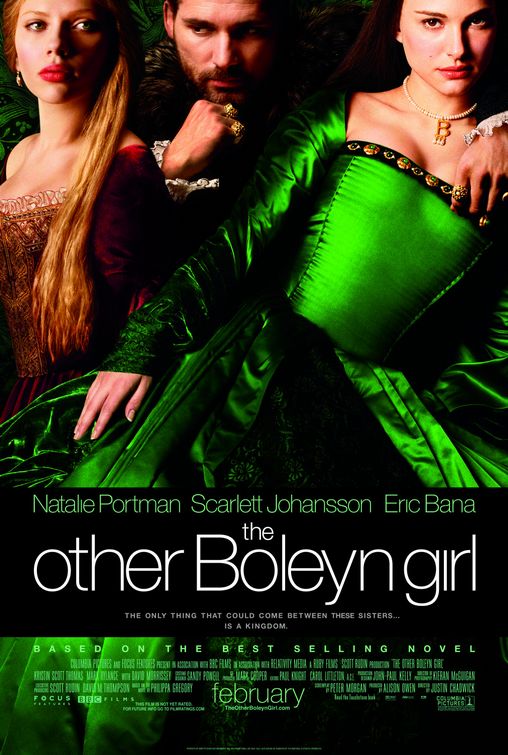
THE OTHER BOLEYN GIRL is strewn with cowpats from the Devil's own satanic HERD

Who is Cyberman's favourite Briton? It would have to be Henry the Eighth. He killed off the Catholic Church. He killed Cardinal Wolsey. He killed Catherine Parr and Anne Boleyn. Yes our favourite Briton is definitely Henry the Eighth. Because he was an unstoppable killing machine!THE OTHER BOLEYN GIRL is an adaptation of Philippa Gregory's historical novel. She portrays the Boleyn and Howard family as eager to advance in wealth and position by pimping out their daughters to Henry VIII. First, Henry knocks up docile Mary, but then casts her aside for her more intelligent and ambitious sister Anne. Her pride piqued by her rejection at the hands of Henry Percy and her family's prior support of Mary, Anne pressures the King into divorcing his true wife, Catherine. But as Queen, Anne's position will only be safe if she can deliver Henry a son.

It's a fantastic story written in clear unpretentious English. Best of all, Gregory manages to balance our base instinctual need for trashy romance and a happy ending with a more profound depiction of a society where women were chattel, and those who made their own way were liable to be seen as abominations.

The movie, however, is problematic.

The problems start with the script. Peter (of THE QUEEN fame) takes an intellectually superior work of historical fiction and strips it of any subtlety. He leaves behind a work that is much reduced - in terms of scope, motivations, credibility and enjoyment. The novel made the relationship between the two sisters more complicated. Yes, there were jealousies and rivalries but there was also a shared commitment to success and wrongs on either side. By contrast, the film has Mary as a pantomime do-gooder heroine and Anne as a malicious little whore. (Anne's relationship with Henry Percy is so quickly skated over that we have no time to see her softer side. It's also ironic to see Anne portrayed in the first half of this film almost as maliciously as she would have been portrayed at the time. So much for historical revisionism in a post-feminist world!) The motivations of Henry VIII are rendered especially opaque and Peter Morgan creates a particularly crass scene in which Henry rapes Anne. This strikes me as a particularly lazy and insidous short-hand. The mechanics of how Anne comes to be accused of being a witch are also reduced to a crude and obvious incest charge - a theme that is handled with far more subtlety and intrigue in the novel.

Finally, the most grave charge against Peter Morgan's adaptation is slovenliness. He introduces themes only to leave them hanging in the air. A classic example is that we are introduced to Mary's husband William Carey. He sort of disappears and then before we know it William Stafford is offering to take care of her. The informed viewer will realise that Carey has died in the interval, but Peter Morgan doesn't bother passing on this information. Morgan also allows a couple of lines of jarringly anachronistic dialogue to creep into the script. So, one moment we are talking of "piss-pots". The next, we're being asked to "look on the bright side". Morgan also makes the Boleyn's mother, Lady Elizabeth, the voice of feminist dissent. This is rather patronising. I think I might have worked out the social importance of the film without having a character precis it for me.

The director and cinematographer, Justin Chadwick and Kieran McGuigan, do little better, making choices that reduce their film to a cheap bodice ripper with no self-respect. From the start, the movie is drenched in a warm honey glow - soft-focus love scenes and dappled sunlight that renders the actors faces orange in the interior scenes. This is so starkly in contrast to the aggressively modern, grimly real look of Chadwick's BLEAK HOUSE that one can only assume that the critically acclaimed BBC adaptation was a success because of fine editing and production design rather than its direction. Or maybe Chadwick was hamstrung by producers and marketing departments going for a "heritage" TV look and a simple tale of sibling rivalry?

There's little joy in front of the camera. Scarlett Johansson (Mary Boleyn) doesn't so much act as look doe-eyed and slow-witted. Natalie Portman (Anne Boleyn) is the better actress. At least, she is very good at working herself up into fits of hysteria. Her mastery of the English accent is less certain. Jim Sturgess (George Boleyn) looks uncomfortable and inadequate. David Morrissey (the Duke of Norfolk) delivers his lines in a modern style that stands out from the self-conscious affected period melodramatics of the lead actress. Accordingly, he seems mis-cast, or at least misdirected. Eric Bana (Henry VIII) is a fine actor but Peter Morgan's script doesn't offer him much opportunity to portray the complexities and gravity of Henry VIII's decisions. There is some compensation in the smaller roles. Mark Rylance (Sir Thomas Boleyn), Kristin Scott Thomas (Lady Elizabeth Boleyn) and Benedict Cumberbatch (William Carey), all do brilliantly well is largely under-written parts.

Finally, what more can one say than that this movie is a dreadful disappointment?

THE OTHER BOLEYN GIRL is on release in the US, Netherlands, Ukraine, Estonia, Latvia, Spain, Egypt, Russia, Germany and the UK. It opens later in March in Australia, South Korea and Iceland. It opens in April in France, Singapore, Belgium, Israel and Italy. It opens in May in Brazil; in August in Norway and in Finland on Septmeber 12th.

Sunday, October 28, 2007

London Film Fest Day 12 - SAVAGE GRACE

It's a story so delicious, you couldn't make it up. The suave heir to an industrial fortune marries a beautiful social climber. They lead a life of privelege and ease in the summer resorts of Europe. She is embarassingly over-ambitious for her delicate young son. All three have casual sex with alarming alacrity. No-one is off limits. Nothing is unexpected. And then, after an hour or two of bed-hopping, the young son and mother indulge in the only coupling as yet untried. The fuck each other. He kills her. He orders chinese take-out and waits for the cops.

All this is true. But so much is left out. We never learn of Barbara Baekeland's disgust at her son's homosexuality. We never see that she seduces him in an attempt to turn him heterosexual, rather than out of careless boredom. We never see Tony exhibit signs of mental illness - the murder is not foreshadowed in anything he says or does. As a result, the movie lacks momentum or narrative drive. It just drifts across the screen - one scene of boredom and casual sex after another. You never understand why any of the characters do anything, much less care. Even during acts of incest or murder, the dull tedium of their lives has infected the movie-goer to the point where we couldn't care less. Things aren't helped by the lack of context in the production design. Apart from one scene in the Stork Club we never see the Baekelands as social animals, living fast in glamourous parties or nightclubs. Maybe this was due to a budgetary constraint? The result is that visually, this is rather a dull film. There's also a sort of prudishness when it comes to the sex scenes. They are hinted at but never shown - certainly this movie has none of the balls-out bravery of Christophe Honoré's
MA MERE.

All of this is a tremendous shame. I have great respect for all three lead actors - Moore, Dillane, Redmayne - and the subject matter could have been fascinating. But the movie had a listless, bizarrely prim feel to it. I was utterly unimpressed.


SAVAGE GRACE played Cannes, Toronto and London 2007. It opens in the US, Spain and Turkey in 2008.

Monday, October 22, 2007

ELIZABETH - THE GOLDEN AGE - absurdly anachronistic

Spain intends to place Mary Stuart on our country's throne, and I am to be assassinated. Does this sound familiar?  Shekhar Kapur's ELIZABETH: THE GOLDEN AGE is an unworthy successor to his original depiction of Elizabeth I.

It depicts the era in Elizabeth's reign (the late 1580s) where she ordered the execution of Mary Stuart for treason and faced off the Spanish Armada. But it plays fast and loose with history and has none of the narrative drive of its predecessor. The production design is handsome, of course, but almost everything else is off-key. The score is manipulative and repetitive - endless high-pitched violins. The photography consists of endless slow pans and tableaux. The high-class actors walk through their roles looking, for the most part, bored. This is especially true of Tom Hollander and Clive Owen. The following actors are uncertain in their accents: Samantha Morton as the Scottish Mary Stuart, Clive Owen as Sir Walter Raleigh (bizarrely, as he's playing an Englishman), and Abbie Cornish as Elizabeth Throckmorton. And other great British actors are wasted in small parts of no consequence, notably David Threlfal as the court astrologer, Rhys Ifans as a Jesuit conspirator and the interesting young Eddie Redmayne as an assassin.

Cate Blanchett is fine as Elizabeth but her talent is wasted on a meandering script with anachronist dialogue. For the first hour of the film she indulges in a faintly homo-erotic, voyeuristic relationship with Walter Raleigh and her lady-in-waiting. She says absurdly modern and whiny things like, "I would love not to be in control all the time." To which Walter Raleigh improbably replies, "You eat and drink control!" There's also a ham-fisted attempt at modern political relevance. The Catholics are depicted as dangerous religious fundamentalists. English politics is seen as a trade-off between the rule of law and safety. Very Global War on Terror.

The second half of the film picks up. Elizabeth frets about whether or not she should order Mary Stuart's execution. Mary steals the show with a melodramatic execution scene. And then we are on to the Spanish Armada, where Philip of Spain attempts a naval invasion of England in order to put a Catholic on the throne. Shekhar Kapur clearly cannot direct action sequences for toffee, which is especially sad in an era when CGI and directorial vision can combine to give us great naval sequences. See, for example, the MASTER AND COMMANDER film. By contrast, Kapur never quite captures the majesty and excitment of a naval battle and doesn't even succeed in getting across the basics of what actually happened when the Spanish attempted to invade. You get the fireships and you get the Tilbury speech but you never understand the importance of the weather; Sir Francis Drake's superior tactics despite the fact the he commanded the inferior fleet; or the importance of the Spanish cutting their anchor lines. The whole Irish coast disaster is also ommitted. Absurdly, it is Sir Walter Raleigh who is depicted as the hero rather than Drake. And most incredibly, Elizabeth is depicted as giving her famous Tilbury speech astride a horse in full armour!

Ah well, what can we say. Hollywood is not under obligation to give us historical truths. But the fantasy it substitutes for truth should at least be compelling. Instead, in ELIZABETH: THE GOLDEN AGE, we have a mish-mash of fact and idiocy that is neither intellectually satisfying nor emotionally engaging.

ELIZABETH - THE GOLDEN AGE played Toronto 2007 and is on release in the US. It opens in Portugal, Iceland, Italy, Norway, Sweden and the UK on November 2nd and in Finland and Spain on November 9th. It opens in Australia, New Zealand, Russia and Denmark on November 15th and in Egypt, Hungary, Slovakia, Slovenia, Estonia, Latvia and Turkey on November 23rd. It opens in Bulgaria on November 30th and in Belgium, France, Germany and the Netherlands in December 2007. It opnes in Singapore and Brazil in January 2008 and in Argentina and Mexico in February.

Friday, May 11, 2007

LIKE MINDS - silly plot, outstanding central performance

LIKE MINDS is a curious new thriller set in a British public school. Weird new kid Nigel has a fondness for dissecting dead animals in his dorm room. He also believes that he and his room-mate, Alex, are descendants of the Knights Templar and have an obligation to well - the film isn't entirely clear on this but I think it boils down to screwing corpses. That the film manages to hold our attention for quite as long as it does is down to the moody cinematography and direction by debut helmer, Gregory J Read and powerful central performances by Eddie Redmayne as Alex and Patrick Malahide as his father, the Headmaster. That the film ultimately fails boils down to, I think, three things. First, Tom Sturridge is weak as Nigel. He spends the first half of the film looking indifferent and stoned rather than murderous and mad. Second, Richard Roxburgh and Toni Colette, who play a copper and a forensic psychologist respectively, do not hold onto their English accents, which brings us out of the moody boarding school atmosphere. Third, the final twist seems to come out of nowhere and does not ring true. Still, as thrillers go, you could do worse, and the movie is worth seeing for Redmayne's performance alone.

LIKE MINDS was released in Australia in 2006 and is currently on release in the UK.