Showing posts with label maggie cheung. Show all posts

Monday, April 28, 2008

Wong Kar Wai Retrospective - DAYS OF BEING WILD

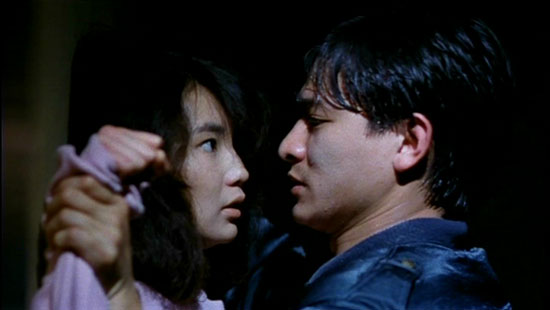
I always thought one minute flies by. But sometimes it really lingers on.Continuing with our sporadic Wong Kar Wai retrospective, we come to his 1991 feature, DAYS OF BEING WILD. A critical success but a commercial failure, the movie has all the hallmarks of Wong Kar Wai's particular brand of cinema: love-lorn urban men; women unable to move on from heart-break; the beautiful, evocative camera-work of Christopher Doyle; kitsch American popular music; and a plot that is less event-driven than an exploration of character and mood.

We are Hong Kong in the 1960s. It's monsoon season and the colour-scape of the film is lush green and brooding blue. Tragic pop-star Leslie Cheung takes on the lead role of Yuddy - an emotionally jaded young man who seems unable to maintain a stable relationship with the many girls who fall in love with him. The first of these is a naive, whimpering girl called Su Lizhen, played by Wong Kar Wai regular, Maggie Cheung in a "typical" role. The second is a ballsy show-girl called Leung Fung-Ying, played brilliantly by Carina Lau. Possibly a third is Yuddy's controlling, intimidating, ex-whore mother (Rebecca Pan). In some ways, she is the most interesting character, given her decision to cruelly reveal to Yuddy that she is actually his adoptive mother, and that his real mother is living in the Philippines.

In contrast to Yuddy, Wong Kar Wai presents one of his classic policeman characters. Andy Lau plays a decent neighbourhood copper, who comes across Su Lizhen stalking Yuddy's apartment. He takes pity on her, and is so emotionally affected by their encounters that he leaves Hong Kong for the Philippines. There he will come across Yuddy, who is now searching for his birth-mother.

DAYS OF BEING WILD is far from a masterpiece and viewers not familiar with Wong Kar Wai's patient mood pieces may be frustrated by its longueurs. However, it's a rewarding film for fans not least because it takes us further on the journey to the most perfect expression of Wong Kar Wai's style - IN THE MOOD FOR LOVE - a movie presaged by the brief, irrelevant and yet lovely little cameo of Tony Leung at the end of the film.

DAYS OF BEING WILD played Berlin and Toronto 1991 and was released that year. It is available on DVD.

Wednesday, March 12, 2008

Wong Kar Wai retrospective - AS TEARS GO BY/WONG GOK KA MOON

People like us don't have tomorrows
AS TEARS GO BY sees Wong Kar Wai's essentially romantic, fanciful nature shoe-horned into a conventional Hong Kong traid movie, reminiscent of MEAN STREETS. The result is a movie that is occasionally surprising but which has dated badly. Indeed, to modern eyes, it can sometimes feel like a pastiche. Having said all that, the movie opens in classic WKW territory. We're in a cramped flat in Kowloon and a young man (Andy Lau of INFERNAL AFFAIRS fame) is about to fall in love with a woman he has barely met. Instead of the femmes fatales of later flms, AS TEARS GO BY features a young Maggie Cheung as a milk-sop provincial who simpers in a hugely under-powered role. Naturally, this new relationship will force Brother Wah to reconsider his future as a gangster. It doesn't take much: he was already getting tired of bailing out his volatile, useless side-kick, Fly (classic Joe Pesci territory).

The movie oozes eighties stylings. There's a deeply annoying synthesizer sound-track; everyone looks like they trying to be extras in TOP GUN; the plot is pretty conventional and the denouement utterly unsurprising. Jacky Cheung over-acts horribly as Fly and Andy Lay isn't given a chance to display the talent he shows in INFERNAL AFFAIRS. So, pretty much the only reason to watch this film is to trace out the developing style of Wong Kar Wai. We can see it in superficial things like the use of cheesy songs and stroboscopic photography from DP Wai-Keung Lau. But we can see it in the substance of the film and the scenes that sit around the obligatory set-piece action sequences: lovers are thwarted and romantic life is squeezed between the petty obligations of real life.

AS TEARS GO BY was originally released in 1988 and played Toronto 1989. It is available on DVD.

*Thanks to the old lag, Berko, for clueing me in to the correct terminology for this maddening effect that so marred my enjoyment of MY BLUEBERRY NIGHTS.

Saturday, February 23, 2008

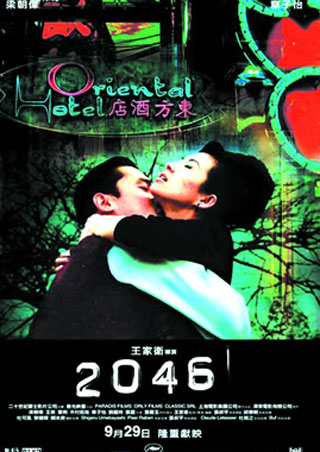
Wong Kar Wai retrospective - 2046

I once fell in love with someone. I couldn't stop wondering if she loved me back. I found an android which looked just like her. I hoped she would give me the answer.
After the perfection of IN THE MOOD FOR LOVE came the sequel, 2046 - a reflexive, rambling film that was ultimately a failure despite its ravishing visuals. Tony Leung reprised his role as Chow, now living in the Hong Kong of the late 1960s. He lives in a seedy hotel, next to room 2046 - a metaphor and focus for all his regrets and sexual yearnings. At the same time, he's writing a sci-fi novel set in 2046 - a place where you can relive your dreams in perpetuity. In this strange world of past, present and future, Chow meets a parade of beautiful, mysterious women, each dressed to perfection and photographed in a state of heightened beauty. If all these themes and striking images had been harnessed to empathetic characters and a proper story, Wong Kar Wai might have given his fans a film to treasure. Instead, the movie feels self-indulgent and unsatisfying. And, to paraphrase an interview with DP Christopher Doyle during a retrospective at the National Film Theatre, somewhat redundant. Wong Kar Wai said everything he needed to in IN THE MOOD FOR LOVE.

2046 played Cannes and London 2004 and is widely available on DVD.

Friday, February 22, 2008

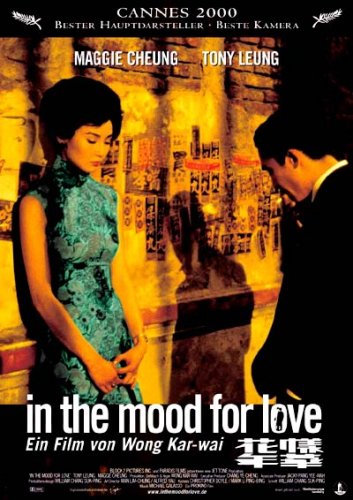
Pantheon movie/Wong Kar Wai retrospective - IN THE MOOD FOR LOVE/FA YEUNG NIN WA

As though looking through a dusty window pane, the past is something he could see, but not touch. And everything he sees is blurred and indistinct.

IN THE MOOD FOR LOVE is one of the most beautiful and touching movies of recent years. It is quite simply a story of unconsummated love between a man, Chow, and a woman, Li-zhen, who decide to rise above the pettiness of the world that surrounds them. They first meet in the cramped apartment building that they share - surrounded by nosy neighbours and the noise and fast pace of Hong Kong in the 1960s. Tony Leung plays Chow as a weary, hard-bitten newspaper man. The emotional range he conveys and the empathy he evokes in the audience won him the Best Actor prize at Cannes in 2000. Though a married man, he becomes transfixed by his glamourous new neighbour. They spend time together and the sexual tension is evident. The discovery that his wife and her husband are having an affair changes everything. At once, the tension is heightened as they play-act the roles of their spouses - indulging in dialogue they would so dearly love to be for real. And yet, they cannot now consummate their relationship because that would be as cheap as the world that surrounds them.

The story is reminiscent of BRIEF ENCOUNTER, but the resulting film couldn't be more different. The movie feels like a lament to a lost age. Wong Kar Wai delights in the fashion, interior decor and music of the 1960s. The movie is quite self-consciously retro, whereas BRIEF ENCOUNTER is delightful because it is so definitely of its time. The feeling of self-indulgence in IN THE MOOD FOR LOVE is heightened by the fact that Wong Kar Wai seems content to meander through his sets and linger in places he has no business being. So, Christopher Doyle's camera will gently move through corridors, into bedrooms and cramped kitchenettes. Sometimes, the action will be off screen or reflected in mirrors. The whole movie seems to live in a world where colours are brighter, movement is slower and emotions are inescapable. And that's what transforms a basically simple story into an unforgettable tragedy, making IN THE MOOD FOR LOVE a true pantheon movie.

IN THE MOOD FOR LOVE was released in 2000 and won Best Actor and the Technical Prize at Cannes. It is widely available on DVD, but if you ever have the chance to see it on the big screen you should definitely avail yourself of the opportunity.