Wednesday, April 30, 2008

Mike Leigh retrospective - ABIGAIL'S PARTY

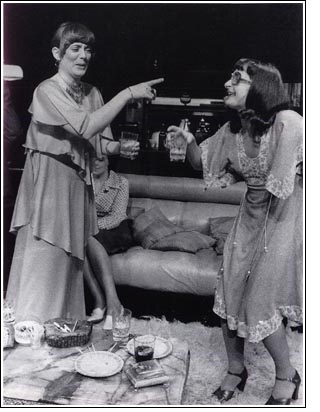
ABIGAIL'S PARTY has a mammoth reputation in British cultural history. It's a late 1970s TV play that threw a satirical light on the British obsessions of class, social climbing, and consumerism. It made Alison Steadman famous and propelled sometime actor Mike Leigh into his career as a writer-director.

I found ABIGAIL'S PARTY heavy work. Recent television shows such as SHAMELESS have made an art-form of the serio-comedy that satirises British class prejudice and social aspiration. As a result, ABIGAIL'S PARTY feels like a clunking prototype that is less subtle and insightful than its successors.

The film is a straightforward adaptation of a stage play, and is filmed in a very unambitious "camera in front of the proscenium arch" style. All the action takes place in a suburban living room in 1970s Britain. A couple - Beverly and Laurence - are hosting their neighbours - a couple called Angela and Tony and a divorced mother called Susan. Susan's teenage daughter, Abigail, is hosting a party next door but is never seen. Over the course of the evening, alcohol is consumed, music is played and marital tensions exposed. There is also a rather incredible and odd denouement.

Alison Steadman is much-praised for her performance as the domineering, sharp-tongued social climber, Beverly. It's true that Beverly is a true monster and, as such, a memorable creation. But is she credible? Is she funny? Certainly, we can all recognise aspects of her character - the grandstanding - the ambition - her self-delusion - the ruthless use of others for her own ends. But Steadman's shrill voice, heavy accent and over-bearing body language turn Beverly into a caricature rather than a real character. As a result, it's hard to empathise with her and, worse still, hard to remain interested in her after the first fifteen minutes or so.

Janine Duvitski also adopts a caricature accent as Beverly's dowdy neightbour, Angela. Angela is a nurse and has a more practical mind than Beverly but still whines about inconsequential matters.

Both of these women are contrasted with their emasculated husbands. Indeed, they barely register as a presence: Beverly's husband Laurence (Tim Stern) is mostly absent, running errands, and Angela's husband Tony (John Salthouse) is silent and superior. One wonders why, if he feels so superior to his own prattling wife, he is so taken in by another.

All four neighbours are thrown into contrast with the patient, poised, evidently upper middle-class neighbour, Susan, played by Harriet Reynolds.

Mike Leigh is presumably trying to make some sort of point about the superficiality and frustration at the heart of British lower-middle class life in the 1970s. The audience is invited to mock people who try to portray themselves as having superior taste in music and clothes, but only reveal themselves to be kitsch. Are we meant to feel sympathy for these characters? After all, they are all deeply unhappy? Sadly, I don't think so.

To me, this film felt deeply nasty - just an opportunity to mock people of poor taste, unhappy marriages and superficial character. Maybe I'm missing something, but I could discern nothing that was funny or insightful or that spoke to the human condition.

ABIGAIL'S PARTY was originally broadcast on British TV in 1977. It is available on DVD.

Tuesday, April 29, 2008

Martha Fiennes retrospective & pantheon movie of the month - ONEGIN

Martha Fiennes' feature length directorial debut, ONEGIN, is one of the most impressive films I saw during my university years. I strongly remember wandering into the local arts cinema with a motley crew of scoundrels, more out of passive boredom than out of an active decision to watch the film. We all left the cinema in complete silence, walking back to my flat without discussing the film at all because we were so wrapped up in our own emotions and reactions. Despite our very catholic taste in film, we all later agreed that it was a desperately moving and brilliantly executed film.

The first great success of the film is its translation and adaptation of the classic Pushkin poem. Peter Etedgui and Michael Ignatieff - a writer, historian and public intellectual - manage to preserve the characterisations, wit, beauty and even some of the lilt of the source language without making the characters speak dialogue that feels cold and anachronistic.

The second great success of the film is Martha Fiennes' particular visual style. Her camera moves elegantly around ball-rooms and through corridors, and has a very fluid, sensuous feel. Moreover, she has created sets and costumes that are rather stylised. So instead of a static, crowded, 100% historically accurate "BBC costume drama" feel, we have a sense that the characters are real and have room to move and breathe.

Finally, the casting is, with a few exceptions, absolutely spot-on. Ralph Fiennes is perfect as the anti-hero, Onegin. His face is almost immobile, his voice barely raised to inflection, in the early scenes in Petersburg. He is manifestly bored by society, bored further by his idea of the country and, as we meet him in the opening scene, wrapped in furs, wandering when "death will take me". Later, when he comes to realise the value of the innocent love that Tatiana Larina offered him - and which he patronisingly rejected - Ralph Fiennes will transform Onegin into an uncertain, weary, perhaps deluded figure, huddled in a blanket on a freezing Petersburg balcony, forever waiting for the love letter that will never come.

Playing against Ralph Fiennes, Liv Tyler is outstanding as Tatiana - the young girl who offers herself to Onegin, only to be rejected, and then martyrs herself in a loveless but faithful marriage to a dull but worthy man. Tyler always manages to convey passionate emotions and profound thought just behind her very proper and conventional surface. And, of course, it doesn't hurt that she's so beautiful. There's also a wonderful little scene where her rich aunt has praised her skin and Tatiana, perhaps for the first time, turns to a mirror and assesses her value on the marriage market, with some evident pride.

In the smaller roles, we have some economically sketched and wonderfully portrayed cameo performances by British character actors. Harriet Walters is suitably spiky and thwarted as Madame Larina; Simon McBurney is very funny as the oleaginous, pretentious French tutor Triquet and Irene Worth is magisterial as the pragmatic, amoral Petersburg matriarch Princess Alina.

If there is a flaw with the film, I think it's in the casting of Tatiana's sister Olga, and her lover, Lensky. In fairness to Lena Headey, she doesn't have much to do as Olga, other than flirt, but I've always found Headey curiously lacking in screen presence and unable to portray depth of characterisation. Toby Stephens isn't bad as the simple-minded but honest country lord and aspiring poet, Lensky. In other roles I have found Stephens irritating - he always seems to come across as arrogant and dull-witted, no matter what the part. Luckily that is not a distraction here, although I think the scene where he thinks Olga is flirting with Onegin is horribly over-acted.

But perhaps the real skill was in choosing to adapt the poem in the first place. I've always thought that the more closely drawn and sparely populated the source material, the better the film. Sprawling epics are rarely done justice on the big screen. Collapsing WAR AND PEACE into a two-hour romance necessarily degrades it, and few film-makers have the unlimited budget offered to Sergei Bondarchuk. On the other hand, look at the wonderful recent adaptation of BROKEBACK MOUNTAIN - a short story with a cast of maybe two main and two secondary characters; a few key dramatic episodes; and lots of room for the film-maker to take a lyrical and patient approach. ONEGIN is another example of a source text that is richly but tightly drawn, with a handful of key protagonists, a few key episodes but a profound and unforgettable emotional journey lying underneath it.

Fiennes carefully contrasts the prattling posers in Petersburg with the more straightforwardly socially aspirant country society. Amidst all the useless beauty, Onegin spots Tatiana Larina and is intrigued by her honest integrity, intelligence and curiosity. He sees her worth and while he does not consider her as a lover, he sees how much more she is worth than her flirtatious superficial sister Olga. Onegin's relationship with Lensky is, in some ways, even more interesting. Lensky is a fool, but honest, and honestly in love with Olga. One imagines that Onegin's intelligence and cynicism is offended by this ridiculous and yet apparently deeply felt love. Offended even more when it is thrown into contrast by Tatiana's genuine offer of love which Onegin, jaded, high-handed, cannot accept.

Perhaps it is the ludicrous nature of the contrast between the romance between Olga and Lensky - and the romance he won't permit between himnself and Tatiana - that leads Onegin to cruelly expose the emptiness at its heart. He dances with Olga, Lensky is enraged, they duel, and Onegin kills his friend. He has destroyed a second-rate sort of love affair, but he curses himself in the process. He has learned the true value of Tatiana, of his capacity for love, and the true hell of an empty and solitary life. All this is captured with a delicate camera, sensitive performances and without the dessicated feel of a period drama, in Martha Fiennes' wonderful film.

ONEGIN played Toronto and Venice 1999 and was released in the UK and US that year. It opened in Israel, South Korea, Japan, New Zealand, Australia, Portugal, Spain, the Philippines, South Africa, Germany and Poland in 2000 and in Hungary and Hong Kong in 2001. It is available on DVD.

Monday, April 28, 2008

Wong Kar Wai Retrospective - DAYS OF BEING WILD

I always thought one minute flies by. But sometimes it really lingers on.Continuing with our sporadic Wong Kar Wai retrospective, we come to his 1991 feature, DAYS OF BEING WILD. A critical success but a commercial failure, the movie has all the hallmarks of Wong Kar Wai's particular brand of cinema: love-lorn urban men; women unable to move on from heart-break; the beautiful, evocative camera-work of Christopher Doyle; kitsch American popular music; and a plot that is less event-driven than an exploration of character and mood.

We are Hong Kong in the 1960s. It's monsoon season and the colour-scape of the film is lush green and brooding blue. Tragic pop-star Leslie Cheung takes on the lead role of Yuddy - an emotionally jaded young man who seems unable to maintain a stable relationship with the many girls who fall in love with him. The first of these is a naive, whimpering girl called Su Lizhen, played by Wong Kar Wai regular, Maggie Cheung in a "typical" role. The second is a ballsy show-girl called Leung Fung-Ying, played brilliantly by Carina Lau. Possibly a third is Yuddy's controlling, intimidating, ex-whore mother (Rebecca Pan). In some ways, she is the most interesting character, given her decision to cruelly reveal to Yuddy that she is actually his adoptive mother, and that his real mother is living in the Philippines.

In contrast to Yuddy, Wong Kar Wai presents one of his classic policeman characters. Andy Lau plays a decent neighbourhood copper, who comes across Su Lizhen stalking Yuddy's apartment. He takes pity on her, and is so emotionally affected by their encounters that he leaves Hong Kong for the Philippines. There he will come across Yuddy, who is now searching for his birth-mother.

DAYS OF BEING WILD is far from a masterpiece and viewers not familiar with Wong Kar Wai's patient mood pieces may be frustrated by its longueurs. However, it's a rewarding film for fans not least because it takes us further on the journey to the most perfect expression of Wong Kar Wai's style - IN THE MOOD FOR LOVE - a movie presaged by the brief, irrelevant and yet lovely little cameo of Tony Leung at the end of the film.

DAYS OF BEING WILD played Berlin and Toronto 1991 and was released that year. It is available on DVD.

Sunday, April 27, 2008

PERSEPOLIS (US dub) - after careful parent consideration, a film teenagers should see

Some critics are getting a bit sniffy about this English language re-dub of the critically acclaimed French language animted film, PERSEPOLIS. But the great thing about this new version is that you now have more of a chance of dragging along the teenagers, to whom some of the material will speak very directly. PERSEPOLIS is basically a coming of age story and it's disarmingly frank about how girls experience musical crazes, puberty, first love and first heart-break. It's insightful, honest, funny and beautifully hand-drawn, largely in stark black and white against watercolour backdrops.

What gives the movie its depth and importance is that it's essentially a true story of a young girl who grew up in Iran during the Islamic revolution. She starts off as someone who could easily be a Westerner - wearing sneakers, idolising Bruce Lee and obsessed with pop music. But she quickly learns how members of her family have been imprisoned and then killed; she is forced to wear the veil and can't hold hands with her boyfriend in public.

Twice our heroine flees Iran. First, as a mouthy teenager her parents decide to send her to Vienna. She struggles to fit in, and after a disastrous love affair returns to Iran. Finally, when the repression increases and her marriage fails, she leaves her family for good, for Paris.

The dark material is faced head on. Early on we see a young buy shot during the revolution; later we see a Communist stand in front of a noose, and the Iran Iraq war sees batallions fall under fire. Added to this, we have to negotiate suicide, torture and homelessness. So parents should carefully consider whether their kids are ready for this stuff. The good news is that the material is usually shown in silhouette and in a highly stylised form. The best news is that, if your kids are ready for the material, it could prompt some wonderful conversations and reflections on how modern life in the West compares to Iran.

PERSEPOLIS played Cannes 2007 where it won the Jury Prize tied with STELLET LICHT. It also played London and Toronto 2007 and was nominated for the Academy Award for Best Animated Feature. PERSEPOLIS was released in France, Norway, Finland, Denmark, Russia, Tyrkey, Spain, Greece, Belgium, Germany, Sweden, the Czech Republic, Austria, Hungary, Hong Kong and Japan in 2007. It was released earlier this year in the USA, Poland, Singapore, Italy, Brazil, the Netherlands and Thailand. It is currently on release in Romania, Argentina and on re-release in the UK. It opens in Austrlia in August.

Saturday, April 26, 2008

THE OXFORD MURDERS - beware of grad students bearing spaghetti

Can't even get decent food - right after I got here, I ordered some spaghetti with marinara sauce, and I got egg noodles and ketchup. I'm an average nobody... get to live the rest of my life like a schnook.THE OXFORD MURDERS is a tremendously silly murder mystery that fails on every level despite having a decent cast. Despite beng set in the picturesque quads of the University of Oxford, this film is a largely Spanish production which may explain some of the more stilted dialogue but not the fact that the script that has a feeble solution, a killer that no-one cares about and one of the most excruciating sex scenes I've ever seen.

John Hurt and Elijah Wood star as Maths professor, Arthur Seldom, and grad student, Martin. They are on the hunt for a serial killer who's trying to prove a neat mathematical point to Seldom, and so chooses victims who are already on the brink of death (so that's okay then!) The movie throws up a bunch of suspects who are odd but neither sinister nor threatening. Burn Gorman, who was so brilliant as Guppy in the recent BBC adaptation of BLEAK HOUSE, was particularly disappointing as Russian mathmo Podorov - just what was that accent he was attempting?! The final solution to the murders is disappointing both in terms of its mathematical content and because by that point I really didn't care a fig.

As far as it goes, THE OXFORD MURDERS might have been suitably condensed into a 1hr TV detective show - a more forgiving format. As a feature film it fails on every level. Where it tries to be sinister, it's banal. Where it tries to be sexy, it's causes genuine embarassment. Where it tries to be clever, it's obvious.

THE OXFORD MURDERS was released earlier this year in Spain, France and Italy. It is currently on release in the UK and opens in Argentina on May 1st.

Friday, April 25, 2008

DECEPTION - beware lawyers bearing weed

DECEPTION is a nicely shot and decently acted thriller that's ultimately skewered by a plot so transparent it could've come sponsored by Swarovski.

Ewan Macgregor stars as an introverted auditor who's offered a pass into a glamourous world of anonymous sex by a suave lawyer (Hugh Jackman). Turns out, Jackman's character is using the hot sex to blackmail the auditor into embezzling money from a client.

For the most part, this is a fairly ordinary but workable thriller but in the final half hour it truly jumps the shark. I can buy that the auditor has the smarts to put up a fight, but would he really have the Mission Impossible skills to get his hands on a fake US passport at 2 hours notice? The film-makers also commit the unforgiveable sin of wasting Charlotte Rampling.

Overall rating: Meh.

DECEPTION is on release in the US, UK and Australia. It opens in May in Belgium, and France; in Singapore and Finland in June; and in Germany in September.