Showing posts with label karan johar. Show all posts

Monday, July 31, 2023

ROCKY AUR RANI KI PREM KAHANI*****


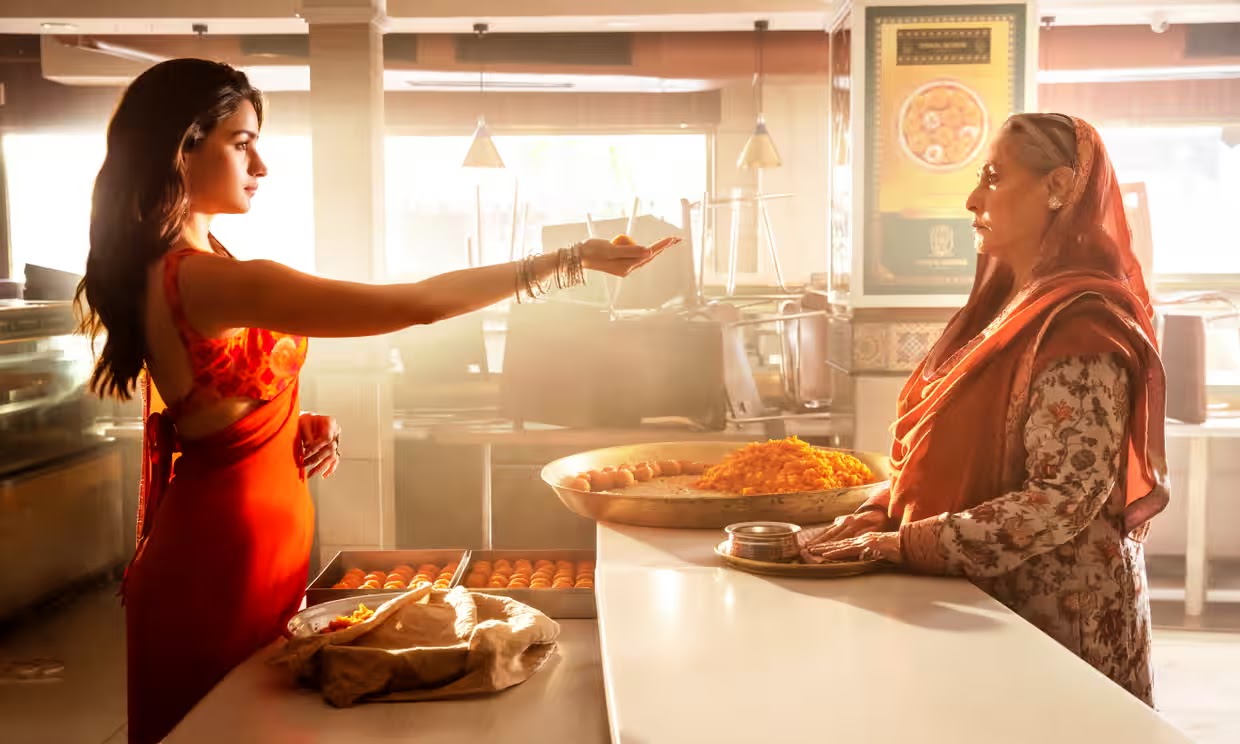
ROCKY AUR RANI KI PREM KAHANI (Rocky and Rani's love story) is everything we expect from a Karan Johar film. It's a multi-generational family dramedy with broad laughs, beautiful clothes, wonderful music, and moments that genuinely make you cry.  But more than that, this is a movie that is daring in its surface message of progressive inclusion, and even more radical in its meta-message of queer acceptance. 

On the surface, this is a typical Karan Johar multi-generational dramedy. Rocky Randhawa (Ranveer Singh) is the scion of an incredibly wealthy Delhi family that is traditional and Punjabi (North Indian). He is a flamboyant, luxury-label obsessed, gym-obsessive who speaks broken English, and whose father bribed his teachers for his grades. The family is run by the frighteningly strict matriarch Dhanlaxmi (Jaya Bachchan) and her equally fearsome son Tijori (Aamir Bashir). Tijori's wife Poonam (Kshitee Jog) is servile and their daughter Gayatri (Anjali Anand) is mocked for being overweight. 

Contrast this to Rani Chatterjee (Alia Bhatt), a deeply intellectual, American-educated news-anchor whose Bengali family are cultured, bohemian and socially progressive.  Her mother, Anjali (Churni Ganguly), is the breadwinner and a university professor. Her father Chandan (Tota Roy Chowdhury) is a male classical Indian khatak dancer.  Her grandma Jamini (Shabana Azmi) recites poetry at recitals in their house. They are so progressive that her father can happily discuss why Rani's relationship with Shomen broke up - he was a bad lover. 

Chance brings Rocky and Rani together. Rocky's beloved grandfather (Dharmendra) is suffering from dementia and Rocky thinks that if he tracks down the women he once had a love affair with - Jamini - this might trigger his memories.  At first Rani mocks Rocky for his ignorance and crass personality but they soon start their own affair, just as the grandparents are also reconnecting.  

The first half of the movie is basically the two realising that they do have genuine feelings for each other despite their cultural differences.  The second half of the movie sees them move in with each others' families to see if those differences can be overcome. Can the cultured Chatterjee's help Rocky become more progressive while also becoming less snobby themselves? And can the Rhandawas accept a daughter-in-law who speaks her mind, speaks English, and doesn't cover her head?

So far so rom-com with a side-order of melodrama. What elevates this film about the norm is its surface message of progressive inclusion.  Rocky gives a powerful speech about feeling judged by the Chatterjees for his poor English - a real issue in India given that most education is private and language can be interpreted as denoting class. Mrs Chatterjee gives an amazing speech about how Indian men use the language of "honour" to disguise misogyny, and that they might sing lewd songs about what's behind a sari blouse (chola ke peetchay kya hai?) but are too embarrassed to utter the word brassiere. Most powerfully, Mr Chatterjee gives an amazing speech describing his joy at dancing Khatak but also the incredible mockery he has faced his entire life because of it. 

I commend the (now) openly gay director Karan Johar for including this material. Even more, I commend Ranveer Singh for undercutting his hyper-masculine image and partnering with the supremely talented dancer Tota Roy Chowdhury in dancing the khatak inspired and iconic Dola Re song from Devdas.  Just as the evil matriarch mockingly laughs behind her scarf, I can imagine many viewers doing the same. For Ranveer Singh to show this kind of allyship is powerful and explodes the hypocrisy of an Indian Bollywood culture where it's totally fine and not at all queer for straight men to wax their chests and dance around to Bollywood songs, but heaven forfend they do classical dance, which is still seen as the province of women.

Indeed, one can take this radical message one step further. I would argue that ROCKY AUR RANI is really a film about questioning gender roles and sexuality, and for a less toxic masculinity. After all, when you think about it, we have come a loooong way from Johar's 2001 film KABHI KUSHI KABHI GUM. In this film both families are run by financially dominant women, with Jaya Bachchan taking the evil patriarch role that her real-life husband Amitabh took in KKKG. And in the current generation it is Rani and Rocky's sister Anjali that are smart and earning a living, while Rocky is just a nepo-baby.  

In both families the patriarchs are criticised for a love of the arts that is somehow seen as not masculine enough in India's toxic hyper-masculine culture. Rocky's grandfather was scorned by his wife Dhanlaxmi for his love of poetry, and she kept their son Tijori from spending time with his father for fear that somehow this anti-masculine behaviour might be contagious! By contrast, Rani's mother and grandmother have stood by her father and his love of the arts, but his father beat him for dancing.  Maybe it's because we all know Karan Johar's real-life journey of self- and societal acceptance that I think we can read this entire storyline of what it would be like to come out not as a khatak dancer but as a gay man in India today.

The resulting film is one that wears its politics as well as its heart on its sleeve, but remains entertaining throughout. Pritam's songs are fantastic and the choreography, outfits and sets are wonderfully over the top.  In particular, I love Manish Malhotra's brightly coloured chiffon saris for Alia Bhatt's Rani, and Ranveer Singh brilliantly self-parodies his real life image as a fashion obsessive as Rocky.  Karan Johar expertly uses the iconography of DEVDAS in his pivotal khatak scene, and my only real criticism is the heavy product placement for a certain music back catalogue's hardware in the grandparents' reminiscence montage. As for scene stealers - well it's lovely to have Dharmendra and Shabana Azmi back on the screen, although I could have done without Jaya Bachchan's two-dimensionally-written evil grandma.  I think it's actually Anjali Anand as Golu/Gayatri who really steals the show with a late movie singing scene that cracked me up. 

ROCKY AUR RANI KI PREM KAHANI has a running time of 168 minutes plus an interval. It is rated 12A for infrequent strong language, moderate innuendo, sexual violence references.

Thursday, December 04, 2008

DOSTANA - mainstream Bollywood tackles homophobia

Don we now our gay apparel, fa-la-la, fa-la-la, la-la-laaaa!DOSTANA is being touted as a breakthrough Bollywood movie but I think it's absolutely typical in its slippery depiction of modern sexuality. After all, Bollywood cinema delights in showing us waxed and bronzed men and women, scimpily clad, gyrating provocatively. But god forbid you actually show two people kissing!

DOSTANA takes this paradoxical attitude to modern sexuality and applies it to gay relationships. So, on one hand, this is a brave movie. It's telling Indian parents not to be so judgmental that their kids are forced to stay in the closet. Surely, loving parents should want an honest and open relationship with their children? But on the other hand, this is a movie that still wants to make money and can't afford to offend its conservative audience. As a result, the two gay characters are, in fact, only faking it. And faking it in such a crass manner that it makes Robin Williams' performance in BIRDCAGE look restrained. The message seems to be: yes, it's fine to be gay, but just so you know, I'm most definitely NOT GAY! In a Western movie - such as I PRONOUNCE YOU CHUCK AND LARRY - I would excoriate the hypocrisy and cowardice of the film-makers. But given that this is Hindi cinema I can only give thanks that we are finally inching toward maturity.

So, back to the nuts and bolts. DOSTANA is a movie about young single Indians living in Miami and enjoying a measure of freedom that they wouldn't enjoy at home. Kunal (John Abraham) and Sameer (Abhishek Bachchan) pretend to be gay so that they can share an apartment with Neha (Priyanka Chopra) whose conservative aunt won't allow co-habitation with straight single men. Problems arise when Sam's mother thinks he really IS gay and both guys realise that they are in love with Neha and try to ruin her incipient romance with her boss Abhi (Bobby Deol). The situations are resolved thanks to lots of typical Bollywood broad humour, farcical mix-ups, glycerine tears and ludicrously opulent romantic gestures.

Despite the fact that this movie is written and directed by Tarun Manusukhani, the movie has the look, feel and self-referential narcissism of your typical Karan Johar film. It's all lush location shots, designer clothes, over-styled actors and ludicrous over-acting. Having said that, in embracing his camp sensibility, Johar has finally found a narrative that suits his style and the result is highly entertaining. Let's face it, Priyanka is just a clothes-horse, and John Abraham is just there to flash his well-oiled pecs, but Abhishek Bachchan turns out to be very gifted at physical comedy, carrying the movie until the mid-way mark when Kiron Kher and Boman Irani show up. Irani is a scene stealer as flamboyantly gay magazine editor M - like a Hindi Mugatu for all you ZOOLANDER fans! - and Kiron Kher, as Sameer's devestated mother, has by far the best musical number in the movie, beautifully spoofing her performance in DEVDAS. Admittely, the movie starts to flag when we get into a tortously drawn out denouement, but at least it ends on a high with the dance number "Desi girl" and the first mainstream Bollywood gay (or at least man-on-man) kiss.

DOSTANA went on global release on November 14th.

Sunday, August 13, 2006

KABHI ALVIDA NAA KEHNA/NEVER SAY GOODBYE - Crass Bollywood melodrama

Man. I thought I was bored watching MIAMI VICE. If you choose to disregard my advice (rant) and see this movie you will get very little change from four hours. Of course, long isn't bad all on its own. THE SORROW AND THE PITY is one of the films I admire most and it clocks in at well over four hours. But why take four hours to say something that could easily be said in the regular ninety minutes?

The plot is insultingly simple and I'm going to go ahead and tell you what it is. Don't worry, this doesn't constitute a spoiler. There is barely any plot to spoil and what does happen can be seen half an hour before it actually happens. So, we are in contemporary New York and there is an embittered ex-pro soccer player* called Dev (Shah Rukh Khan) whose career ended after an injury. He resents his high-earning wife, Rhea (Preity Zinta) and is abusive to his young son. Also in New York there is a barren primary school teacher called Maya (Rani Mukherji) who has married a man, Rishi (
Abishek Bachchan) who loves her and settled for cotentment rather than love. They are sexually incompatible. An hour into the movie, Maya and Dev start hanging out and half an hour later they declare their love for each other. Then there is an intermission. After the intermission, Maya and Dev sleep with each other. Then they confess to their other halves who kick them out of their respective houses. Three years later (an hour and a half in movie time but it really does seem like three years) the other halves have moved on and found new loves. But Maya and Dev are alone and miserable because for some odd reason they didn't tell each other that they had been dumped. Rishi and Rhea tell Maya and Dev to get it together (such magnanimity!) and they do. The End.

Like I said, the plot is simple and does not need four hours. We have writer/director Karan Johar to thank for it. Karan Johar is a supreme hack with delusions of profundity. He wants to tell us that the only foundation for a successful marriage is love. Hmmm. Thanks for that, Mr. Johar, but I'm seriously not going to take any advice on adult relationships from a man who writes "I love you, mom" on a credit at the start of his film. And yes, I know that the concept of sanctioned marital infidelity is a novelty in mainstream Bollywood cinema, but KABHI ALVIDA NAA KEHNA is hardly an adult, insightful treatment of this theme. For all its pretensions, this movie is not remotely in the same league as PAGE THREE or SILSILA. I mean, come on, how can you tackle marital infidelity when you haven't got the balls to show two adults so much as kissing on screen?

So this movie sucks. The script and directing are superficial and hammy and Karan Johar cannot do discreet or subdued. Everything is egregious to the point where you want to vomit. At the key "declaration of love" scene between Maya and Dev, he says to her, tearfully: "I'll buy a blue car. I like blue. You like blue..?" She replies, tearfully, "I like blue!" (Audience laughs maniacally.) Everyone on the train platform is now miraculously wearing blue. And now Maya and Dev are wearing blue. I had this compulsion to do an Alan Patridge and keep shouting "A-ha!"

The over the top camera work and production design continue throughout. Someone should tell the photographer that he can use shots other than tight close-ups. Someone should tell the production designer that real houses don't look like pictures from the Heal's home catalogue. Real women don't wear fake eyelashes and hot curlers every day. And they don't go out in the rain without an umbrella. Someone should tell Karan Johar that great directors don't use Manhattan city scape as a vapid picture-postcard, but capture the energy and spirit of the city. They should also tell him that Burberry and Louis Vuitton aren't aspirational but
chav. And while they're at it, they should point out just how crass it is to have a couple about to embark on adultery singing to each other as they walk up the aisle of a Catholic church making the sign of the cross.

In fairness, KABHI ALVIDA NAA KEHNA is delivered by a competent but hamstrung cast. That is, with the exception of lead actor Shah Rukh Khan. Khan's apparent desire to be David Beckham and/or an MTV star is induldged to the hilt and his "acting" is absurdly over the top.

All in all, KABHI ALVIDA NAA KEHNA feels like a delusional attempt at profundity from a director best known for creating crappy, melodramatic B movies. It is the most expensive Bollywood movie ever made, apparently, and that will guarantee it some publicity. Maybe it will have a large box office taking. Frankly, the whole exercise looks like a shameless cash-in. Why else would Johar give small cameos to stars such as Kajol, Arjun Rampal and John Abraham if not to lure in their respective fan-bases? Oh yeah, and the music sucks. The dance numbers are derivative and sound like shitty Euro-house with the odd tabla beat and Hindi lyrics.

KABHI ALVIDA NAA KEHNA is on release in India, the US, the UK, the Netherlands and Australia. *I know, I fell off my seat laughing at that one, too.