Showing posts with label oliver platt. Show all posts

Monday, June 16, 2014

CHEF


First a public service announcement: do not go to see CHEF on an empty stomach or with a vegetarian friend! Not since Stanley Tucci's glorious BIG NIGHT have I seen a movie more in love with food and the process of cooking - that photographs sumptuous sides of pit beef and steaming piles of spaghetti with more indulgent care. It's a movie that's passionate above being passionate about what you eat - and that wraps us up in that mission to eat authentic, but not over-complicated, food. Which is not to sound precious - this is also a movie that is at its heart a simple family story - about a father reconnecting with his son when his career hits a road bump by quitting his fancy restaurant and driving a food truck serving simple Cuban food from Miami to LA.

I can imagine a lot of critics getting quite sniffy about the basic simplicity of the story. There's nothing particularly new about seeing a workaholic divorced dad (Chef Carl Caspar - Jon Favreau) struggling to reconnect with a cute, emotionally wise kid (Emjay Anthony - IT'S COMPLICATED). There's although nothing particularly new about the mid-life crisis movie in which an apparently successful middle-aged man throws it all in to fight the Man (think Jerry Maguire). And of course, there's something almost annoyingly ungrateful in the obvious analogy between Chef Carl and the writer-director-lead actor of the movie. Jon Favreau started off in the indie hit SWINGERS, but ended up helming the mega franchise IRON MAN movies. It's no great leap to think that he too dreamed of giving it up (albeit temporarily) for smaller scale, more authentic tales/films, and CHEF is the literal and metaphorical result. And while we're on a downer, it did get ever so slightly irritating how every woman in this movie was there as a loving, supportive two-dimensional pretty young thing to swoon over Chef's food and ease him through his existential crisis. I mean, in the modern era, is there any excuse for the shot of Maitre D Molly (Scarlett Johanson) wearing little more than an over-sized jumper ogling Chef's spaghetti? Oh, and do we really need such full on product placement for Twitter?!

So why, given the trite emotional journey and 2-D female characters should one still watch CHEF? Because despite all that nonsense the sheer enjoyment of authentic food drips off of the screen. Favreau is writing about what he loves and it shows. And it's not just the food but the cultures and communities that create it and nurture it - the idea that eating something in its place of birth is special and unique and to be protected. It's also worth giving a shout out to the music in this movie. The soundtrack is just hands-down the most fun you can have in a cinema, and put together with the sun-kissed cinematography from DP Kramer Morgenthau (THOR: DARK WORLD and the movie just wills you to have a good time. The second thing to enjoy in this movie is the sweet and occasionally spiky relationship between father and son. I love that Jon Favreau allows himself to look as mean as he does - shouting his evidently emotionally distraught son out of the food truck and serially undercutting touching moments with his debbie-downer attitude. Other occasional joys: the sheer energy John Leguziamo brings to the screen as Sous-Chef Martin; the classic gonzo cameo from Robert Downey Junior at the centre of the movie; a use of cornstarch that you just can't forget once you've seen it.

So, despite it's well-worn path to emotional enlightenment, and the rather cloying product placement, CHEF is a wonderfully feel-good movie, full of love, authentic spikiness and a real passion for food, family and community.

CHEF is rated R in the USA and X in the UK and has a running time of 115 minutes.

CHEF played SXSW 2014 and was released earlier this year in New Zealand, the USA, Kuwait, Lithuania, Portugal, Vietnam, Singapore and Hong Kong. It goes on release in Estonia in June 20th, in the UK on June 25th, in Ireland on June 27th, in Brazil on July 10th, in Greece on August 21st, and in the Netherlands on September 4th.

Saturday, October 13, 2012

London Film Fest 2012 Day 4 - GINGER & ROSA


2009 was a great year for British literature, with Hilary Mantel's Wolf Hall and A.S.Byatt's The Children's Book duking it out for the Booker. The latter book was deeply concerned with how the sexual liberation of the Edwardian bohemians impacted their children. One of the key themes of the novel is to contrast the earnest liberal politics of the Bohemians with the lack of regard for their actual children. They want to make the world a better place, regardless of whether their children are fed and cared for, or hurt by their affairs. Byatt makes the point that artists and intellectuals can be both admirable for their work but a nightmare to live with. Strict principles can often be a convenient fig leaf for selfishness.

Sally Potter's new film, GINGER & ROSA makes much the same point, drawing on a much smaller canvas, but with greater intensity. It's about how a father's radical conception of personal freedom damages his doting teenage daughter. Roland sees Ginger's tears but cannot stop the actions that cause the pain, equating personal sexual freedom, and setting aside bourgeois morality, with his opposition to armed conflict. It's a pompous but not indefensible position, but the the same could be said for so much that happens around the girl. Her gay godfathers genuinely care for her, but their tales of radicalism fuel her wallowing deaths possibility of a nuclear holocaust. Similarly, their friend Bella praises Ginger's activism but denies whipping her up. It's no wonder the poor girl is sad and confused, desperately trying to please and not complain.


Alice Englert and Elle Fanning,
Rosa & Ginger respectively.

And what of Ginger's best friend Rosa? Although the focus of the film is not on her, she's an equally tragic figure. Where Ginger suffers from a surfeit of concerned but misguided adults, Rosa has a distracted mother and an absentee father. No wonder she latches onto Roland as an impressive father figure - a composite man to take care of her and shepherd her into adulthood.

GINGER & ROSA seems to me to be a perfect film - tightly scripted, beautifully acted and photographed, evoking in minute detail the spirit and design of early 60s London, but also hinting at wider themes of revolt and parenting. I love that in place of the Swinging Sixties cliché we get a drab, grimy post-war world and an uneasy conflict between radicalism and 50s suburbia. Particular praise has to go to Elle Fanning (Ginger) who carries so much of the emotional burden of the film, but also Christine Hendricks in a smaller but equally intense role as her mother. Alessandro Nivola as Roland, her father, brings just the right balance of sleaze and headstrong idealism. But ultimately, the triumph of this picture is Sally Potter's, in bringing a new perspective to 60s London, and doing so with such formal control and intensity. If there is any justice, this film, and particularly Fanning and Hendricks' performances, will be recognised come awards season.

GINGER & ROSA played Toronto and London 2012. It opens in the UK on October 19th. The running time is 89 minutes.

Wednesday, June 01, 2011

X-MEN: FIRST CLASS - Gentlemen, you can't fight in here: this is the war room!


I have always been rather conflicted about the X-MEN movies. On the one hand, I found the comic book tale of mutants, whose mutations had the appearance of superhero powers, rather confused and illogical. In a cosmic tale of "scissors-paper-stone" how was I to know whether a particular mutant's ability to whip up a storm could be trumped by another mutant's ability to throw fireballs? It all seemed too easy for the writers to whip up a deus ex machina. On the other hand, I absolutely loved the profundity of the intellectual debate at the heart of THE X-MEN. The comic books served as a plea for the acceptance of "freaks" - and for mutants one can read those who are sexually or racially oppressed in real life. The real battle was not between humans and mutants but between Professor X and Magneto. Professor X believes mutants can "be the better people", helping humanity, even though humanity is not always supportive of mutants. By contrast, Magneto believes that humanity will inevitably hunt what it fears and fear what is different. Mutants should therefore go on the offensive. This is the debate between Dr King and Malcolm X - the language of acceptance and self-hatred - the conflict between appeasement and aggression.

The great news is that X-MEN: FIRST CLASS, by taking us back to the origin story of Professor X aka Charles Xavier and Magneto aka Erik Lensherr, really delves into these issues. For the first time in the franchise, I really felt as though I had equal sympathy for both sides (rather than disdain for Magneto), and felt the emotional conflict that ultimately ripped these two friends apart and led Xavier's adopted sister Raven/Mystique to leave him for Erik. I can't say enough about James McAvoy and Michael Fassbender's nuanced and emotionally affecting performances as Xavier and Erik respectively. I truly believed in their friendship between opposites - the little boy who grew up amidst great wealth and led a sheltered life at Oxford befriending the angry, tortured soul, brutalised by the Nazi scientist Sebastian Shaw. And Jennifer Lawrence, given far less to do than in her Oscar nominated role in WINTER'S BONE, brings real depth to her performance as Raven - the girl who cannot hide her mutation in plain sight and has self-esteem issues that any teenager can relate to. Because you care about these people, your perception of the stakes shift. Every good action movie needs you to feel the stakes to make you care. But the stakes here aren't stopping Sebastian Shaw from inciting the USA and Soviet Union to turn the Cuban Missile Crisis into Nuclear War. (Although these serve as an amazing setting for the final action set-pieces and made me wish Matthew Vaughn could direct a James Bond movie starring Michael Fassbender). No, the real stakes are whether the disagreement between Magneto and Xavier will destroy their friendship and tear apart the mutant family.

All of which makes the movie sound rather ponderous, but that really isn't the case. It is intelligent, yes, and takes its material seriously. But it also has a sense of wit and, even cheekiness! What I really love about Matthew Vaughn's direction is that he takes the 1960s Cold War setting and really mines it well, with production design that has an air of those early Sean Connery Bond films and costumes for January Jones' that are practically Austin Powers-esque. I mean, we have January Jones (Emma Frost) in fem-bot spangly bikinis; an urbane Bond-like action hero in the form of Fassbender's Erik; and Kevin Bacon is pure Blofeld, with his double-breasted suits, yachts and obsession with atomic energy. Other comedic touches included a training montage of the type spoofed in TEAM AMERICA: WORLD POLICE, that stays just the right-side of camp. A set-piece with the mutant kids showing off their skills that involves a choreographed move that feels like SCOOBY-DOO. And when the action set-piece reaches its climax, with Erik pulling off an amazing feat, we get a soundtrack that comes straight out of TOP GUN. Not to mention the war-room looking like something out of STRANGELOVE!

The genius of X-MEN: FIRST CLASS is, then, that it combines the intelligence of Jane Goldman, Ashley Miller and Zack Stentz's script with the pop-culture sensibility of director Matthew Vaughn. It's a movie so earnestly in love with the comic book material and its cinematic antecedents, that it can be intelligent but also witty - it can be self-referential (viz. the Hugh Jackman cameo) but never kitschy. I truly think this is a great summer blockbuster - and is far more entertaining and quietly clever than INCEPTION ever was. It has restored my faith in big summer action movies, after the disappointment of PIRATES 4 and THE HANGOVER 2. I can't wait for the next installment!

X-MEN FIRST CLASS is released today in the UK, Denmark, France and Serbia. It is released on June 2nd in Argentina, Australia, Hong Kong, Hungary, Israel, Kazakhstan, Malaysia, the Netherlands, Portugal, Russia, Singapore and Thailand. It is released on June 3rd in the US, Brazil, Canada, Colombia, Estonia, Finland, Iceland, India, Norway, Paraguay, Poland, Spain, Sweden and Turkey. It is released on JUne 8th in Italy; on June 9th in Germany and Greece; on June 11th in Japan; on June 18th in Armenia and on June 23rd in Georgia.

Saturday, July 03, 2010

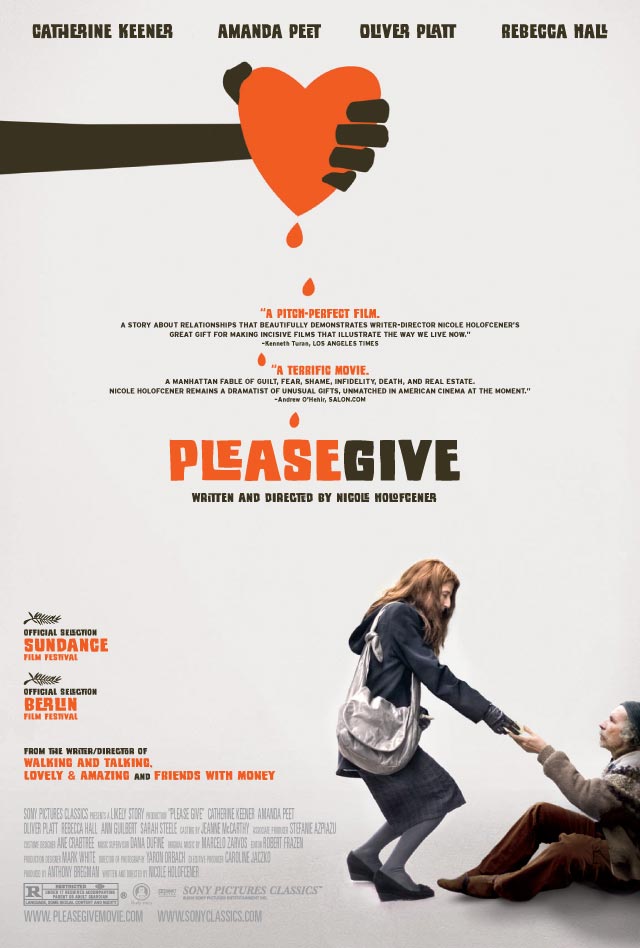
PLEASE GIVE - They fuck you up your mum and dad - Part One

So, I've watched about five movies in the past three months - compared to the old standard of five a week. It's been strange. Mostly I've been watching movies on a date rather in a screening room - and typically I've rescinded control of what we're watching, and watched more lazily - less with an eye to detail and a future review. At any rate, the whole experience has been different, and I think speaks to how film critics become jaded by seeing too many films in too sterile an environment. The upshot is that while I had decided to go completely cold turkey from blogging about cinema, I am going to jump back in with a few quick reviews of a couple of films that really made me think deeply about cinema and about relationships.

First up is the latest film from American indie writer-director, Nicole Holofcener. With LOVELY AND AMAZING and FRIENDS WITH MONEY, Holofcener established herself as a director who was able to communicate an authentic idea of how real women interact with each other, as friends and across generations. She writes movies that contain dialogue and situations that are uncomfortably real, and isn't afraid of presenting protagonists who may not be all that likeable. Their conflicts are self-involved and can seem petty to the viewer. But then, in all honesty, how many of us behave differently?

PLEASE GIVE sits somewhere between the lighter, more forgiving LOVELY AND AMAZING and the more bleak, alienating FRIENDS WITH MONEY. It poses difficult questions about body image, how we treat the elderly, and how we can choose not to speak of family trauma as a sort of defensive amnesia. Most importantly, PLEASE GIVE deals with middle-class guilt. How far should privileged people feel bad about how much they have? And is there such a thing as an authentic gesture of giving back, as opposed to mere self-interested guilt-mitigation?

Catherine Keener and Oliver Platt are superb as Kate and Alex - a wealthy married couple living in Manhattan, making a living from buying furniture from the children of the recently deceased, and selling it on at a huge mark-up in their store. Alex feels fine about what they do for a living, but Kate feels guilty about shaking down people who don't know the market price of their possessions. So she reacts by giving beggars money and by volunteering her time. Problem is, Kate is so self-involved in her misery that she brings the people she's meant to be helping down, and comes across as just plain patronising. Kate's self-involvement has more dire consequences. She alienates her teenage daughter, struggling with teenage skin; and bores her husband. One of the best scenes in the film sees the husband and daughter have a conversation that is ostensibly about facials but really speaks to her knowledge that he is having an affair. It's one of the great emotionally devastating scenes in the film. You know that the daughter will remember it for the rest of her life - it's one of those moments of complete emotional damage - all too typical in real life.

Set against this tale of upper middle-class angst we have the story of Audra and her two grand-daughters. Kate and Alex live next door to the 91 year old Audra, and have bought her apartment. Essentially they are waiting for her to die so that they can knock through and create a dream apartment. Audra is an old battle-axe, and her grand-daughter Mary (Amanda Peet - where has she been hiding?!) calls a spade a spade. She has no problem treating Audra like shit, and openly talks about the remodelling plans. But what I love about the writing and Amanda Peet's performance is that you can tell that underneath all that tough-girl no-nonsense jazz there's a deeply vulnerable woman so lacking in self-esteem that she'll throw herself onto a completely unsuitable guy. By contrast, Mary's sister Rebecca (Rebecca Hall) is one of life's quietly suffering good girls - caring, overlooked, but ultimately grounded enough to have a proper relationship.

PLEASE GIVE is one of those films that isn't necessarily fun to watch - I didn't enjoy my time with these characters. But when I watch Nicole Holofcener films I see characters that I actually know in situations I find familiar and it's just so refreshing to see real life on screen. And more than that, to see a writer portray a relationship between a mother and daughter - or between two sisters, that has the ring of authenticity. Thank Christ movies like this can still get made and get some kind of a release.

Additional tags: Yaron Orbach, Marcelo Zarvos, Robert Frazen, Elizabeth Keener, Elise Ivy, Josh Pais, Ann Guilbert, Sarah Steele, Nicole Holofcener

PLEASE GIVE played Sundance and Berlin 2010 and was released in the USA and Canada earlier this year. It is currently on release in the UK and opens in Germany next week.

Saturday, September 12, 2009

YEAR ONE - sporadically, funnier than I'd been led to believe

YEAR ONE had such a critical basting that I didn't bother watching at first. Good news is that it's really not as unwatchable as I'd been led to believe. Indeed, there were scenes I really liked. Maybe it's just a question of low expectations?

The movie is basically a puerile comedy vehicle for Jack Black and Michael Cera. They start of as a couple of Neanderthals, a hunter and a gatherer respectively. The best contextual and verbal humour is found in these early scenes, and I though Black and Cera worked well together. Both have crushes on girls they can't get so Black eats the forbidden apple from the tree of knowledge. This catapults them into a biblical epic, which the movie then tries to spoof. The Cain and Abel is pretty unfunny and underwritten, but the movie picks up when the protagonists end up Sodom. There's a brief skit by Hank Azaria as Abraham, but the real humour in this session comes from Oliver Platt as a libidinous High Priest.

Overall, I'd say the movie really is worth DVD and pizza night, if entirely forgettable. Still, you'd have hoped that actors of the profile of Jack Black and Michael Cera could find scripts that weren't essentially strung-together skits of variable quality.

YEAR ONE is on release in Australia, Iceland, the USA and the UK. t opens later in July in Finland, Sweden, Portugal, Denmark and Norway. It opens in August in Belgium, Egypt, France, Brazil, Bulgaria, South Africa, Spain, Argentina, Germany, New Zealand and Singapore. It opens in September in the Czech Republic, Greece, Russia, Estonia, Hong Kong and the Netherlands. It opens in October in Italy, Mexico, and Romania.

Wednesday, October 15, 2008

London Film Festival Day 1 - FROST/NIXON never convinces

You should marry that woman. She comes from Monaco. They don't pay any taxes there.FROST/NIXON never convinces in its assertion that the 1977 TV interview between the British talk-show host and the disgraced ex-President was a pivotal moment of catharsis for the US public. Indeed, playwright and screen adaptor Peter Morgan (THE QUEEN) diminished his case by pandering to the “all or nothing” school of melodrama. It’s not enough that Nixon is fighting for rehabilitation and Frost is fighting for his reputation as a serious journalist. Nixon must be seen as a man on the psychological edge – making drunken midnight telephone confessions. Frost must be seen a playboy dilettante who stands to lose all his TV shows and his personal fortune if the interview is a failure. Moreover, in a particularly crude narrative choice (whether based in reality or not), Morgan decides to give Frost a third-act montage (so beautifully spoofed in TEAM AMERICA WORLD POLICE) wherein the talk-show host goes from zero knowledge or interest in the mechanics of Nixon’s skulduggery, to uncovering deep truths thanks to a bit of all-night study and black coffee. I also found it implausible that years after the scandal broke; a single document in a public library would be uncovered and force the confession of a President.

Despite all this, the film does get near to an emotional truth. Nixon finally confessed to the cover up because he was tired of lying. Not because of Frost’s new found skill as a crack cross-examiner. The film also gets near to an even more important and significant truth: that Nixon was tremendously insecure; resented the way in which elites bent the rules (notably JFK’s dubious presidential victory); and thought that was simply how you had to play the game. The tragedy is that he was a hard-working and intelligent man who had tremendous insight into Cold War relations but that he made poor decisions because paranoia and a sense of entitlement had trumped his personal morality.

Frankly, I don’t think you needed to artificially inflate the importance of the Frost-Nixon interview; the stakes for David Frost; or the importance of that final shred of evidence (all very Perry Mason). You certainly didn’t need to make some sort of cod psychological link between Frost and Nixon as insecure boys-made-good who’ll never quite be accepted by the establishment. Nixon is the story and when this movie focuses on Nixon it’s brilliant. Frank Langella’s performance is captivating. But frankly, there’s too much dancing around until we get to it.

FROST/NIXON opened London 2008. It opens in the US on December 5th and in Australia on December 26th. It opens in Spain and the UK on January 9th; in Belgium and France on January 14th; in Finland on January 23rd and in the Netherlands on January 29th. It opens on February 6th in Sweden and Norway and on January 12th in Germany, Hungary and Denmark. It opens in Argentina on February 19th.

Thursday, August 14, 2008

MARTIAN CHILD - banal bonding movie

Actor John Cusack and director Menne Meyjes are reunited in sentimental father-son bonding drama, MARTIAN CHILD. Cusack plays a grieving sci-fi author who fosters a disturbed young child who combats his feeling of isolation by claiming to be a martian - photosensitive and thus unable to come out from under a box and play with the other kids. Cusack's character starts to believe that the kid might actually be an alien - so spooky is his ability to predict when traffic lights will turn green. The film-makers certainly lead the audience down this road. But in the final analysis, the film-makers aren't particularly interested in creating a spoooooooky film, but a sentimental one. The final scene sees Cusack's character battling a sceptical social welfare panel for the right to adopt the child and there are no prizes for guessing how it all turns out. Paternal love can be the foundation of powerful drama - viz Cusack's GRACE IS GONE - but not in this hackneyed treatment.

The technical aspects of this film are fine but nothing special, and you could say the same for the performances, barring Joan Cusack as a scabrous older sister.

MARTIAN CHILD was released in the US in fall 2007. It went straight to video in the UK and is currently available on DVD.

Saturday, February 18, 2006

CASANOVA - gorgeous but neither funny nor particularly romantic

CASANOVA is not a good movie. For a romantic comedy, too much of the comedy relies on physical slapstick and too little on verbal wit. There are no laugh-out-lines and some of the players are horribly mis-cast. Jeremy Irons, who plays the Catholic inquisitor, and so should have some of the best comic lines about the Catholic Church, simply cannot play comedy. The romance is there, but there is little chemistry between Heath Ledger and Sienna Miller, playing Casanova and Francesca Bruni respectively. For real romance, we must look to the marvellous and beautiful actress Lena Olin, who plays Francesca's mum - and of all people, Oliver Platt! Although Platt is cast as the fat lard-merchant that Francesca may be forced to marry, by the end of the movie, he is the closest thing we have to a romantic hero! And for real laughs, Omid Djalili steals the show. On a technical level, the faults are less obvious, but those with a sensitivity to these things will notice some ropey special effects when Casanova escapes over the roof-tops of Venice and later when he takes off in a hot air balloon. The foreground action has been "cut and pasted" onto a background and we can see the lines!

Having said all this, there are some good things in this movie which save it from being tossed into the trash-can of romantic-comedies, alongside Just Like Heaven and Bewitched. For a start, it looks gorgeous. Never has Venice looked so beautiful, so decadent, so scrumptious. Exterior shots have majesty, intererior shots are breathtaking, costumes are lavish. Still, visual flair is not enough and I found myself looking at my watch rather often during this flick. Worse still, I found myself comparing it to the infinitely better recent BBC adaptation - a common theme for today's reviews. The BBC had a fraction of the cash but produced a film of double the beauty, four times the comedy, and eight times the intelligence. So, if you want to see David Tennant and Peter O-Toole share the honours as Casanova, click here. And if you want to see a good romantic comedy, go rent THE 40 YEAR OLD VIRGIN instead.

CASANOVA premiered at Venice 2005 and is already on release in the US, Austria and, as of yesterday, in the UK
.