Showing posts with label rebecca hall. Show all posts

Tuesday, December 30, 2025

PETER HUJAR'S DAY**


PETER HUJAR'S DAY is an odd fish of a film that offers a fascinating glimpse into what life must have been like at the heart of the bohemian, queer arts scene in late 70s New York, before woefully outstaying its welcome. 

It stars Ben Whishaw as the titular real-life queer activist and portrait photographer Peter Hujar.  We spend the entire hour and a quarter in his stunning New York apartment (imagine enjoying THAT on a magazine salary now!) as he relates what happened to him the day before to his friend and writer Linda Rosenkrantz (Rebecca Hall).  To be fair, this minute detail contains a lot of delicious gossip about iconic writers - not least Fran Lebowitz, Susan Sontag and Allen Ginsberg.  But the minute detail and almost deadpan tone bely the emotion of what Peter is actually experiencing.  Ginsberg, for example, is wildly, offensively, inappropriate. But we don't really see or feel what Hujar's response is to this.  Maybe that's because the film is based on a transcript of the real-life version of this interview that was recently uncovered in the Morgan Library.  It's not so much a scripted drama as a recreation of an admittedly and deliberately mundane retelling of the day in the life of a jobbing photographer. The problem is we never see or feel the importance of his art. 

That said, there is a tug back into emotional response at the end of the film. It's scored with the Mozart Requiem and cuts to white. Those of us who know anything about Hujar realise that this is the heyday of that beautiful moment of queer expression and activism in New York. The AIDS crisis was around the corner of the 1980s and would claim Hujar as a victim, iconically photographed on his deathbed.  None of that is in THIS film, to be clear. But for those of use who know, it adds some poignancy to Whishaw's final scenes.

PETER HUJAR'S DAY played Sundance, Berlin and London 2025. It has a running time of 76 minutes. It was released in the USA in November and will be released in the UK on Jan 2nd.

Thursday, October 12, 2017

PROFESSOR MARSTON AND THE WONDER WOMEN - Day 9 - BFI London Film Festival 2017


PROFESSOR MARSTON AND THE WONDER WOMEN is a really fascinating and subversive story about the real-life creator of Wonder Woman, told in a disappointingly conventional and banal manner by director Angela Robinson (HERBIE FULLY LOADED, says it all).

The story begins in 1920s Harvard-Radcliffe, where Professor Marston (Luke Evans) is a psychology professor with a theory of dominance and submission and proto-feminist views on how women should rule the world. This is frankly unsurprising as he's married to the fantastically smart, sexy, unconventional Elizabeth (Rebecca Hall - dazzling) - who is intellectually everything a Wonder Woman should be.  They both fall in love with Marston's teaching assistants - a student called Olive (Bella Heathcote), a woman who knows what she wants, but is far more submissive than Elizabeth.  The three form a menage a trois that is truly based on love as well as sex, but are kicked out of Harvard.  Forced to earn a more conventional living, Elizabeth becomes a secretary, both women have kids, and Marston invents Wonder Woman after a trip to a S&M costume shop that blows his mind. He combines the dominance and submission of both the women in his life - their fierceness and softness - to create a modern comic that will very deliberately radicalise children with ideas of feminism and, er, bondage. 

I recently got a trade hardback of the early Wonder Woman comics and it was shocking to see how overtly sexual they were - some of the frames are like something out a Bettie Page film. But also how radically feminist they were, despite Wonder Woman's ludicrous outfit.  And I love how this film shows how subversive the character was, but also questions the more dubious aspects of the supposed feminism through the framing device of an interrogation by Connie Britton's moral authority.  The story - and Rebecca Hall's character - are enough to make this film worth watching.

The problem is that everything about the direction is utterly conventional to the point of banality. Every set choice, the way the scenes are constructed, the utterly forgettable score - it's all so dull. And it's particularly sloppy not to have the characters age over the 25 odd years of the film. It was incredible - and drew me out of the film. It's not the origins story that Wonder Woman deserves and I won't be rushing out to see another Angela Robinson film any time soon.

PROFESSOR MARSTON AND THE WONDER WOMEN has a running time of 107 minutes and is rated R. The film played Toronto and London 2017. It opens in the USA on October 13th, in Germany on November 2nd, and in the UK on November 10th.

Monday, October 10, 2016

CHRISTINE - BFF LFF 2016 - Day 6


In 1974, a field reporter on a local TV station committed suicide live on air.  This film, by director Antonio Campos, gives us the context for that notorious act, in a film of rare empathy with its subject - Christine Chubbuck.  Actress Rebecca Hall gives us a portrait of a smart woman of integrity, who volunteers with disabled children and truly cares about social issues.  But  who somehow can't quite connect with the world around her.  Even when people are reaching out to her, she becomes defensive or mishears the complement. And yet she is desperately lonely to the point of not even being able to have a cup of coffee with a co-worker.  And when her boss tells her to change the tone of her news reports to appeal to more viewers, Christine simply can't bring herself to compromise. This is most heartbreakingly depicted in a scene where a co-worker takes her to a kind of culty new-age therapy group where she has to take part in an exercise with another girl.  Christine explains that she's lonely, and so sick that she may not be able to have a child, and that she can't get the promotion she so desires and retain her journalistic integrity.  The other girl asks tells Christine that she should adjust her expectations of life but Christine simply can't comprehend this as an option.  And so we move to the grim finale of the film.

CHRISTINE is a meticulous film. The production and costume design perfectly recreate the mid-70s small-town milieu. I also really loved the almost tangible feel and sound of using clunky old recording and editing equipment.  We get a real sense of what it was like to be a journalist in that era, and more importantly, of Christine's desire to master journalistic techniques and her perfection in how to cut together a segment of television.  But this is first and foremost a nuanced character study by an actress of exceptional talent.  I felt genuinely moved by the film and by her performance and it's testament to the director's respectful tone that even though the suicide is explicitly depicted, it never feels exploitative. Kudos to all involved.

CHRISTINE has a running time of 119 minutes and is rated R.  CHRISTINE played Sundance, Toronto and London 2016 and opens next week in the USA.

Wednesday, April 24, 2013

IRON MAN 3

I had a great time watching IRON MAN 3. What I love about the movie is that after the Whedony alien-esque craziness of AVENGERS ASSEMBLE, we get a much more intimate, personal film, in which a handful of key relationships underpin the story. I mean, the evil villain has a personal motivation.

All of this is down to writer-director Shane Black, the guy who wrote the Lethal Weapon movies and trademarked his brand of authentic buddy movie action comedy. He hasn't directed anything since his cult comedy-noir KISS KISS BANG BANG., which not unco-incidentally also starred Robert Downey Junior aka Tony Stark aka Iron Man. Taking over from the franchise's original director, Jon Favreau, Black makes the story smaller, funnier, less action dependent (although there are still some exceptionally good set pieces) and more anchored in the performances. The result is a movie that has some of the psychological depth of Christopher Nolan's Batman with none of its turgid self-congratulation. 

So, down to business. The movie picks up where AVENGERS ASSEMBLE left off. Tony Stark has saved New York from aliens, but he's suffering from PTSD and a girlfriend (Gwyneth Paltrow) seriously unimpressed by his withdrawal into tinkering with his Iron Man suits. Meanwhile, the US is apparently being threatened by a nasty Bin Laden like terrorist (Ben Kingsley) although the fact that the suicide bombers can regenerate Terminator style, hints at the involvement of an Evil Scientist (Guy Pearce). 

So far, so predictable. Where the movie gets interesting is when it undermines the importance of the suit. Still a prototype, it repeatedly malfunctions at key moments, leaving Stark to fall back on his core skills: making cool simple stuff. It's in this middle section that the movie's at its best: as Stark goes all McGyver aided by a smart kid with whose he has real chemistry.

In fact, the movie can be seen as something of a buddy film in three parts. First, Stark has good banter with his Knight Rider style posh English computer cum valet, Jarvis (Paul Bettany). Then he meets his emotional and verbal match in the cute kid. And finally we some brilliant wisecracking with Don Cheadle's Iron Patriot.

I guess the overriding theme of the flick is that suits are cool but that having a few good mates is better. That, and that science starts out pure but ends up weaponised. The latter has been heavily done already in this franchise. The former is a refreshing change. And despite the epilogue, I certainly hope we see more. 

IRON MAN 3 is on release in the UK, New Zealand, Australia, Belgium, Finland, France, Iceland, Italy, the Netherlands, Sweden, Taiwan, Argentina, Bolivia, Bosnia, Chile, Croatia, Denmark, Greece, Hong Kong, Hungary, Peru, Portugal, Macedonia, Singapore, South Korea, Brazil, Bulgaria, Estonia, India, Ireland, Japan, Mexico, Norway, Romania, Spain and Vietnam. It opens next week in Germany, South Africa, Thailand, Israel, Kuwait, Lebanon, Russia, Serbia, Slovenia, Ukraine and the USA. It opens on May 9th in Poland.

IRON MAN 3 is rated PG 13 in the USA and the running time is 130 minutes.

Saturday, June 23, 2012

LAY THE FAVORITE


Stephen Frears is a perplexing director, who has gone from auteur indie director in the 1980s (MY BEAUTIFUL LAUNDERETTE) to a director-for-hire of bland, rather mediocre films with no consistent theme (THE QUEEN).  He turns up here, helming LAY THE FAVORITE, a movie based on the real-life story of Beth Raymer, a stripper turned bookmaker's runner, who got mixed up in illegal gambling.  

As played by Brit Rebecca Hall, Beth is a sweet, comical, blowsy stripper-with-a-heart, and is it turns out, a cool head for figures. Hall's accent is high-pitched and pitch-perfect - a kind of believable version of Mira Sorvino's Woody Allen stripper.  She comes to Vegas for a better life and ends up book-running for Bruce Willis' typically laconic legal bookie, Dink, much to the chagrin of Dink's insecure wife Tulip (Catherine Zeta-Jones). This gives rise to the one good tragicomic joke of the film - Dink can take Beth back as a runner so long as his insecure wife can have a face lift.  But of course, it doesn't work out and in the second half of the film Beth moves to New York and works for Rosie (Vince Vaughn, also playing himself).   Trouble is, Rosie is operating in a jurisdiction where gambling is illegal, and poor naive Beth is laying herself open to trouble. 

Of course, all ends well. It's that kind of movie. Day-glo bright, in which a young pretty girl will be mildly exploited  but ultimately cared for by good kind people. There's none of the dirt and danger and darkness of a movie like 21, and no real attempt to explain to viewers exactly how the system works. The result is a movie that is, at best, light and frothy. Another opportunity to see Vince Vaughn do his motormouth schtick that he's been doing since SWINGERS. But it's ultimately forgettable and hardly worth the candle. 

LAY THE FAVORITE played Sundance 2012 and opens this weekend in the UK and Ireland. It opens on July 19th in Germany, on August 8th in France, on August 23rd in Denmark, on September 7th in Turkey, on November 2nd in Estonia, on December 7th in the USA,  on January 13th in the Netherlands and on March 28th in Russia.

The movie is rated R and has a running time of 94 minutes.

Tuesday, October 25, 2011

London Film Fest 2011 Day 14 - THE AWAKENING

Dominic West (Robert) and Rebecca Hall (Florence) star in THE AWAKENING.

THE AWAKENING is an intelligent, adult horror movie that sees Florence (Rebecca Hall), a notorious debunker of spiritualism, invited to a boy's boarding school by Robert (Dominic West) to investigate an apparent haunting. This sets up a classic haunted house movie, in the manner of Alejandro Amenábar's The Others - but with the refreshing site of a clever, independent woman as the protagonist, and the pervasive air of  post-war mourning hanging heavy over proceedings. The resolution is satisfyingly complicated and there were enough genuinely unexpected scary moments to make this good horror - particularly the pivotal bathroom scene. Admittedly, there is nothing particularly innovative in the set up (Nick Murphy and Stephen Volk), but first time feature director Murphy creates and sustains a genuinely tense and morbid atmosphere that completely sucked me in, largely thanks to superb cinematography from DP Eduard Grau (A SINGLE MAN, BURIED) and a desaturated colour palette.


THE AWAKENING played Toronto and London 2011. It opens in the UK and Ireland on 11th November.


Friday, October 15, 2010

London Film Fest 2010 Day 3 - EVERYTHING MUST GO


You lose your job. You come home. Your wife has locked you out of your house, left your belongings on the front lawn and asked for a divorce. What do you do? If you're Nick Halsey, you drink beer, you order take-out, you shower with a hose and start a yard sale, largely to pass the time. You strike up a friendship with the nice pregnant lady across the street, you ask your neighbours to throw you some electricity, and you play ball with a young bored kid. Maybe you even start to think about your life - about the alcoholism that has landed you in this situation - and try to reconnect with an old high school friend. But there are no easy answers.

It's a great movie set-up, and Dan Rush's debut feature, based on a short story by Raymond Carver, is a quiet, sympathetic little movie. Will Ferrell, in the lead role, gives a muted, restrained performance that is convincing and charming. He is ably supported by Rebecca Hall, Laura Dern and, in particular C J Wallace as the little kid. I like that Rush/Carver give the alcoholic no easy wins - this isn't that kind of film. But, still, this movie has a sort of Hollywood sheen to it - a warm glow - that was entirely subverted in another low-key film - CYRUS. During the movie, I really did care about what happened to the lead character. But once the lights came up, it was utterly forgettable. There wasn't enough bite to it - or enough content to sustain the run-time. Apparently this movie started off as a short-film, and I couldn't help but wonder if that was the best format for this novella turned movie.

EVERYTHING MUST GO played Toronto and London 2010. It doesn't yet have a commercial release date.

Tuesday, October 05, 2010

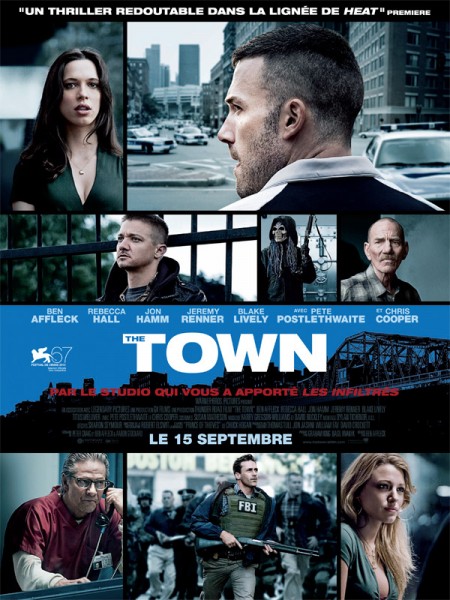
THE TOWN


GONE, BABY, GONE was a surprise. Who could have foreseen that washed-up screen actor, Ben Affleck, could’ve directed a movie with such assurance and heft – capturing not only the tension of a crime-drama but also the particularity of a neighbourhood. By contrast, THE TOWN is a disappointment. It’s a solid crime thriller but nothing more than that – and given the acting heavyweights on screen, it should’ve been far better. The plot is straight out of the conventions of the genre. Doug (Ben Affleck) is a bank-robber, based out of Charlestown, Boston. As in all good crime thrillers, Doug is conflicted about what he does, feels bad about terrorizing a hostage, and is doing that “one last job” that we know is going to go horribly wrong. Also true to genre, Doug has a side-kick called Jem (Jeremy Renner) who is a bit of a nutcase (Joe Pesci – anyone?) and takes too many risks. It’s because of Jem’s instability that the robbers end up taking the hostage in the first heist, and cross the line into murdering cops and bystanders. Also by convention, Doug’s loyalty to Jem means that he will go through with that One Last Job despite his better instincts. And, of course, Doug has a girlfriend, from whom he is hiding his true nature. In this case, she is the hostage he was sent to stake out.

The script does a disservice to its minor characters, and the high-powered actors wasted in those roles. Chris Cooper plays Doug’s father in a wasted cameo; Pete Postlethwaite plays the local crime boss in another wasted cameo, and John Hamm shows none of the subtlety that makes Mad Men so great, in his role as the FBI investigator. The worst used is Blake Lively, of Gossip Girl fame, presumably cast to draw in the teen-girl crowd, and given little to do but trigger the final betrayal. At least she makes a stab at an authentic accent though. Jeremy Renner doesn’t bother and Ben Affleck fluctuates in how broad he takes his accent. And this works against what should’ve been Affleck’s greatest strength – his ability to depict the neighbourhood and the society that spawns these robbers. Compare Affleck’s portrayal of Charlestown with Debra Granik’s portrayal of the Ozarks in WINTER'S BONE, and you’ll see just how far short he has fallen.

THE TOWN played Venice and Toronto 2010 and is currently on release in the US, Canada, Germany, Austria, the UK, Belgium and Malaysia. It opens later this month in Australia, Portugal, India, Greece, Hungary, the Netherlands, Singapore, Brazil and Iceland. It opens in December in Russia, Finland and Poland.

Additional tags: Peter Craig, Aaron Stockard, John Hamm, Blake Lively, David Buckley, Harry Gregson-Williams

Saturday, July 03, 2010

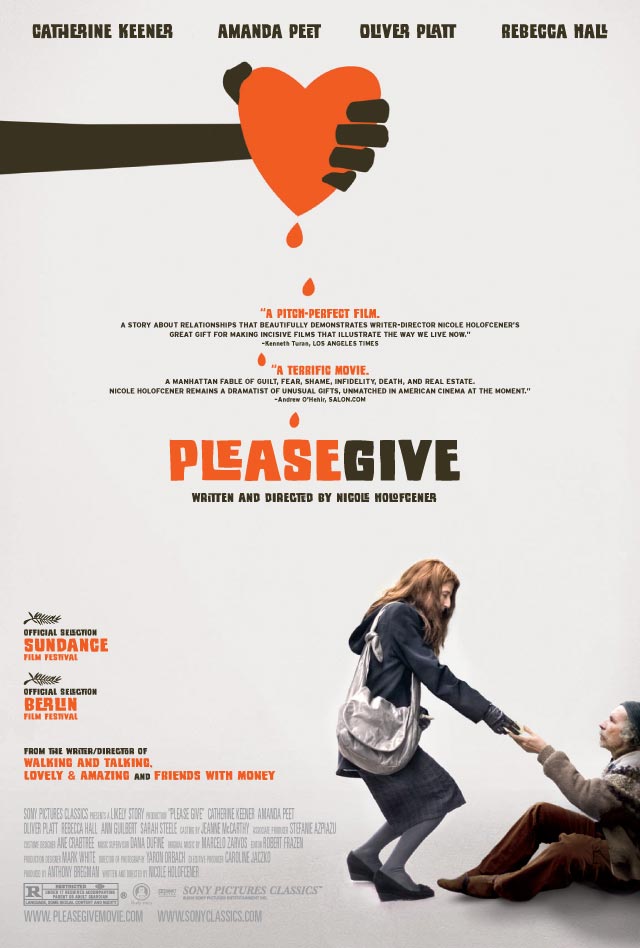
PLEASE GIVE - They fuck you up your mum and dad - Part One

So, I've watched about five movies in the past three months - compared to the old standard of five a week. It's been strange. Mostly I've been watching movies on a date rather in a screening room - and typically I've rescinded control of what we're watching, and watched more lazily - less with an eye to detail and a future review. At any rate, the whole experience has been different, and I think speaks to how film critics become jaded by seeing too many films in too sterile an environment. The upshot is that while I had decided to go completely cold turkey from blogging about cinema, I am going to jump back in with a few quick reviews of a couple of films that really made me think deeply about cinema and about relationships.

First up is the latest film from American indie writer-director, Nicole Holofcener. With LOVELY AND AMAZING and FRIENDS WITH MONEY, Holofcener established herself as a director who was able to communicate an authentic idea of how real women interact with each other, as friends and across generations. She writes movies that contain dialogue and situations that are uncomfortably real, and isn't afraid of presenting protagonists who may not be all that likeable. Their conflicts are self-involved and can seem petty to the viewer. But then, in all honesty, how many of us behave differently?

PLEASE GIVE sits somewhere between the lighter, more forgiving LOVELY AND AMAZING and the more bleak, alienating FRIENDS WITH MONEY. It poses difficult questions about body image, how we treat the elderly, and how we can choose not to speak of family trauma as a sort of defensive amnesia. Most importantly, PLEASE GIVE deals with middle-class guilt. How far should privileged people feel bad about how much they have? And is there such a thing as an authentic gesture of giving back, as opposed to mere self-interested guilt-mitigation?

Catherine Keener and Oliver Platt are superb as Kate and Alex - a wealthy married couple living in Manhattan, making a living from buying furniture from the children of the recently deceased, and selling it on at a huge mark-up in their store. Alex feels fine about what they do for a living, but Kate feels guilty about shaking down people who don't know the market price of their possessions. So she reacts by giving beggars money and by volunteering her time. Problem is, Kate is so self-involved in her misery that she brings the people she's meant to be helping down, and comes across as just plain patronising. Kate's self-involvement has more dire consequences. She alienates her teenage daughter, struggling with teenage skin; and bores her husband. One of the best scenes in the film sees the husband and daughter have a conversation that is ostensibly about facials but really speaks to her knowledge that he is having an affair. It's one of the great emotionally devastating scenes in the film. You know that the daughter will remember it for the rest of her life - it's one of those moments of complete emotional damage - all too typical in real life.

Set against this tale of upper middle-class angst we have the story of Audra and her two grand-daughters. Kate and Alex live next door to the 91 year old Audra, and have bought her apartment. Essentially they are waiting for her to die so that they can knock through and create a dream apartment. Audra is an old battle-axe, and her grand-daughter Mary (Amanda Peet - where has she been hiding?!) calls a spade a spade. She has no problem treating Audra like shit, and openly talks about the remodelling plans. But what I love about the writing and Amanda Peet's performance is that you can tell that underneath all that tough-girl no-nonsense jazz there's a deeply vulnerable woman so lacking in self-esteem that she'll throw herself onto a completely unsuitable guy. By contrast, Mary's sister Rebecca (Rebecca Hall) is one of life's quietly suffering good girls - caring, overlooked, but ultimately grounded enough to have a proper relationship.

PLEASE GIVE is one of those films that isn't necessarily fun to watch - I didn't enjoy my time with these characters. But when I watch Nicole Holofcener films I see characters that I actually know in situations I find familiar and it's just so refreshing to see real life on screen. And more than that, to see a writer portray a relationship between a mother and daughter - or between two sisters, that has the ring of authenticity. Thank Christ movies like this can still get made and get some kind of a release.

Additional tags: Yaron Orbach, Marcelo Zarvos, Robert Frazen, Elizabeth Keener, Elise Ivy, Josh Pais, Ann Guilbert, Sarah Steele, Nicole Holofcener

PLEASE GIVE played Sundance and Berlin 2010 and was released in the USA and Canada earlier this year. It is currently on release in the UK and opens in Germany next week.

Tuesday, January 05, 2010

RED RIDING - 1974 - Less slippery and subversive than the novel but well put together nonetheless

1974 is the first of three films produced for television by Britain's Channel 4, based on the "Yorkshire noir" novels of David Peace. Each of his four books, 1974, 1977, 1980 and 1983, is about the corruption of policeman, priests, politicians and businessmen who murder and extort for no reason other than that they can. There never seems to be much money or success to be had from it, other than protecting the status quo. These crimes are posited as endemic in a region crippled with obsolete heavy industry and chippy toward outsiders. The greatest tragedy is to think you can remain an outsider - a cool observer - and that you can affect change. West Yorkshire is a law unto itself, and that law is policed by West Yorkshire's Finest, and spun by the compliant journalists of the Yorkshire Post. David Peace's world is one of almost complete corruption and casual evil. There are no heroes, but there are characters through whom we investigate the world and with whom we come to empathise.

In 1974, that character is a cocky young journalist called Eddie Dunford, newly back from a failed stint as a journo in Fleet Street, and desperate to make a name for himself by proving that someone is serially killing little girls despite the obfuscation of the rozzers; competition from senior crime reporter Jack Whitehead; and the powerful forces protecting a successful local property developer, John Dawson.

The movie is directed by Julian Jarrold, whose previous directorial efforts included the painfully superficial and hi-gloss remake of BRIDESHEAD REVISITED. 1974 is a far more successful film. Shot in sepia tones through the perpetual haze of cigarette smoke, the movie feels claustrophobic and sinister - just as it should. There's a superb scene where the camera looks over Dunford's shoulder through the patterned glass to a distorted image of Paula Garland - mother to a murdered girl - and soon to be Dunford's lover. That sums up Dunford: he sees through a glass darkly. And the tragedy of the film is that his eventual knowledge brings no relief. In a pivotal scene, he hands over a bag of documents - the research of his dead colleague Barry Gannon - to the one policeman he thinks is honest. Dunford is relieved - elated - as he drives toward his lover for an escape to the South. What a fool, the film-makers say, to think that he could actually escape the clutches of Yorkshire corruption. What a selfish, naive fool to think he could dump the files and fuck of to the South, where the sun shines.

Andrew Garfield is superb as Dunford - with his performance in THE IMAGINARIUM OF DOCTOR PARNASSUS - he has become an actor I will go out of my way to watch. Rebecca Hall is moving as his lover, Paula Garland. In John Dawson, Sean Bean finds yet another role that capitalises on his slightly sleazy charisma. But the real strength is the depth and quality of British character actors filling the cast, from John Henshaw as the harsh-but-fair Editor, to Peter Mullan's Reverend Laws.

The resulting film is atmospheric, sometimes like a bad dream, hard to hold on to, unnverving, and very hard to let go of. Tony Grisoni has done a good job in adapting a ferociously complicated novel for a hundred minute runtime, and cleverly compresses characters. What the film looses, however, is the sheer force of its brutality. The novel is hard work, both in terms of language and descriptions of violence and sex. Every time Julian Jarrold cuts away from a blackmail photo or pans away from a scene of torture, David Peace takes you into the mind of the aggressor. And where the worst crime Grisoni's Dunford can be accused of is naivety, and a final loss of temper, Peace's Dunford is a far more ambivalent character. If policemen casually rape whores, then in the novel Dunford treats women as casually and cruelly, though playing, as it were, in the minor leagues.

And, without ruining either, I found the "solution" of 1974 and the closing scenes too neat and twee, where they should've been more slippery and open-ended. Presumably this was the result of the compression of a large conspiracy into a single culprit but the result was that the ending felt rushed and just plain bizarre - the logic behind the killing was almost given as a throw-away line, and significantly undermines the slow build-up.

RED RIDING was shown on UK TV in 2009 and is available on DVD and on the Channel 4 4oD video on demand service.

Saturday, September 19, 2009

DORIAN GRAY - a mess

In recent years, filmgoers have been treated to some rather lovely adaptations of Oscar Wilde's work, not least director Oliver Parker's AN IDEAL HUSBAND. Therefore, I was rather hopeful about Parker's adaptation of Wilde's The Picture of Dorian Gray. However, Dorian Gray is a very different beast to Wilde's society plays. They dealt with issues of contemporary morality, certainly, but in light atmosphere. By contrast, Dorian Gray is a pyschological novel, dealing with debauchery and corruption, using the genre tropes of gothic horror. The key question was whether Oliver Parker's directing style - high-gloss Merchant Ivory with whimsical modern touches - would be flexible enough to grapple with a meatier book.

The novel opens in late nineteenth century London. Talented artist Basil Hallward falls in love with handsome young Dorian Gray while painting his picture. Of course, there is no crude declaration of love given that homosexuality is taboo, but sublimated "ownership" of Gray's social life. This is put under threat when Dorian becomes fascinated with Basil's friend Lord Henry Wootton - a man who, while a member of the British establishment at the height of Victorian prudery, preaches a life of unrestrained sensuality. Encouraged by the man he admires, falling prey to narcissism seeing the finished portrait, Dorian starts to value beauty and art above all else, casually wishing that he could remain as young and beautiful as his portrait. He callously rejects his young lover Sibyl Vane when her talent fades and learns that his casual wish has been fulfilled: the wages of sin show on the portrait but he remains outwardly youthful and innocent.

With this apparent freedom, Dorian degenerates into a life of excess and cruelty - sexual encounters straight and gay, and eventually to blackmail and murder. It is here that Wilde most brilliantly takes aestheticism to its logical conclusion - positing that crime is merely, as art, "a means of procuring sensation". Eighteen years later, returned from his travels, Dorian tries to turn his life around, looking to his portrait as the ultimate barometer of authentic repentance. In this latter portion of the book, we are privy to some of the most high-stakes soul-searching in modern literature. Wilde, an artist who turned his life into art, simultaneously warns us of the dangers of so doing - themes he later explored in De Profundis. A the end of novel, order is restored: art is restored, in its frame, beautiful - life is separated from it, real, variegated.

The new movie of Dorian Gray is, essentially, a failure. Director Oliver Parker and debutant screenwriter Toby Finlay, fail to translate the feeling of menace and corruption to screen, condensing crucial episodes (Sibyl Vane) and introducing new material that amps up the Hollywood action and romance for crass commercial reasons. Ben Barnes is mis-cast as Dorian. He just doesn't have the acting chops to depict inward moral disintegration in the way that, say, Al Pacino did in the GODFATHER movies. Colin Firth is also mis-cast as the corrupting Sir Henry Wootton. He just can't play sinister. Imagine how much better this movie would have been with Eddie Redmayne and Jeremy Irons in the lead roles. In terms of execution, the movie features some of the most unsexy orgy scenes since EYES WIDE OPEN and some of the cheapest CGI. The only plus points are the lovely costunes, settings and the breath of fresh air that is Rebecca Hall's performance as the newly invented daughter of Sir Henry.

DORIAN GRAY is on release in the UK and played Toronto 2009. It will be released in Italy on October 23rd, in Australia on November 12th and in Finland on Christmas Day.

Saturday, October 25, 2008

London Film Festival Day 11 - VICKY, CRISTINA, BARCELONA

VICKY, CRISTINA, BARCELONA is a superficial film about superficial people. It has the surface polish of all Woody Allen films - sun-dappled, beautiful people in beautiful houses - but none of the moral bite or emotional imsight of a MANHATTAN or CRIMES and MISDEMEANORS. It slips down easily thanks to the pretty faces and the witty dialogue, but frankly there is no reason for this movie to exist nor for you to waste ninety minutes on it.

The movie opens with two classic Woody Allen tony yanks arriving in Barcelona for the summer. Vicky (Rebecca Hall) is Sense and Cristina (Scarlett Johansson) is Sensibility. Both are propositioned for a weekend of culture and casual sex by free-thinking painter Juan Antonio (Javier Bardem). They accept - Vicky reluctantly, Cristina happil - but of course its sensible, engaged Vicky who ends up in the sack. Back in Barcelona, Cristina moves in with Juan Antonio and enters into a menage a trois with him and his dramatic ex-wife Maria-Elena (Penelope Cruz). As the summer ends, serially dissatisfied Cristina writes it all off as a phase and leaves, along with Vicky who condemns herself to a life of boring marriage to a safe investment banker.

Have we learned anything? Woody Allen is down on love. Sensible girls end up with the safe life and the cash. Flighty girls end up being disatisfied. Sexual bombshells are a complete fucking nightmare. Everyone is self-involved - everyone ends up unhappy. The fact that this is all set in beautiful, sunny Barcelona should not fool you as to the deeply nihilistic message at the core.

As to the quality of the production, certainly the film and the actors look beautiful, and even when Woody Allen isn't saying anything new or interesting, he still says it with some style. The big problem is that Javier Bardem and Penelope Cruz act Scarlett Johansson off the screen. The even bigger problem is that Allen never really explores or gets under the skin of the emotional and sexual dynamics of the menage-a-trois as Christophe Honore did in LES CHANSONS D'AMOUR.

VICKY, CRISTINA, BARCELONA played Cannes and London 2008. It was released earlier this year in the US, Norway, Spain, Singapore, France, Taiwan, Italy, Israel, Belgium and Finland. It opens in December in Germany, the Netherlands, Sweden, Russia and Australia. It opens in Argentina on February 5th.

Wednesday, October 15, 2008

London Film Festival Day 1 - FROST/NIXON never convinces

You should marry that woman. She comes from Monaco. They don't pay any taxes there.FROST/NIXON never convinces in its assertion that the 1977 TV interview between the British talk-show host and the disgraced ex-President was a pivotal moment of catharsis for the US public. Indeed, playwright and screen adaptor Peter Morgan (THE QUEEN) diminished his case by pandering to the “all or nothing” school of melodrama. It’s not enough that Nixon is fighting for rehabilitation and Frost is fighting for his reputation as a serious journalist. Nixon must be seen as a man on the psychological edge – making drunken midnight telephone confessions. Frost must be seen a playboy dilettante who stands to lose all his TV shows and his personal fortune if the interview is a failure. Moreover, in a particularly crude narrative choice (whether based in reality or not), Morgan decides to give Frost a third-act montage (so beautifully spoofed in TEAM AMERICA WORLD POLICE) wherein the talk-show host goes from zero knowledge or interest in the mechanics of Nixon’s skulduggery, to uncovering deep truths thanks to a bit of all-night study and black coffee. I also found it implausible that years after the scandal broke; a single document in a public library would be uncovered and force the confession of a President.

Despite all this, the film does get near to an emotional truth. Nixon finally confessed to the cover up because he was tired of lying. Not because of Frost’s new found skill as a crack cross-examiner. The film also gets near to an even more important and significant truth: that Nixon was tremendously insecure; resented the way in which elites bent the rules (notably JFK’s dubious presidential victory); and thought that was simply how you had to play the game. The tragedy is that he was a hard-working and intelligent man who had tremendous insight into Cold War relations but that he made poor decisions because paranoia and a sense of entitlement had trumped his personal morality.

Frankly, I don’t think you needed to artificially inflate the importance of the Frost-Nixon interview; the stakes for David Frost; or the importance of that final shred of evidence (all very Perry Mason). You certainly didn’t need to make some sort of cod psychological link between Frost and Nixon as insecure boys-made-good who’ll never quite be accepted by the establishment. Nixon is the story and when this movie focuses on Nixon it’s brilliant. Frank Langella’s performance is captivating. But frankly, there’s too much dancing around until we get to it.

FROST/NIXON opened London 2008. It opens in the US on December 5th and in Australia on December 26th. It opens in Spain and the UK on January 9th; in Belgium and France on January 14th; in Finland on January 23rd and in the Netherlands on January 29th. It opens on February 6th in Sweden and Norway and on January 12th in Germany, Hungary and Denmark. It opens in Argentina on February 19th.

Monday, November 20, 2006

STARTER FOR TEN - 80s nostalgia masks formulaic bilge

STARTER FOR TEN is woefully formulaic coming-of-age romantic-comedy. Decent but naive working-class boy makes it to pinnacle of academe (Bristol(!) and University Challenge TV quiz programme). On the way he falls for a supposedly sophisticated middle class girl who uses him shamelessly. He then realises he loves the more worthwhile but less fit activist chick. Blah blah blah.

What saves STARTER FOR TEN from utter mediocrity is the sheer likeability of lead actor,
James McAvoy who is suitably at right-angles with the in-crowd. But the biggest reason to see this film, and the only reason you might make it through with a smile on your face, is some class 1980s nostalgia. The movie is set in Britain in the early 80s - a time of deep political polarisation, mass unemployment and awesome pop music and the movie does well to capture the spirit of the times. This is achieved by means of an outstanding sound-track, some brilliantly well-observed production design and by giving Brian some mates who are stuck at home in Essex being indicted for dole fraud. Best of all, a lot of the drama is played out against the backdrop of the TV programme University Challenge. For non-UK readers, University Challenge is a British quiz show that pits teams of four from different universities against each other answeringly fiendlishly obscure general knowledge questions. The comedy part is that Oxford and Cambridge enter not as Universities but as individual colleges. Back in the 1980s the programme was hosted by cult-presenter Bamber Gascgoine, and part of the joy of this film is seeing Bamber Gascgoine brought back to the screen.

So, much like
SIXTY SIX, STARTER FOR TEN is a harmless and mildly entertaining comic drama, on its own terms. But I can only really recommend it for the generation that got drunk for the first time to New Order....

SIXTY SIX is on release in the UK. It opens in the US on February 16th 2007.