Showing posts with label robert richardson. Show all posts

Thursday, August 31, 2023

THE EQUALISER 3****


Something interesting is happening with THE EQUALISER 3.  I was expecting another "does what it says on the tin" vigilante film, along the lines of 1 and 2.  But 3 has a confidence and a vibe that altogether surpasses its predecessors.  It is so patient in doing the work to create its emotional climax that I wonder if it's even commercial.

The plot is simple enough and sounds like a standard Equaliser film.  In the course of equalising a wrong in a Sicilian mafia cell, our protagonist Robert McCall (Denzel Washington) stumbles upon an operation to import ISIS-manufactured hard drugs, the sale of which is funding terrorist attacks in Europe. He calls the scheme in to CIA operative Emma Collins (Dakota Fanning) who brings in the Americans to investigate. Meanwhile, McCall recuperates in a beautiful small town terrorised by organised crime, and decides to equalise their wrongs.

What makes this film fascinating is the way in which the franchise's director, Antoine Fuqua, chooses to go about his business in this final instalment.  

First of all, the style of violence is brutal but credible, and acknowledges McCall/Washington's age. The action sequences are skilful and suspenseful but does not require the superhuman anti-ageing of Tom Cruise in a MI film, or the CGI de-ageing of Harrison Ford in an Indiana Jones film.  McCall's equalising is brutal and effective but always feels perfectly plausible for an older man.

Second, the pace is deliberately slow and the language probably over half in Italian, in a way that truly pays off in the final act.  Fuqua really takes his time establishing McCall's rejuvenation in Altamonte's small town.  The friendship with Dr Enzo, and the slow growth of trust between Robert and the townsfolk, are lightly essayed but deeply moving. The language never switches entirely to English.  I would estimate that over half of the dialogue is in Italian, and I wonder if that choice will impact the film's commercial success. But I loved that choice, as it once again roots McCall in the life of Altamonte and roots us in the stakes of wresting it free of the Camorra. 

The result is a film that has - as strange as it might sound - an elegance, a lightness of touch, but a real impact.  This is enhanced by some truly beautiful cinematography and framing from Fuqua and cinematographer Robert Richardson, as well as the sparing inclusion of only two powerfully choreographed and compelling action sequences. 

It's kind of strange that people don't seem to really talk about Fuqua or this franchise much.  And yet with this instalment - that is so superior to its predecessors - I feel we need to reassess both. Why have they slipped under the radar? Is it because, like the film's protagonist, they are so quiet, unassuming and efficient that they don't call attention to itself? Let me know if you know.

THE EQUALISER 3 is rated R, has a running time of 109 minutes, and is on global release.

Sunday, January 12, 2020

ONCE UPON A TIME...IN HOLLYWOOD


Quentin Tarantino's ONCE UPON A TIME...IN HOLLYWOOD is a triumph.  Indeed it may be my favourite of his films since the superlative JACKIE BROWN.  It's a love letter to old Hollywood, and drips with compassion for fading stars, and indulges in nostalgia for the days when radio stations were the soundtrack of our lives.  The movie stars Leonardo Di Caprio as Rick Dalton  - a fictional TV star of the 50s and 60s whose career is in the doldrums because of his age and alcoholism.  As a portrait of the fickle callousness of the star system, it's a moving film. There isn't much that's honourable or likeable in Rick, but he's our idiot, and to see him bested in his art and conversation by a child star (Trudi - a scene-stealing Julia Butters) is to weep for him. To see him lured by the quick cash of Spaghetti Westerns and saddled with a young wife is to laugh at our own frailty. He's an idiot, but we care that he's okay.  And we care largely because of the most humanising thing about him - his long and loyal friendship to his stuntman/driver/buddy Cliff Booth. In a career-best performance from Brad Pitt, Cliff is just a decent no bullshit kind of a guy. He's tough.  We see him beat up Bruce Lee in one of the most hilarious scenes in the film, and we hear rumours about a potentially murderous past, so the final showdown is well within the realms of his capabilities, despite his being high as a kite. There's something so tragic about his life in a mobile van, heating up tinned food, and something so likeable about his seeming indifference to it.  He's just a good guy. We see this too in his care for Bruce Dern's Spahn - exploited owner of the ranch in which the Manson Family are living. Which of course brings us to the other story in this film...

I think a lot of us came to this film thinking it was going to be a film about the Manson Murders and it's kind of discombobulating realising that it isn't really. We only meet Manson in one scene, and barely see Polanski from a distance at a party.  Polanski and Sharon Tate (Margot Robbie) live next door to Rick, but their lives are largely separate.   And what of Tate?  She's barely given the same screen time or depth of character as the two male leads. She's just a sunny happy dancing blonde, exciting to see herself on screen, in a scene that will give anyone who knows about Tarantino's foot fetish the creeps.  I felt sad for Robbie, who has nothing to do in this film, but really sad for Sharon Tate, who apparently isn't worthy of an inner life.  We do see the events of that fateful night play out. The way in plays out won't surprise people who've seen Tarantino's recent films.  It's really fucking entertaining.  But...

ONCE UPON A TIME...IN HOLLYWOOD is rated R and has a running time of 119 minutes.  The film played Cannes 2019 and went on global release last summer. It is now available to stream, rent and own.

Sunday, January 27, 2019

A PRIVATE WAR


Documentary Matthew Heineman (CARTEL LAND) returns to our screens with a fictionalised account of the final years of war journalist Marie Colvin - a story told recently in the superb doc UNDER THE WIRE [link]. His film opens with Marie in Sri Lanka, covering the civil war, being shot in the eye and acquiring her trademark eye-patch. The movie ends 11 years later, inevitably, with Colvin's death, the victim of a targeted bombing in Homs. In between these two events, we see Marie move between war zones and metropolitan dinner parties, carrying with her her trauma, drinking heavily to forget, blaming her editors for sending her out, daring her colleagues to face their face, or overlook it, to return to the war zone, unable to allow herself to quit. She was truly a superb woman, committed to exposing the impact of war on ordinary people, and her cussedness and intelligence one her the access to figures such as Gaddafi, and the respect of her peers and readers. But questions must be asked about the risks she took, whether it was worth it, and the men she led in her wake, not least her photographer Paul Conroy. There's also some tough questions to be asked about why Marie, of all the dead war reporters, gets docs and films.  Because she was so good? Yes, maybe. But maybe also because she was the iconic woman with the eyepatch?

This fictionalised account is well-enough made, with Rosamund Pike doing a superb impression of Colvin. A gritty script doesn't shy aware from her private fears and trauma, the contradictions in her predicament, and the grim reality of being a war reporter.  There's a superb set piece argument with her editor, played by Tom Hollander, that captures the questions at the heart of her story.  But I couldn't help but feeling that this version of events didn't add anything to the experience of watching UNDER THE WIRE, and that rather than being mediated by a fictionalised retelling, I'd rather just here this story from Paul, and from old footage of Marie, and from her friends, editors, colleagues.  This didn't seem to add any greater insight, and because the direction here is workmanlike, it just didn't seem to add anything. 

A PRIVATE WAR is rated R and has a running time of 100 minutes.  The film played Toronto and London 2018 and was released last year in the USA. It will be released in the UK on February 15th 2019. 

Thursday, October 05, 2017

BREATHE - BFI London Film Festival 2017 - Opening Night Gala


As predicted, and in keeping with a long line of banal, pretty heritage products opening the BFI London Film Festival, Andy Serkis' directorial debut BREATHE is a deeply dull and forgettable drama about a very nice couple.  There isn't any dramatic tension or any surprises. The story proceeds as expected and then comes to a neat end.  It's all done in a perfectly competent manner, but the big emotional set pieces failed to move me (although Meester Phil was successfully emotionally manipulated despite himself.) 

The plot is based on the true story of Robin and Diane Cavendish. In the late 50s, the blissfully married couple were living in Kenya in sun kissed perfect imperial gorgeousness.  And then, just after Diane fell pregnant, Robin contracted polio, rendering him paralysed from the neck down and unable to breathe without an artificial respirator.  Such was the state of medical science at the time that Robin was condemned to a short and depressing life chained to a respirator in a hospital ward. (Although as we see later, in the one genuinely moving scene in the film, the poor bastards in a German sanitarium have it far worse.)  

But this being upper class British heritage drama, nothing is going to stop our heroes from triumphing over this adversity.  Bottom lips quiver, tears are suppressed, and they just keep calm and carry on.  Luckily, although pleading poverty, Diane can still afford a nanny and a stately pile in which Robin can convalesce and their best mate happens to be an Oxford professor who designs the first ever artificial respirator cum wheelchair. And so it all continues.  Even when they need money for chairs for some other patients they find a helpful rich aristo to dole it out.  

There are never any emotional outbursts or arguments, because they love each other perfectly. Even their teenage son (who in real life went on to produce this film) never has an angry frustrated teenage strop.  And so we merely perambulate earnestly toward a conclusion that comes half an hour later than it really needed to.  The problem about making movies about paragons is that they are dull. Maybe the couple were really this unflappable and lovely.  But ye gods, you can't power 120 minutes of cinema out of that. 

BREATHE opens in the USA on October 13th, in the UK on Oct 27th and in Australia on Dec 27th. The film is rated PG-13 and has a running time of 114 minutes.

Saturday, January 19, 2013

DJANGO UNCHAINED - Castigat ridendo mores


Quentin Tarantino returns to our screens with his gonzo Western homage slash anti-slavery revenge movie DJANGO UNCHAINED. It's arguably his best work since PULP FICTION - a movie so tightly drawn, so beautifully produced, so funny, so earnest, so delicately handled. Yes! Delicately handled.  There may be the trademark pulpy shootouts, and those archetypal Tarantino tense long-form dialogue scenes, but watch how Tarantino handles the politics of slavery here.  It's so deft, so respectful, so bracing, it achieves in the context of a pulp mash-up what no earnest AMISTAD like film could achieve.

The first shot of the three hour epic is of Jamie Foxx's whip-scarred back. The camera holds its gaze, forcing us to internalise what slavery really means.  It's not the forced silence of Hollywood, only to be occasionally broken by Mammy in GONE WITH THE WIND, or Spielberg's dignified oppressed. It's violent, and sadistic, sweat and blood-stained.  Throughout the film, Tarantino shocks us with visions of slaves in hook ringed chains, metal face guards, branding irons and most appallingly, a torture chamber called a hotbox. I don't think any movie has brought us up close to the reality of slavery, and given us, in the form of Christoph Waltz' Dr King Schultz, a liberal almost preternaturally modern pair of eyes through which to view it. Then notice how carefully Tarantino shows us the violence of slavery.  When he wants us to see something, he holds the camera on it, preventing us from looking away. But look how carefully he shows us Broomhilda's (Kerry Washington) limp body being wheelbarrowed out of the hotbox.  He's very careful to show us the horror without exploitatively showing us her nakedness. Or in another key episode, look at how he shows us the sadistic plantation owner and Mandingo fighting boss Calvin Candie (Leonardo di Caprio) ordering a runaway slave to be torn apart by dogs.  We hear the horror, and see it reflected it the faces of the onlookers, and we see fleeting glimpses, but Tarantino is careful not to exploit it. Even in a pivotal later seen, when our conscious, Dr Schultz, remembers it, the powerful imagery is held to a minimum.  

The film falls into three broad parts. In Act One, we meet Dr Schultz, a bounty hunter with a smooth tongue and a faster trigger-finger, as he  meets and frees the slave Django. Waltz is characteristically charismatic, holding our attention as the film's hero, almost to the detriment of Django, at least until the final act.  They make a deal - Django will help him as a bounty hunter, and then he'll help Django find and free his beloved Broomhilda.  In the second act, the initial bounty has been killed, and we move to a kind of training montage. Django becomes a sharp-shooter, and the two form a bond as Schultz explains the significance of the Siegried-Brunnhilda legend.  Our heroes have a run-in with the Clan, that plays like something out of a Coen Brothers movie.  For me, this second act was the weakest of the piece. It felt like the film was meandering, and I particularly disliked the stunt casting of Jonah Hill as it brought me out of the film.  In the final act, our heroes meet the real anti-hero of the piece, Calvin Candie and his sidekick, the obsequious head house slave Stephen (Samuel L Jackson).   This is where the true horror of slavery is exposed, where Di Caprio gets to chew up the scenery, and where righteous anger is unleashed.

The structure, revenge motif and complete mastery of DJANGO bears no small resemblance to INGLOURIOUS BASTERDS, but this film feels more tightly written, less meandering and more focussed.  There's nothing as memorable or as tense as the initial scene where the Nazi general is sitting in the French farmhouse looking for hidden Jews, or as the bar-room scene where the English spy is given away, but as a complete movie, DJANGO feels superior. 

I think the courage to show what slavery was, and the restraint in showing it, especially in the context of what is essentially an exploitation-revenge movie, makes DJANGO UNCHAINED a peerless film - certainly one of the finest of Tarantino's career, and easily the most important.  But if all that makes it sound too earnest, rest assured that this is also a movie for cinema lovers - full of references to old classics, belly-laugh dialogue and ludicrous shoot-outs.  You will enjoy this film, and be educated by stealth - the perfect combination.

DJANGO UNCHAINED is on release in the USA, Canada, Belgium, France, Chile, Croatia, the Czech Republic, Greece, Hong Kong, Hungary, Israel, Italy, Kuwait, Lebanon, the Netherlands, Macedonia, Russia, Serbia, Slovenia, Ukraine, Albania, Austria, Brazil, Bulgaria, Estonia, Finland, Iceland, Ireland, Mexico, Norway, Poland, Romania, Spain, Sweden and the UK. It opens on January 25th in  Australia, Denmark, New Zealand, Portugal, Lithuania and Uruguay. It opens on January 31st in Argentina, on February 27th in Taiwan, on March 1st in Japan, on March 21st in Singapore and in March 29th in India. 

DJANGO UNCHAINED is rated R in the USA and has a running time of 165 minutes.

Friday, December 02, 2011

HUGO

HUGO is a movie about the wonder and beauty of cinema - an elegy to the age of celluloid and hand-made special effects - a plea to preserve the fragile, crumbling history of this fantastic art form.  In this aim, HUGO is a wondrous, magical success.

But, far from being, conservative and nostalgic, legendary film-maker Martin Scorsese has shown us not just the past but the future of cinema.  The nostalgia is matched by an equal wonder at the new technology of 3D - not piss-poor retro-fitted 3D - but delicately aligned, beautifully designed 3D designed to give us that same immersive, spectacular thrill as when those first cinema-goers gasped at the Lumiere Brothers' train arriving at the station.  In this aim - in showing us both the past and future power of cinema, HUGO is a technical achievement that surpasses AVATAR and redefines what we thought was possible with 3D. HUGO is, if ever there was one, a movie that demands to be seen in 3D and on the biggest screen you can find.

HUGO is also meant to be a children's adventure - a physical comedy - a plea not to give up on love, or yourself. In that aim, HUGO is a tedious bore.  

So let's tackle these elements in reverse order. Hugo is the story about a young orphan boy (Asa Butterfield) who lives in a train station in a 1931 Paris heightened by fantasy and stunning production design.  Hugo is a tinkerer - he loves to fix things - in particular the beautiful automaton his father left him.  His love of mechanics lies in his loneliness and his need to find his own place in the world.  Together with a plucky little bookworm called Isabelle (Chloe Moretz), Hugo scampers through the station, stealing little mechanical parts to finish his work, and desperately trying to avoid the station inspector (Sacha Baron Cohen) and his hound-dog.  These chase scenes through the hidden passages and platforms of the station make up much of the tedious first hour of the film.  The dialogue is minimal, as are the genuine belly laughs. Poor Sacha Baron Cohen does his best, but I get the feeling that Martin Scorsese just cannot direct physical comedy.  Moreover, too many of his chase scenes through the train station are there to showcase the 3D and the spectacular production design but nothing else. They become repetitive.  They don't advance the plot.  The first hour of this two hour film could easily lose forty minutes. 

Then again, let's talk about that 3D and the production design.  Dante Ferretti (SHUTTER ISLAND, SWEENEY TODD) has created a beautifully detailed, rich set that evokes a kind of super-Paris - a Paris as we would all imagine it to be in our wildest romantic moments. Always snowing - couples dancing - accordion music - little plucky girls in berets - steaming croissants -  book shops that groan under the weight of beautifully engraved volumes - the Eiffel Tower always in the background.  All this forms the environment for a kind of 3D cinematography that combines achingly superb attention to detail with Scorsese's trademark breath-taking tracking shots.  The opening scene of this film, where we swoop through Paris, itself a giant automaton, then into the station, along the track, weaving through the crowd until we reach Hugo hiding behind the face of a clock - is a tour de force to match the Copacabana tracking shot in GOODFELLAS.  Martin Scorsese and longtime DP Robert Richardson - both new to 3D - deserve credit for such an achievement - not just in creating a particular look for their own film - but in echoing and recreating some of the seminal scenes of early cinema.

And so to the history of cinema. The second hour of the film, where the children are led through the history of cinema, first from Professor Rene Tabard (Michael Stuhlbarg) and then through Melies himself (Ben Kingsley) is just an absolute pure joy for any lover of the artform.  I already mentioned the recreation of the Lumiere Brothers' train scene, but the pivotal recreation is of Melies film, "A Trip To The Moon" - see the Youtube clip below. The movie shows us the joy and wit of those early special effects and spectaculars, and the final montage is a thing of awe and beauty. I defy any film-lover not to start crying at the skilful direction of a scene that is at once a culmination of the technical achievement of the film, and its emotional high-point.

The resulting movie is one that is, as I have said, not without its flaws. The first hour drags, and I do wonder whether children will engage with it.  But for cinema-lovers, the second hour is pure joy and an experience I would happily repeat at the cinema, because this is a movie that assures us that despite the fashion for watching movies on mobile devices - sometimes magic demands a communal experience and a big screen.


HUGO was released last weekend in the USA and Canada. It was released this weekend in the UK and Turkey. It opens on December 14th in France; on December 21st in Belgium; on December 23rd in India; on December 30th in Mexico; on January 5th in Russia; on January 12th in Australia and New Zealand; on January 26th in Israel and Spain; on February 3rd in the Czech Republic, Italy, and Poland; on February 9th in Germany, Hungary, the Netherlands and Portugal' on February 16th in Hong Kong and Brazil; on February 27th in Finland; on March 15th in Denmark, Singapore, Norway and Sweden; and on April 27th in Lithuania.

Wednesday, October 06, 2010

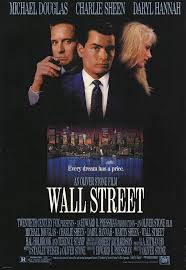
Some thoughts on WALL STREET (1987)


Oliver Stone is left of centre in his personal politics. How ironic, then, that his iconic 1980s morality tale, WALL STREET, single-handedly persuaded the teenagers of my generation that, rather than being teachers, doctors or engineers, what we really wanted to be when we grew up was Liquid. “Rich enough to have your own jet. Rich enough not to waste time. Fifty, a hundred million dollars, Buddy. A player. Or nothing.” Sure, the movie was an alleged morality tale and social critique. It took a naïve kid called Bud Foxx who traded insider information and his loyalty to his father’s little airline for a ticket to the big time. Naturally, he then got skull-fucked by his supposed mentor, Gordon Gekko. Foxx ended up in jail, and so did Gordon. But before we got to that point we saw a young kid living in a flash Manhattan apartment, date a hot blonde chick, eat at the best restaurants, and bask in the glory of the most charismatic man alive, Gordon Gekko. We wanted what Bud wanted, and so what if Gordon was a bit too sharp? – when he spoke about taking sleepy companies and making them profitable, it made sense! This man was dangerous PRECISELY because he was right. Greed was good. Greed was going to turn around over-unionised, over-bureaucratised corporations and increase profits. And don’t think Oliver Stone didn’t know what he was doing. As much as he gives Hugo Chavez a more than fair hearing in his latest documentary, half of what Stone’s doing isn’t applauding Chavez' Marxist policies but being dazzled by Chavez' power. WALL STREET is a film about power – and what makes it a great film – is that it shows how power is both repellant and fascinating. This is the ultimate human tragedy.

WALL STREET was both genius by design and favoured by good fortune. The good design lay in three things: a great script; great direction; and a great leading performance. To start with Stanley Weiser’s script, it’s about as near to perfect as you can get. You start with something rock-solid but not unusual: starry eyed boy tempted by fortune, sells his soul, loses everything, but finds himself. But then you add something truly original – you put that archetypal story in a world that few ordinary people have experienced – Wall Street – but which they were bound to be fascinated by, given its power and glitz. Finally, you express this story in a series of eminently quotable one-liners - “Lunch is for wimps” - “Money itself isn't lost or made, it's simply transferred from one perception to another” - “If you need a friend, get a dog.” 

And then you anchor the whole package in a speech so logical, so persuasive and so dangerous, that today most bankers of my generation can still quote it in full: 

“The richest one percent of this country owns half our country's wealth, five trillion dollars. One third of that comes from hard work, two thirds comes from inheritance, interest on interest accumulating to widows and idiot sons and what I do, stock and real estate speculation. It's bullshit. You got ninety percent of the American public out there with little or no net worth. I create nothing. I own. We make the rules, pal. The news, war, peace, famine, upheaval, the price per paper clip. We pick that rabbit out of the hat while everybody sits out there wondering how the hell we did it. Now you're not naive enough to think we're living in a democracy, are you buddy? It's the free market. And you're a part of it. You've got that killer instinct. Stick around pal, I've still got a lot to teach you.” 

If we look at the direction and the leading performance, that iconic speech is a great place to start. Michael Douglas, with his good looks, slicked back hair, designer suits, and charisma, was everything Gordon Gekko should be. He was the guy whose self-belief was so over-powering you wanted to be in his world.    And look at how Oliver Stone films that great speech. It’s basically a still camera, with no cut-aways. In other words, Stone has the good sense to let the man take centre frame and hold our attention with his words.

True success requires not just talent but luck, and Wall Street had the luck of being released at a time when a lot of people realized that something was afoot, but hadn’t yet seen it articulated. We knew that bankers were becoming more aggressive and that ordinary people were getting caught up in an equity boom – we knew that Reagan and Thatcher had somehow changed the rules of the game – that we could want to make money without being embarrassed about it – but no-one had come out and just plain said it. Gordon Gekko took what everyone was feeling, took it to its logical conclusion, and brought it out into the open. He scared us with his candour – but there was also a crucial recognition and identification. WALL STREET didn’t just echo the zeitgeist, it told us what it was and reinforced its importance. So much so, that when we look back at that era, it’s Gordon Gekko, with his DynaTac phone, who still best articulates the mood of the time.

WALL STREET was released in 1987. Michael Douglas won the Best Actor Oscar beating William Hurt for Broadcast News; Robin Williams for Good Morning, Vietnam; Jack Nicholson for Ironweed; and Marcello MAstroianni for Dark Eyes.

Sunday, July 20, 2008

STANDARD OPERATING PROCEDURE - brutal, brilliant documentary

This is not prisoner abuseSTANDARD OPERATING PROCEDURE is a documentary about the Abu Ghraib torture and prisoner abuse scandal. It is directed by Errol Morris - the film-maker who brought us a stunningly candid interview with former US Defense Secretary, Robert McNamara. Morris' documentary, THE FOG OF WAR, allowed McNamara to walk us through his decisions to escalate the war in Vietnam. It transformed my rather thin understanding of the period, and my prejudice against McNamara, into empathy and sympathy. Part of the reason why THE FOG OF WAR was such a good documentary was that Morris allowed his documentary subject the room to feel comfortable and be himself. Moreover, in sharp contrast to the high-concept documentaries of Michael Moore, Morris' doesn't loom large over his films. The subject is centre stage and the documentarian is as neutral as possible.

Those sterling qualities are what make STANDARD OPERATING PROCEDURE a tremendous film. Morris goes straight to the people at the heart of the biggest moral quandries of our time and gives them a comfortable environment in which to explain themselves. There's no hectoring, no crude politics - people are left to damn themselves with their own excuses or gain our sympathy in turn. The subject matter is also similar to THE FOG OF WAR. McNamara is a poster-boy for liberal hate for his involvement in Vietnam. Lynndie England, Charles Graner, Sabrina Harman, Ivan Frederick, Megan Ambuhl et al are even more notorious as the cocky, smiling sadists, posing with Iraqi prisoners in humiliating sexual positions for their own kicks.

Morris interviews many of the key participants, though not Charles Graner, who seems to have been the ringleader, because he's still in jail. Morris wants to get behind the infamous photographs. Photos don't lie, but they are simply a snapshot. You don't see the before and after, the cajoling, the nervousness, the regret or the defiance. So he just turns the camera on the people involved and lets them calmly explain what was going on when the photographs were taken, inter-cutting this with the actual footage, re-enactments, and a subtle score from Danny Elfman.

Lynndie England feels very strongly that she was the victim of the cajoling of her domineering boyfriend. She makes excuses but doesn't seem particularly contrite. She regrets her life being ruined so young, but does she really recognise why people were so horrified? Doesn't seem so. Megan Ambuhl and Javal Davis make exuses too. Then again, they come across as more cogent. You get the feeling that they knew what they were doing wasn't morally correct but that they had reasoned that in "the fog of war" all gloves are off. Sabrina Harman, on the other hand, does seem to regret what happened. She seems to acknowledge that she crossed a line: that at some point, she knew she had done wrong and that she was going to be punished. The only person who I felt genuinely sorry for - apart from the Iraqis, of course, was Janis Karpinski - the commanding officer at the prison. She comes across as a woman of real integrity and honour who was treated very poorly by the hierarchy eager to be seen to react.

Watching STANDARD OPERATING PROCEDURE is a brutal experience because you are constantly exposed to gruesome footage of people being sadistic and then making excuses. You're seeing humanity at its worst. But what's even more shocking is that, in the final analysis, these US soldiers - some of them very young - some of them clearly under the impression that their behaviour was sanctioned - were hung out to dry. And, after all, aren't they partly right? The photograph shown above wasn't one for which they were prosecuted. No. This wasn't "prisoner abuse". This was Standard Operating Procedure. This was sanctioned. And if we've fallen to the point where this is allowed, who's to judge what isn't?

STANDARD OPERATING PROCEDURE played Berlin 2008, where it was the first documentary to be nominated for the Golden Bear. It was released in the US, Germany and Belgium earlier this year. It opens this weekend in Australia and on July 18th in the UK.