Showing posts with label andrew garfield. Show all posts

Tuesday, October 14, 2025

Complex thoughts on AFTER THE HUNT***** - BFI London Film Festival 2025 - Day 6


Director Luca Guadagnino redeems himself after a run of mid films, not least QUEER and CHALLENGERS, with the adult, nuanced, tricksy and provocatively brilliant AFTER THE HUNT.  It’s based on a script by Nora Garrett and deals in shades of grey and ambiguity. It reminded me of the best of those ethical dilemma dramas that Woody Allen made in the mid to late 80s, not least because Guadagnino pays homage to Woody with the style of his credits.  It also reminded me of the iconic ALL ABOUT EVE in its depiction of a rather spiky marriage and the disruptive interloping of a young rival.

It is far from a perfect film. I felt that Andrew Garfield's performance went from depicting an obnoxious character to just being obnoxious. Whenever he's faced with a choice he always tends to go too big.  I also didn't feel the epilogue was necessary or additive. So why have I given the film five stars?  Because I have spent much of the hours following the screening discussing its choices and themes and debating what was actually happening. I love it when films provoke debate and withhold easy answers.  I also think that Nora Garrett has pulled off a rare feat in so evenly balancing the accusations that Gen Z and Gen X have of each other. 

The movie is essentially a four-hander battle of the wits between two generations.  In the older cohort we have Julia Roberts’ Alma, a Yale University Philosophy Professor who specialises in teaching virtue ethics.  Alma is cool and calm, perhaps too well-put together and unflappable. Her sense of style is assured and unique and easily aped.  Early on we discover that she has some kind of secret from her youth, and that she withholds a lot from her husband.  We feel that it must be traumatic and yet she seems to regard its artefacts with fondness. The deepest level of the film is concerned with uncovering her attitude to this event. 

In contemporary life, Alma seems to attract acolytes, and has a dangerously unboundaried relationship with her star students and her younger colleague Hank.  She somehow holds this all in a fragile equilibrium that the movie will shake. The fascinating and unresolved side-issue that we get no clear answers on is whether Alma has a problem with drug addiction or if she really is just treating excruciating pain. Did the drugs cause the ulcers or the other way around?  What we do know is that Alma is a career woman and deeply ambitious. She wants tenure. She has battled her way through the misogynistic world of academia and wants her just desserts.  

This may well be the role of Julia Roberts’ life, and certainly it’s her greatest role and performance of her later career.  She is on screen for almost every scene and she carries the film. Alma is enigmatic, infuriating, arrogant, makes terrible choices, and yet I found her to be real and sympathetic. 

Alma is married to a psychiatrist called Frederick, played by the always wonderful Michael Stuhlbarg.  It's a small role, even a cameo, but as in CALL ME BY YOUR NAME, in some ways it's Stuhlbarg's character that carries the emotional heart of the film. Frederick can be theatrical and immature and petulant. But he truly loves his wife and understands something profound about her childhood trauma that she cannot see. He also understands something profound about her relationships with Hank and Maggie.  He is flawed but wise.

In the younger cohort we have adjunct professor Hank who is also battling for tenure.  His students love him, he flirts with everyone, and he is an obnoxiously large character, played to the limits of largeness by Andrew Garfield. I suspect some of this is a necessary choice. His career will be ruined by a graduate student, Maggie, who accuses him of sexual assault right after he accuses her of plagiarism. We will not know if he did it, but we have to see his largeness, his physical presence, his lack of self-control, to feel that he might have done.  It's a slippery role. His first reaction is hurt and entitled and arrogant. That does not mean he did it, of course. 

And finally, in real opposition to Alma, we have The Bear's Ayo Edibiri as Maggie, her young PHD student, acolyte, and mentee.  She is a young black female philosopher at Yale, so one might imagine she is already on the back foot. But screenwriter Nora Garrett complicates Maggie by making her incredibly wealthy: the daughter of major donors.  Does Alma suspect she is a plagiarist? Is she? Yes she does dress like Alma.  Did she steal her mother's Bulgari ring to wear as a pendant, copying Alma? Is her accusation of trauma replicative of Alma's?  Is the accusation an attempt to discredit Hank? Is she dating a trans man for the optics?  It's a good performance from Edibiri, every now and then hinting at satisfaction at getting a certain reaction from Alma, but I felt that of the four actors she was the weakest. Perhaps because this is by far the largest and more complex dramatic role she has been given.

The wonder of this script and film is that both Maggie and Alma are right. Maggie is right to say that Alma has let her down, both in her reaction to the assault but more broadly.  Maggie is right that first-wave feminists did not adequately support the struggle of women of colour, and too often tried to get what they could within the existing patriarchal structure rather than challenging it. Alma's life has been one of not compromising her ambition by upsetting the apple-cart. Maggie wants to destroy it.  But Alma is also right in how she skewers Maggie's generation for its virtue-signalling progressive illiberalism: its need for the safety of a lukewarm bath when university in general, and a philosophy class in particular, should be all about debating uncomfortable subjects. 

Like I said, this is far from a perfect film. But it is an ambitious and provocative film. I love that it centres a middle-aged complex woman and is willing to confront and interrogate shifting inter-generational attitudes to difficult issues. The running time is long but I was not bored for a minute.  This is grown-up cinema at its best.

AFTER THE HUNT has a running time of 139 minutes and is rated R. It played Venice and London. It opens in the USA on October 10th.

Friday, October 18, 2024

WE LIVE IN TIME* - BFI London Film Festival 2024 - Day 10


WE LIVE IN TIME is a sub-Richard Curtis attempt at a tragicomic romance from director John Crowley (BROOKLYN) and writer Nick Payne (A SENSE OF AN ENDING). The film is so mannered and meet-cute and interior designed to within an inch of its life that I was utterly alienated from it. Its utter lack of authenticity robbed me of emotional engagement with what should’ve been a deeply emotional film.

Andrew Garfield (THE EYES OF TAMMY FAYE) gurns his way through the film as the nerdy and conventional Tobias (oh yes!) who is run over by the 2024 version of a Manic Pixie Dream Girl played by Florence Pugh (DUNE: PART TWO).  Pugh’s Almut Bruehl (oh yes!) is a cool, unconventional, highly competitive, bisexual hipster chef. They fall in love, break up over whether to have children, she gets cancer, they have a kid, she gets cancer again, wins a cooking competition and dies.  That’s literally it.  

There’s no emotional growth or even emotional tension beyond a small spat at the start when the man asks the woman if she wants kids.  The excruciatingly embarrassing and improbable meet-cute is trumped by an even more excruciating and improbable birth-cute?  Worst of all, there’s no dramatic tension because the film has a non-linear structure.  

What a waste of a fine actress.

WE LIVE IN TIME is rated R and has a running time of 107 minutes. It played Toronto and London 2024. It was released in the USA on October 11th and will be released in the UK on Jan 1st 2025.

Sunday, December 26, 2021

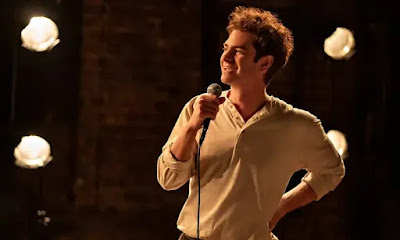
TICK, TICK...BOOM!****

 
I came to TICK, TICK...BOOM! knowing nothing about its subject, real-life musical theatre composer and performer, Jonathan Larson. I know RENT - his hit show - primarily for its South Park spook, "Everybody has AIDS". So when the opening framing device revealed that Larson died the night before his hit show opened, I assumed it was from AIDS. What an idiot. Two hours later, I learned that Larson died of aortic failure in his early thirties having slaved away at various commercially failed projects, living in a crappy 1990s New York apartment, and generally struggling to hold onto this love of theatre despite the temptations of getting a Real. Job. 

That I found Lin Manuel Miranda's movie of Larson's last decade is testament to Andrew Garfield's lead performance. To call it big is an understatement, and for anyone less charming, Larson might come off as an insufferably insecure, selfish attention seeker. In Garfield's hands, one cannot but admire Larson's energy and gregarious good humour even as he suffers crippling self-doubt and ... whisper it quietly... his songs aren't that good. Maybe RENT was though? I shall endeavour to find out.

TICK, TICK...BOOM! has a running time of 115 minutes and is rated PG-13. It was released earlier this year on Netflix.

Thursday, October 05, 2017

BREATHE - BFI London Film Festival 2017 - Opening Night Gala


As predicted, and in keeping with a long line of banal, pretty heritage products opening the BFI London Film Festival, Andy Serkis' directorial debut BREATHE is a deeply dull and forgettable drama about a very nice couple.  There isn't any dramatic tension or any surprises. The story proceeds as expected and then comes to a neat end.  It's all done in a perfectly competent manner, but the big emotional set pieces failed to move me (although Meester Phil was successfully emotionally manipulated despite himself.) 

The plot is based on the true story of Robin and Diane Cavendish. In the late 50s, the blissfully married couple were living in Kenya in sun kissed perfect imperial gorgeousness.  And then, just after Diane fell pregnant, Robin contracted polio, rendering him paralysed from the neck down and unable to breathe without an artificial respirator.  Such was the state of medical science at the time that Robin was condemned to a short and depressing life chained to a respirator in a hospital ward. (Although as we see later, in the one genuinely moving scene in the film, the poor bastards in a German sanitarium have it far worse.)  

But this being upper class British heritage drama, nothing is going to stop our heroes from triumphing over this adversity.  Bottom lips quiver, tears are suppressed, and they just keep calm and carry on.  Luckily, although pleading poverty, Diane can still afford a nanny and a stately pile in which Robin can convalesce and their best mate happens to be an Oxford professor who designs the first ever artificial respirator cum wheelchair. And so it all continues.  Even when they need money for chairs for some other patients they find a helpful rich aristo to dole it out.  

There are never any emotional outbursts or arguments, because they love each other perfectly. Even their teenage son (who in real life went on to produce this film) never has an angry frustrated teenage strop.  And so we merely perambulate earnestly toward a conclusion that comes half an hour later than it really needed to.  The problem about making movies about paragons is that they are dull. Maybe the couple were really this unflappable and lovely.  But ye gods, you can't power 120 minutes of cinema out of that. 

BREATHE opens in the USA on October 13th, in the UK on Oct 27th and in Australia on Dec 27th. The film is rated PG-13 and has a running time of 114 minutes.

Sunday, January 29, 2017

HACKSAW RIDGE


HACKSAW RIDGE is Mel Gibson's re-telling of the true story of Desmond Doss, a deeply religious US soldier who fought in the Pacific against the Japanese and won his country's highest military honour despite being a conscientious objector.  Doss refused to hold or fire a weapon but went into battle as a combat medic. And when his company was forced to retreat in ignominious circumstances, he stayed on top of Hacksaw Ridge and single-handedly rescued over seventy men.  He attributed his success and his survival to his faith, and overturned the prejudices of the men who thought him a coward.

It's easy to see why such material would appeal to Mel Gibson, a man whose faith is a quite extreme version of Catholicism, and whose films are obsessed with a close-up and cloying depiction of violence.   What Gibson isn't interested in are female characters or emotional nuance.  The result is a film, with a script by Robert Schenkkan (THE PACIFIC) and Andrew Knight (THE WATER DIVINER) that is heavy-handed, emotionally manipulative, and full of cliches and cheesy dialogue, and yet despite all this contains moments of great power and tragedy.

The first half of the film is a kind of PRIVATE BENJAMIN slash FORREST GUMP remake but with Andrew Garfield (THE AMAZING SPIDER-MAN) cast as a kind of goofy simpleton.  He just wants to marry his gorgeous nurse sweetheart and protect his fellow soldiers in war despite his objections to holding a gun. We learn in flashback that this stems partly from a backyard scrap with his brother that nearly killed him, but also the example of seeing his father, traumatised by his experience of World War One, turn into a violent alcoholic.  In this section, Vince Vaughn gets to do his usual comedy schtick as the fast-talking mean Sergeant who wants to bully Doss out of the army.  Poor Teresa Palmer gets nothing to do as Doss' girlfriend except to look pretty and angelic and to be utterly supportive.  Indeed the only moment of real cinematic value is Hugo Weaving, who with his portrayal of the tortured ex soldier Papa Doss seems to be acting in another film entirely.

Friday, May 02, 2014

THE AMAZING SPIDER-MAN 2

Yeah so we all know the deal with Spidey, no?  He's was bitten by a mutant spider and got spidey-powers with which he solves minor league crime in New York City.  In this reboot sequel he's played by Andrew Garfield as a mumbling charismatic nerd which is just about perfect.  He's in love with Gwen Stacey but thinks they shouldn't date because he might put her in danger - foreshadowing anyone?  Meanwhile his friend Harry Osborn is dying of a genetic disease and wants to inject himself with Spidey-blood to save his life. Because that will go well. Meanwhile, Harry's employee, a nerd played by Jamie Foxx, has had a massive electric shock that has turned him into, you guessed it, Elektro!

Everything about this Sony produced sequel feels second-rate when compared to Marvel comic book movies.  It's not that it's bad. In fact, it's a lot better than the Tobey Maguire movies. For a start it has an amazing cast - everyone just feels more committed and acting their pants off - just compare Dale deHaan as Harry Osborn with James Franco, who looked bored and embarrassed to even be in a comic book movie.  It's just that it feels a bit mechanical - a bit Tab A into Slot B.  The effects are all big and glossy but left me uninvolved.   The only reason to watch this movie is the Gwen-Peter relationship which really is heartfelt.  And that suggests to me that what you need to do is wait for this film to come out on DVD and then fast forward through the action sequences.

THE AMAZING SPIDER-MAN 2 is rated PG-13 and has a running time of 142 minutes.  The movie is on global release.

Tuesday, July 10, 2012

THE AMAZING SPIDER-MAN


To state the obvious, there is no need for THE AMAZING SPIDERMAN to exist other than that Sony needed a superhero movie for their 2012 production slate. A mere ten years after the critically and commercially successful Sam Raimi revamp is too soon for a reimagining.  And director Marc Webb ((500) DAYS OF SUMMER) seems to acknowledge this with has artistically cowardly retread of Raimi's first film.  There are superficial differences.  Andrew Garfield's Spidey is more emo and Method than Tobey Maguire's.  There's no Daily Bugle. Emma Stone's slightly bored-looking Gwen Stacy is substituted for Mary-Jane Watson. But a lot of the beats of the film - the individual scenes - seem to safely restate what was established by Raimi, especially in its first hour which retells the origin story.

In the second half of the film, Spidey tries to investigate the death of his parents - an event taken for granted in Raimi's version.  Apparently papa Spidey was a genetic scientist - a fact that sits oddly with me. I had always thought Spiderman was compelling because he was a blue collar hero, battling small-time crime, in sharp contrast to his better educated more moneyed superhero peers such as Batman.  Anyways, it is what it is. Following the trail of his father's research leads Spidey to Dr Curt Connors aka the Lizard (Rhys Ifans) - a pretty weak two-dimensional villian more from a cheap pantomime than a modern superhero movie.

The best I can say about the new Spiderman is that it's pretty harmless. And I guess it would've been to much to have expected a genuine reboot along the lines of Nolan's Batman.  Maybe my disaffection stems from the fact that Sony seems to be pitching this film at a younger audience than the typical superhero fare.  There are just too many juvenile jokes - Spidey shooting web at a guy's crotch - Spidey using his superpowers too skateboard better - Spidey biting on FOOTLOOSE in the boat-yard -  for me to take this film seriously, no matter how Method Garfield goes.

Meh.

THE AMAZING SPIDERMAN is on global release.

Wednesday, October 13, 2010

London Film Fest 2010 Day 1 - NEVER LET ME GO


NEVER LET ME GO is a patiently paced, melancholy sci-fi movie that looks like a Merchant Ivory film - BLADE-RUNNER meets THE RAILWAY CHILDREN.  As it opens, Kathy, Tommy and Ruth are children at a picturesque English boarding school called Hailsham. They are good little children - they accept what their teachers tell them about the dangers of the outside world and the importance of keeping well. They are, and I'm sure everyone knows by now, bred as organ-donors. Indeed, the strength of the film is that this fact is taken as read. Far more interesting to avoid petty suspense and to spend precious cinema time examining the ramifications of that fact.  The children know they are donors but also know that they are human - they feel, love, make art - in short have souls - an idea that is deeply disturbing, indeed repugnant, to the society that has bred them.

The sci-fi/pol theory content of the book and film is softened by its immersion in an emotional drama. Kathy (Carey Mulligan) and Tommy (Andrew Garfield) fall in love as teenagers, making Ruth (Keira Knightley) resentful and ultimately destructive.  What could be more human than love and jealousy?  And what is more powerful than confronting people with the consequences of their actions?

But, as with many a London Film Fest Opening and Closing Night Gala, this movie is technically well-made (director - Mark Romanek, ONE HOUR PHOTO) and by no means unwatchable, but it's lacks any real spark.  The pace is too lugubrious for me - the emotions too restrained. Carey Mulligan and Andrew Garfield are superb as Kathy and Tommy but Keira Knightley is utterly flat as Ruth.  I'm not sure how far this is down to Alex Garland's adaptation of Kazuo Ishiguro's novel - in the novel Ruth has more passion to her, more spark - or whether it's just that Knightley is quite simply outdone by Mulligan.  At any rate, by the time the whole thing limped into a final scene with a clumsy voice-over I was rather bored by it.

NEVER LET ME GO played Telluride and Toronto 2010 and was released in the US last month. It open sin Singapore and the UK on January 20th 2011, and in Belgium, France and Germany in February.

Sunday, October 10, 2010

THE SOCIAL NETWORK

Is Mark Zuckerberg a dick? And if so, is it still okay to use Facebook?

Ten years ago, Mark Zuckerberg was an IT student at Harvard. He was pissed off that his girlfriend had dumped him. He was pissed off that his friend Eduardo was getting into an elite club. He was pissed off that he was smarter than everyone but that nobody seemed to notice. So, in a fit of pique, he created a website called Facemash by stealing other students’ photos and uploading them to a photo-ranking site he created, in one evening, while drunk. The site got so many hits it crashed the Harvard network. You get the whole story right there in that scene: the motivations born of insecurity; the disregard for other people’s property; and the insanely brilliant ability.

Mark moves on to helping out elite rowers’, the Winkelvoss twins, with their social networking site, Harvard Connection. He looks around, keeps them hanging on the telephone, and meanwhile mashes the best of their idea (the Harvard exclusivity) with his own talent in creating cleanly designed, functional space. The result is Facebook. They, eventually, sue. (The delay due to being "Gentlemen of Harvard".) The next step is to take Facebook from being a Harvard phenomena to a profitable business. But where Eduardo, co-founder and financial backer, wants to go for advertising and a quick return, Mark is a purist – he wants the site to develop – he wants to know what they have. Of course, this doesn’t stop him being seduced by the charismatic Steve Parker – renegade founder of Napster and Plaxo – taking private equity dollars, and essentially pushing Eduardo out. And when Steve Parker lands himself in trouble with the law, Zuckerberg coolly moves to protect his company again.

When we leave him, Mark Zuckerberg is five years older, some billions richer, invisible no longer. But he's still bitter, insecure, and alone.

In David Fincher’s new film, featuring Jesse Eisenberg in the leading role, Zuckerberg is far more complex a character than I had expected. He’s not a quasi-autistic IT genius who is oblivious to the feelings of the people he screws over, and thus exempt from blame. Neither is he is a mono-dimensional, egomaniacal dickweed, hell-bent on pushing out anyone who dares interfere with his vision for “thefacebook”. Rather, he’s a complex mix of deep insecurity and complete self-confidence. And while he is undoubtedly equivocal with the truth when he needs to manipulate a situation, he’s also as liable to be manipulated by others, especially Justin Timberlake's Steve Parker. He IS an asshole, but a pitiable one at that, and not without redeeming features. He is smart, and creative, and he's usually right.

This is the kind of even-handed, nuanced reading that writer Aaron Sorkin (THE WEST WING) brings to the rather banal, thin source material provided by Ben Mazrich's book "The Accidental Billionaires". Everyone other than Parker gets a fair hearing. Sorkin does this by scrupulously avoiding championing one side or another. Rather every conversation, every action, is shown and then discussed by the people who disagree. We see everything as someone's opinion rather than objective fact - and most things from more than one point of view.  And David Fincher is just the director for this kind of slippery narrative - bringing the adrenaline and excitement of CGI heavy thrillers to what is essentially a movie made up of hacking and depositions. The result is a movie that is fast-paced, emotionally fascinating, and gives us a clear steer on where the film-makers stand:

Sorkin's Mark Zuckerberg invented Facebook and no-one else in this movie had the talent to - but he was also willing to brush past obstacles without pity. Eduardo Saverin - the best friend with money - comes across as nice but naive - never assume the lawyers are your own - and truthfully out of his depth on how to take Facebook forward. The Winkelvoss twins are perfectly summed up by Zuckerberg in a throwaway line - they're pissed off and fighting because in their entitled lives this is the first time something hasn't gone their way. Still, as played by Armie Hammer, they have a kind of anachronistic nobility that's utterly charming. And as for Steve Parker, he's a little kid high on phat cash and hype. Yes he uses Zuckerberg, shamelessly, but you also get the feeling that he genuinely gets him too, and wants FB to succeed. Ultimately, I want a movie on Parker, with Timberlake playing him, all on its own.

I find it quite amazing that Sorkin/Fincher were able to deliver a movie about complicated legal wrangles, populated with complicated characters in a world far from the everyday and yet still make it comprehensible and exciting. I think it's because they tapped into the basic emotions: jealousy, greed, insecurity. They get that Zuckerberg just wanted to be noticed, and was protective of his creation. Which is why I'm really upset that they felt it necessary to introduce two rather cheap tricks to top and tail the narrative. First off, the inclusion of a pretty young lawyer (Rashida Jones) who reaches out to Zuckerberg, and is essentially there just to soften his edges and make us think he's less of a dick. Clumsy. And second, and more serious, the introduction of the fictional ex-girlfriend, Erica Albright as the neat motivating device behind the original facemash hack. I get that she's meant to serve as the amalgamation of all the social hurt he's ever felt, but it's just too pat, and why would she have ever dated him in the first place. It makes the movie stronger in a way - partly because of Rooney Mara's great performance - and because of the strength of the final scene - but it's also pretty weak and obvious for a film that, in general, is a lot more sophisticated.

So is Mark Zuckerberg a dick? Yes. Do I sympathise with him? Yes. Am I still going to use Facebook? Yes!


THE SOCIAL NETWORK is on release in the US, Canada, Germany, Switzerland and Austria. It opens on October 15th in France, Switzerland, Denmark, Bulgaria, Estonia, Iceland, Spain and the UK. It opens on October 21st in Greece, Finland, Lithuania and Sweden. It opens on October 28th in Belgium, the Philippines, Australia, Croatia, the Netherlands, Singapore and Norway. It opens in November in the Czech Republic, Portugal, Slovakia, Poland, Hungary, Italy, Malaysia, South Korea, Russia and Colombia. It opens in December in Brazil, Argentina and India and on January 15th in Japan.

Tuesday, January 05, 2010

RED RIDING - 1974 - Less slippery and subversive than the novel but well put together nonetheless

1974 is the first of three films produced for television by Britain's Channel 4, based on the "Yorkshire noir" novels of David Peace. Each of his four books, 1974, 1977, 1980 and 1983, is about the corruption of policeman, priests, politicians and businessmen who murder and extort for no reason other than that they can. There never seems to be much money or success to be had from it, other than protecting the status quo. These crimes are posited as endemic in a region crippled with obsolete heavy industry and chippy toward outsiders. The greatest tragedy is to think you can remain an outsider - a cool observer - and that you can affect change. West Yorkshire is a law unto itself, and that law is policed by West Yorkshire's Finest, and spun by the compliant journalists of the Yorkshire Post. David Peace's world is one of almost complete corruption and casual evil. There are no heroes, but there are characters through whom we investigate the world and with whom we come to empathise.

In 1974, that character is a cocky young journalist called Eddie Dunford, newly back from a failed stint as a journo in Fleet Street, and desperate to make a name for himself by proving that someone is serially killing little girls despite the obfuscation of the rozzers; competition from senior crime reporter Jack Whitehead; and the powerful forces protecting a successful local property developer, John Dawson.

The movie is directed by Julian Jarrold, whose previous directorial efforts included the painfully superficial and hi-gloss remake of BRIDESHEAD REVISITED. 1974 is a far more successful film. Shot in sepia tones through the perpetual haze of cigarette smoke, the movie feels claustrophobic and sinister - just as it should. There's a superb scene where the camera looks over Dunford's shoulder through the patterned glass to a distorted image of Paula Garland - mother to a murdered girl - and soon to be Dunford's lover. That sums up Dunford: he sees through a glass darkly. And the tragedy of the film is that his eventual knowledge brings no relief. In a pivotal scene, he hands over a bag of documents - the research of his dead colleague Barry Gannon - to the one policeman he thinks is honest. Dunford is relieved - elated - as he drives toward his lover for an escape to the South. What a fool, the film-makers say, to think that he could actually escape the clutches of Yorkshire corruption. What a selfish, naive fool to think he could dump the files and fuck of to the South, where the sun shines.

Andrew Garfield is superb as Dunford - with his performance in THE IMAGINARIUM OF DOCTOR PARNASSUS - he has become an actor I will go out of my way to watch. Rebecca Hall is moving as his lover, Paula Garland. In John Dawson, Sean Bean finds yet another role that capitalises on his slightly sleazy charisma. But the real strength is the depth and quality of British character actors filling the cast, from John Henshaw as the harsh-but-fair Editor, to Peter Mullan's Reverend Laws.

The resulting film is atmospheric, sometimes like a bad dream, hard to hold on to, unnverving, and very hard to let go of. Tony Grisoni has done a good job in adapting a ferociously complicated novel for a hundred minute runtime, and cleverly compresses characters. What the film looses, however, is the sheer force of its brutality. The novel is hard work, both in terms of language and descriptions of violence and sex. Every time Julian Jarrold cuts away from a blackmail photo or pans away from a scene of torture, David Peace takes you into the mind of the aggressor. And where the worst crime Grisoni's Dunford can be accused of is naivety, and a final loss of temper, Peace's Dunford is a far more ambivalent character. If policemen casually rape whores, then in the novel Dunford treats women as casually and cruelly, though playing, as it were, in the minor leagues.

And, without ruining either, I found the "solution" of 1974 and the closing scenes too neat and twee, where they should've been more slippery and open-ended. Presumably this was the result of the compression of a large conspiracy into a single culprit but the result was that the ending felt rushed and just plain bizarre - the logic behind the killing was almost given as a throw-away line, and significantly undermines the slow build-up.

RED RIDING was shown on UK TV in 2009 and is available on DVD and on the Channel 4 4oD video on demand service.

Wednesday, October 07, 2009

Some thoughts on THE IMAGINARIUM OF DOCTOR PARNASSUS

THE IMAGINARIUM OF DOCTOR PARNASSUS is a beautiful, dark, wondrous, mischevious film. Every scene is full of visual delights and rich metaphors. PARNASSUS is film as spectacle - taking us back to the earliest tradition of cinema. But perhaps the most spectacular fact about PARNASSUS is that is was made at all, given the death of its star, Heath Ledger, half way through filming, a fact that evidently floored Terry Gilliam, and had the money-men, always troublesome in a Gilliam production, running for the exits. If the PR surrounding "Ledger's Last Film" gets Gilliam better distribution and audiences than he typically attracts, it's a poor motive, but a good result. Because people should see this film. And not just Gilliam fans, or fantasy fans, or fans of Dickens and Inkheart and the Brothers Grimm. THE IMAGINARIUM OF DOCTOR PARNASSUS pleases and works on many levels.

Before I get to how it pleases, let's dwell a moment on the fact that it really does work. People who love Gilliam tend to start with an apology for the baggy structure of his films and the crazy, too large worlds he creates. It's as thought they love what he's doing but wish he'd find a stronger producer and editor, and someone to just package him up neatly like a Tim Burton film. Surprisingly, I've even read some reviews of PARNASSUS alleging the same thing - the movie is, to these critics, hard to follow, rambling, jam-packed and simply strange. Well, I have to say, I found it one of the most tightly structured and dramatically satisfying of Gilliam's films. Each episode propels us from the opening conceit to the final showdown. Each is necessary. And each character develops upon the journey. So don't let the patronising apologists fool you - PARNASSUS is a great film because of its rich visual style and wide-ranging scope, but it's also easy to enjoy because it's structurally tight.

As the film opens, an antiquated travelling troupe of players is pitching its stall in the modern-day City of London. Well, modern, yes, with its drunken chavs, but timeless too, with its Dickensian grimy pavements and desolate vacant lots. The troupe is led by Doctor Parnassus - a thousand year-old mystic, devoted to telling the truths of life through stories. Centuries ago, he gained immortality in a wager with the Devil. (Just how his side-kick, Percy, gained immortality is unexplained). When passers-by go through his looking-glass they enter a world of their imagination, where Parnassus and the Devil battle for their souls. If Parnassus loses, his daughter Valentina will be forfeit. Around this larger story of life and death is wrapped a smaller tale of love. Parnassus' has raised his daughter in an atmosphere of magic and wonder, but what she really wants is a normal life in consumer Britain. A young boy called Anton, who has been taken in by Parnassus, wants to run away with Valentina, but she is more attracted to the mysterious Tony - an amnesiac in a white suit who promises to modernise the Imaginarium and make them all more money. But who is Tony? And why did they find him hanging by a noose underneath Blackfriars Bridge?

PARNASSUS works as a touching love story - where the girl is too dazzled by the handsome stranger to notice the honest, simple man who loves her. It works as a moving coming of age drama in which a young girl rebelling against her father discovers that she loves him; and the father who cosseted his daughter learns to let her go. PARNASSUS works as dark and brooding cautionary tale about the inability of escaping the consequences of one's actions. In the world of the film, imagination is not an escape but being brought to account. PARNASSUS works as a memorial to Heath Ledger, and all stars who became icons by dieing young. PARNASSUS works as a sad comment on the Death of Narrative Cinema, insofar as Parnassus stands up for stories, and the modern world has no time to hear them. Perhaps most cheekily, PARNASSUS works as a critique of Tony Blair's Britain - the pre-Credit Crunch Britain of housing market bubbles and conspicuous consumption and relentless "modernisation" - Ikea catalogues and "Norm-porn" - of eroding civil liberties in the name of greater security - of policeman clubbing G-20 protesters - of politicians with genuinely good intentions somehow messing up.

On the most basic level, PARNASSUS works as an old-fashioned fair-ground attraction. It's just delightful to look act, and when the actors are playing their characters as performers in the show, they are simply wonderful. All the big-name actors, from Christopher Plummer as Parnassus, to Ledger, Depp, Farrell and Law as Tony, to Verne Troyer as Percy, are just fine, and Lily Cole holds her own as Valentina. Tom Waits is brilliantly cast as the rogue and charmer, Old Nick. But the person who absolutely steals the movie is the young British actor Andrew Garfield (LIONS FOR LAMBS, THE RED RIDING TRILOGY). Garfield as Anton, the poor boy in love with Valentina, but also the fairground entertainer, is an absolute revelation - and worth the price of entry alone.

THE IMAGINARIUM OF DOCTOR PARNASSUS played Toronto 2009 and opens next week in Bulgaria and the UK. It opens on October 23rd in Spain; on October 29th in Australia, the Czech Republic, Italy and Vietnam; on November 5th in Argentina, and New Zealand; on November 11th in France; on November 19th in Portugal; on November 20th in Iceland; on December 3rd in Slovakia; Switzerland; Norway and Sweden; on December 25th in Canada and the US' on January 7th in Germany and Poland; on January 28th in Russia and Japan; on February 5th in Estonia; on February 11th and on March 12th in Turkey.

Eventual tags: terry gilliam, charles mckeown, fantasy, johnny depp, heath ledger, jude law, colin farrell, christopher plummer, lily cole, verne troyer, tom waits, andrew garfield, jeff danna, mychael danna, nicola pecorini,

Monday, October 22, 2007

London Film Fest Day 6 - LIONS FOR LAMBS

It seems like Hollywood tries to tackle the fall-out from the Global War on Terror in a new film every week. But I didn't think I'd watch two movies in two weeks written by the same man, Matthew Michael Carnahan, and starring the same actress, Meryl Streep. The first one written by Carnahan was the subversive "CSI-Riyadh", THE KINGDOM. He follows this up with the new Robert Redfod drama, LIONS FOR LAMBS. LIONS FOR LAMBS also stars Meryl Streep as a liberal journalist. She morphs into a CIA neo-con in RENDITION, also currently on release. Added to this, Brian de Palma's Iraqi war drama, REDACTED, is also playing at the London Film Festival.

Of the GWOT films on offer, Robert Redford's LIONS FOR LAMBS has the most intelligence and the most honesty. It doesn't sugar-coat anything. There are no easy choices and no happy resolutions. Rather, it gives us a snap-shot of the US political debate through three inter-weaving scenarios.

The first segment is a conversation between Streep's liberal reporter, Janine Roth, and a presidential-aspirant neo-con Senator called Jasper Irving. (As befits the current Hollywood fashion, we know Tom Cruise's character is a Senator because he's wearing a three piece suit.) The scenes between these two actors are absolutely fascinating to watch. Both actors are on top of their game in this film and the dialogue is fascinating. I love that Carnahan doesn't make Irving the sort of imbecile gung-ho right-winger that liberals love to hate. Rather, Irving is a slippery customer, selling his "by any means necessary" theories with charm and wit. Most of all, he's reasonable. He's candid about the regime's mistakes but has a new strategy to "win the war" (and the presidency). Roth is unconvinced of course. She's heard it before, during Vietnam. But she is forced to admit the fourth estate's complicity in the Iraqi war. The question is, will she sell another story?

Even as Irving's giving Roth the exclusive on the new military strategy, it's failing in the field. Two idealistic young soldiers (Michael Pena and Derek Luke) are stranded in the Afghan mountains, under-fire from the Taliban. In flashback we see that they want to war in order to become engaged with the key issues of their day, and to return home college-educated veterans with a good chance of "being heard". I was convinced neither by their acting, nor by the special effetcs of this segment. Most importantly, I was unconvinced that anyone would join a war on such a pretext. The movie just didn't sell it to me at all. Moreover, I'm not sure you even needed this segment. The dilemmas of the film could have been as easily portrayed by the Senator-Journalist segment and the Professor-Student segment.

This final segment features Robert Redford's liberal college professor using the example of the two soldiers (his former students) to persuade a young privileged kid (Andrew Garfield) to stop being cynical about political engagement. The kid represents the person in all of us who wants to just put their head down, make the monthly mortgage payment, and let the corrupt politicians get away with murder just so long as it doesn't touch our lives. The professor is our conscience, which tells us that "all that is necessary for evil to triumph is that good men do nothing". This segment is well acted but again the script fails to engage us.

And this is, I think, the whole problem with this film. It feels too dry - too much like we're eavesdropping on a college debate. It reminded me a little of reading Camus' plays, insofar as the characters and narrative are hostages to a philosophical exercise. The problem is that while a movie can instruct us, it will be far more successful in doing so if it engages with us on an emotional level. Otherwise, I can save my money and read the literature on the relevant issues. The power of cinema is, surely, that it can make us empathise with characters and play out our inner-debates? But LIONS FOR LAMBS did not allow me to engage with it. I was demoted to the role of eavesdropper.

LIONS FOR LAMBS played London 2007 and goes on release in Belgium, Australia, the Czech Republic, Germany. Hong Kong, Israel, the Netherlands, New Zealand, Russia, Singapore, Slovakia, Brazil, Denmark, Estonia, Finland, Iceland, Mexico, Norway, Spain, Sweden, Turkey, the USA and the UK on November 9th. It opens in Argentina, France and Hungary later in November and in Italy on December 14th. It opens in Japan on April 19th 2008.