Showing posts with label bryce dallas howard. Show all posts

Monday, May 13, 2019

JURASSIC WORLD: FALLEN KINGDOM


This film is utterly without merit, joy, wonder or intelligence  It is a shameless cash-in on a tired franchise, without any of the majesty of the original.  Even worse, it teases us with memories of that film with an early cameo from Jeff Goldblum and a late cameo from BD Wong. Worst of all, it wastes the talents of arthouse director J A Bayona, who made the exceptional A MONSTER CALLS

In this new instalment, a few years after the dinos go bonkers on Isla Nubar, a volcano threatens to make them all extinct again. Goldblum's rational scientist argues for this but reformed park exec Bryce Dallas Howard now wants to rescue them as living creatures deserving of our help. In doing so she enlists the help of ex-lover and dino handler Chris Pratt, and is funded by James Cromwell's dying billionaire and ex partner of the park's original founder.  Of course, the moral of this series was always that the real monsters weren't the killer dinos but the evil capitalist bastards who sought to exploit them. And so it goes with this non-surprising plot-twist.

The whole thing is over-loud, over-long, emotionally involving and lacking in intelligence. Avoid.

JURASSIC WORLD: FALLEN KINGDOM is rated 12A and has a running time of 128 minutes.

Saturday, July 11, 2015

JURASSIC WORLD


I'm not entirely sure what the producer's saw in Colin Trevorrow's indie comedy SAFETY NOT GUARANTEED that made them think, "this director has what it takes to direct a big budget effects-heavy action film" but boy, he can! JURASSIC WORLD is the best film in the franchise since the original, and while not entirely without its problems, it's a handsome way to spend a couple of hours in the cinema. 

The movie picks up as if the events of the second and third film hadn't happened.  We are twenty years on from the "teething problems" on Isla Nubar and arrogant money-hungry humans have learned nothing.  Jurassic World is now a successful theme park, but in order to keep the customers happy, park manager Claire (Bryce Dallas Howard) has sanctioned the genetic modification of dinosaurs to create a new attraction - the Indominus Rex. Oh, and by the way, those insanely violent Velociraptors are still in the park because some idiot wants to use them for military purposes. Naturally, the Indominus escapes its enclosure and we soon learn that a) it's not socialised and b) it can plan complex strategic attacks.  All of which the wrangler Owen (Chris Pratt) had warned them of. And this being a Spielberg film, into the mix we throw two kids - brothers Zach and Gray (Ty Simpkins and Nick Robinson) and a T-Rex.

Everything about the dinosaurs, action, soundtrack and sense of awe and wonder is perfect in this film. It's less scary than the original, which I rewatched recently, but it's going for a younger audience.  The problems start when we look at the characters and the relationship between Claire and Owen in particular.  Dear Hollywood, does every successful businesswoman need to be emotionally frigid?  Does every powerful really woman really just need a hunky old-fashioned man's man to sort her out?  And it's not like Chris Pratt has it any better as Owen - shorn of the humour that made GUARDIANS OF THE GALAXY such a hit, he's essentially just an objectified beef-cake.  And where the two kids in the original movie had a really lovely mixture of vulnerability and moxie, here they're essentially just Macguffins for the adults to protect. 

Still, for all that, I do like this film. It has all the cynicism about human nature that infected Michael Crichton's book. And where that dark element was only channelled by Jeff Goldblum in the original film (I HATED the transformation of the park owner into a cuddly wide-eyed grandpa) at least in this version Irrfhan Khan has the evil charisma of a true DNA-meddling entrepreneur.

JURASSIC WORLD has a running time of 124 minutes and is rated PG-13. The movie went on global release the weekend of June 11th and finally rolls into Japan on August 5th.

Thursday, December 01, 2011

THE HELP - the Driving Miss Daisy de nos jours


Tate Taylor, director of the anonymous 2008 comedy PRETTY UGLY PEOPLE, somehow managed to get the studios to allow to write and direct THE HELP, a soupy drama based on the best-selling novel by Kathryn Stockett. Not having read Stockett's novel chronicling the travails in 1960s racist Mississippi, I don't know whether the emotional manipulation and superficial politics come from her of from the director.  Either way, the resulting movie looks handsome, and made me shed a tear in the final reel, but has all the genuine engagement with the issues of DRIVING MISS DAISY.  It's a bland feelgood movie about a topic that should make us angry and agitated.  It's a movie in which the main African American character's son is lynched and yet we come out feeling warm and fluffy.  Double plus not good.

The film makes the mistake of telling the stories of these African-American maids through the lens of a perky white wannabe journalist - Skeeter (Emma Stone) - a move that immediately tells us we're in a world where a harsh tale has to be made palatable for a mainstream audience.  Ironic, also, in a movie that makes such a big deal about going right to the source.  Skeeter serves as the vessel through which the maids will dish the dirt and get their story published.  The movie is scrupulous in telling us that Skeeter is sharing the royalties with her informants - but while she gets a cool job in New York out of it - they are at risk of being sacked, imprisoned or lynched. The risks and rewards are clearly completely asymmetric, but the film doesn't embrace and mine that fact - it would mess up the fluffy finale.

Worse still, there is no subtlety in the characterisation - no shades of grey. You're either a good-hearted liberal white (Skeeter, her shamed and reformed mother, Jessica Chastain's character Celia), or a nasty racist white (Bryce Dallas Howard's Hilly and her acolytes).  And as for the African-American women they are largely painted in tones of full-on heroism, with even the thief seen as a martyr to a mean mistress.   As for the subject matter, awful, horrible petty racism is seen on screen, but racial violence is referred to rather than shown.  Ditto the subject matter of domestic abuse.  And I couldn't help feeling insulted that the subject of vengeance against racism was reduced to a scatological joke. 

All this isn't to say that the production isn't handsome - with lush on location lensing from DP Stephen Goldblatt (JULIE & JULIA) and wonderful period costumes.  And the female cast is good quality and does the best with the narrowly written characters they are given.  In particular, it was a joy to finally see Jessica Chastain able to round out a character - rather than just being a virtuous icon, as in THE TREE OF LIFE and CORIOLANUS.  

But this movie, so hyped, so likely to win awards, is not a good movie. It's politics are dicey - it's reluctance to truly grasp the profundity of what it's tackling frustrating - it's emotional manipulation dishonest.  I have no time for it.  

THE HELP was released in the autumn in the US, Canada, Australia, Hong Kong and Sweden. It was released in October in Portugal, Finland, Norway, Lithuania, Singapore, France, Ireland, the UK and Spain. It was released in November in Spain, Hungary, Poland, Malta, Estonia, Denmark, Greece, Kuwait and India.  It opens on December 8th in Germany; on December 28th in Belgium; on Dcember 29th in the Netherlands; on January 20th in Italy; on February 3rd in Bulgaria and on February 6th in Brazil.  THE HELP is likely to be feted during awards season judging by the studio campaign and early indications from the New York Film Critics Circle and the Hollywood Film Festival.

Friday, October 14, 2011

London Film Fest 2011 Day 3 - 50/50

Anna Kendrick, Will Reiser and Seth Rogen present 50/50

50/50 is that most difficult of tricks to pull off - a movie that is both raucously funny and genuinely affecting.  For that we have to thank the loosely autiobiographical screenplay from Will Reiser and direction from Jonathan Levine (THE WACKNESS, ALL THE BOYS LOVE MANDY LANE) that keeps the movie in delicate balance.  That balance is key - because this movie is about a young man struggling to beat an aggressive cancer, enduring chemo and surgery, and even then only with a 50/50 chance of survival. It's the subject matter of afternoon TV movies and melodramas.  What saves us (mostly) from emotional manipulation is the the brutal honesty and hilarity with which the topic is treated - everything from getting high on medical-strength weed, to trashing a flaky ex-girlfriends painting with eggs and knives, to exploiting having cancer to get laid by sympathetic chicks.  In other words, Reiser manages to avoid mawkishness (at least until the final fifteen minutes) by transforming his experience of cancer treatment into a "bromance" complete with adult humour.  To that end, the absolute hear of the flick is the relationship between Jospeh Gordon-Levitt as the cancer victim and all-round good egg, and Kyle - the kind of typically loud-mouthed, vulgar but heart-of-gold character that Seth Rogen always plays. The supporting cast is also first class, with Angelica Huston adding dramatic weight as Adam's mother; Anna Kendrick showing her comedic chops as Adam's therapist; and Bryce Dallas Howard deliciously shitty and cast against type as Adam's girlfriend.  If I have a criticism of this otherwise superb movie, it's that one might feel emotionally manipulated in the final reel.  I can see that intellectually, but I totally bought into the relationships in the film, was right their with Kyle in the waiting room during Adam's surgery, and enjoyed every minute of the experience.  

50/50 played Toronto and London 2011. It played Aspen where it won the Audience Award and  Hollywood where Joseph Gordon-Levitt won the Breakthrough Award for Actor of the Year. 50/50 opened in the USA in September. It opens in Portugal on November 10th; in France on November 16th; in Hong Kong and the Netherlands on November 17th; in the UK on November 25th; in Hungary and Japan on December 1st; in Sweden on December 2nd; andin Ireland on January 4th.

Saturday, July 17, 2010

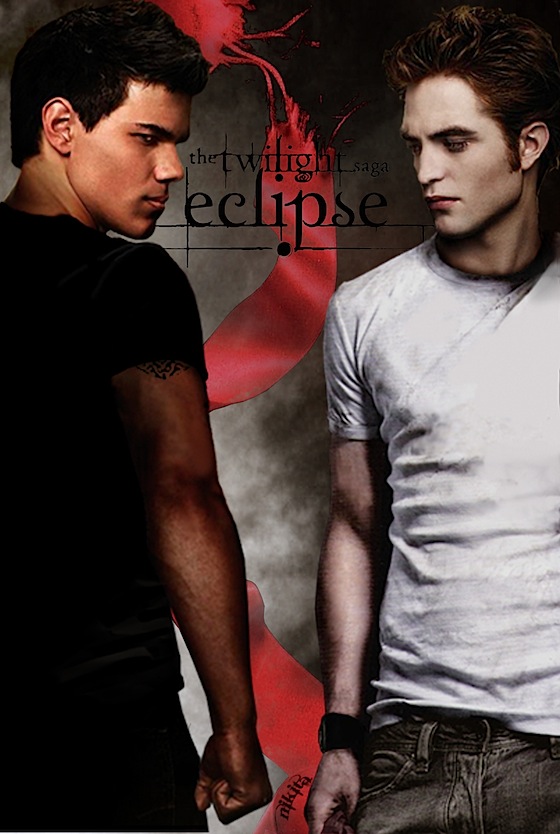
TWILIGHT: ECLIPSE - a world of bad hair colour and worse CGI

So, in an evening of girlie bonding my early twenties cousin and I went to see the third installment of the immensely popular Twilight series, ECLIPSE. Not that either of us could be called fan-girls. I’ve read the first book and seen the first two films: my cousin had only seen the first film. We proclaim no membership of either Team Jacob or Team Edward. But, along we went, open-minded, and if nothing else, happy to be in the lovely big Extreme screens in the Vue Westfield. Two hours later we emerged from a world of bad hair-dye, bad CGI effects and hammy dialogue. For this, my friends, is not a movie of high quality trying to appeal to the neutral movie-goer. Rather, ECLIPSE takes its audience’s buy-in for granted and delivers a workman-like condensed version of the novel, with the cheapest visual effects and wigs it can find. Seriously – the wolves bounce through the forests with little heft, much like Ang Lee’s HULK – and the crimes against hair colour perpetrated by Emmett Cullen and Rosalie Hale disgrace a big-budget film.

As the movie opens, we see our heroine Bella Swan torn between the two boys who love. The first is Edward Cullen – ancient vampire in the body of teen heart-throb – who won’t deflower her until they’re married, and for whom she would have to become a vampire. The second candidate is Jacob Black – ridiculously buff teen werewolf – who is happy to keep Bella warm (sadly, this saga being ludicrously chaste, we can read no double-entendre here) and offer her a romantic life that doesn’t involve dying. So follow two hours of hackneyed dialogue as each boy declares his love for Bella, and Bella looks sulky in response. At the end of which, she declares that the decision was never really about who she loved more but about who she wanted to be. This struck me as a rather unconvincing last minute attempt to give movie that is basically about a chick being dependent on two guys for her physical safety (evil mean red-headed vampire wants to kill her with her “new-born” vampire army) some kind of feminist cred. It would’ve bought into it more if during the course of the film, Bella had talked about this journey to self-realisation with her dad or her friends, or the two boys in her life. Overall then, I remain unconvinced by the whole Twilight phenomenon. The heroine is sulky: the vampires are unsexy: the werewolves on steroids: the CGI sucks: and basically very very little happens indeed. For the life of me I can’t figure out why David Slade, director of edgy indie hit HARD CANDY, would want to helm such a mainstream, banal movie, other than, of course, for the paycheque.

Additional tags: Taylor Lautner, Anna Kendrick, Ashley Greene, Elizabeth Reaser

TWILIGHT: ECLIPSE is on global release.

Friday, June 05, 2009

TERMINATOR SALVATION - a lovely little walking toaster of your very own

TERMINATOR SALVATION is a technically well-made, visually interesting addition to the franchise. Problem is, the plot and character ideas are so ill-developed that the action sequences lose all meaning and dissolve into one long roar of sound and fury.

All if which is a great shame, because director McG (of CHARLIE'S ANGELS fame) clearly had aspirations for greatness, citing influences from THE GREAT ESCAPE to Cormac McCarthy's grim post-apocalyptic novel, THE ROAD. The colour and design of this film is sombre and the mood serious. We have shots of a concrete building collapsing on itself and white dust billowing over the wreckage - an image straight from 9-11. We have scenes of humanity turned savage, fighting over food and fuel. The only wink to the in-joke of the franchise comes late in.

The set-up of the film is promising but squandered. Christian Bale takes on the role of John Connor, prophesied leader of the Resistance against Skynet - the sentient defense machine that launched a pre-emptive strike against humanity on Judgment Day. Terminator robots were designed and sent back in time to kill Connor, his mother and his father with no success. Radical rethinking was required. Skynet creates a Cylon - half human, half android - a Terminator with a real heart. The stage is set for brilliant drama. How far can the Cylon have free will, and counter his programming to destroy the humans? In what sense can a woman really fall in love with a man who is half-robot? These are some of the questions that were explored with great insight and wit in the re-imagined BATTLESTAR GALACTICA.

But TERMINATOR SALVATION is only interested in these questions insofar as they provide breathing room between the set-piece action sequences. Time and again, we have rushed, superficial scenes that hint at deeper questions but never give them room to develop. Thus, resistance fighter Blair Williams (Moon Bloodgood, weak performance) falls for the Cylon who saved her life, and risks her own life to set him free. All this is essayed in five minutes and one scene of laughably Mills & Boon dialogue. Later in the film, the Cylon confronts his creators and asserts his humanity. Sam Worthington gives a good performance despite his inability to hold down an American accent, but we soon jump back to Christian Bale's attack on Skynet HQ.

And what about Christian Bale? His involvement with this film will no doubt be remembered for his ill-tempered attack on the Director of Photography, replayed to the masses on Youtube. This draws attention away from the fact that he has turned in a very mediocre performance in a thankless role. As in the THE DARK KNIGHT, he seems to think that adopting a growling deep voice conveys profundity and authority. And, as in THE DARK KNIGHT, he is upstaged by another actor, for this is really Sam Worthington's film. Maybe Bale just wasn't inspired by a character that is basically one-dimensional. There is an argument that if you were raised by your mother to be the saviour of humanity you WOULD be earnest, single-minded and dull. But, Connor should be charismatic - and when asking the Resistance to commit mutiny - he should sound more convincing, more inspiring than he does. Anton Yelchin, as Connor's teenage father-to-be, Kyle Reese, has more charisma, and indeed, more screen presence, than Bale.

All of this speaks to the weakness of the script overall - as evidenced by the numerous re-writes. Let's only hope they do a better job on the already announced, McG-helmed, TERMINATOR 5.

TERMINATOR SAVLATION is on release everywhere but Japan, where it opens next week, and Mexico, where it opens on July 31st.

Tuesday, June 02, 2009

GOOD DICK - the more you ignore me, the closer I get

Twenty-something writer-director Marianna Palka worked up this shallow, bizarre almost-film in the Sundance labs. At one hour, twenty minutes, with plenty of filler, you get the feeling it might've worked better as a short. As it is, the movie plays as a one note mood piece. Rental video store clerk (Jason Ritter) falls for moody chick who rents porn. He starts stalking her, insinuating himself into her house, but she, understandably, won't sleep with him. No real reason is given their mutual sado-masochism other than a rather cliched, reductive denouement. Overall, lacking in momentum or narrative energy.

GOOD DICK played Sundance 2008 and was released in the UK and USA last October. It is available on DVD.

Saturday, September 22, 2007

AS YOU LIKE IT - I love you, "Bob"!

First, some context for this review. I have some limited experience of Shakespeare, having attended a school where our literary education consisted of little else from the age of eleven. I even took specialist Shakespeare examinations to enter University and before my Masters degree, even though I was applying for a different discipline in each case. I would also count myself as a great admirer of Kenneth Branagh's adaptations of Shakespeare, and I consider his Hamlet and Henry V amongst the best films of the past twenty years. So it was with increasing dismay that I realised how much I disliked his new adaptation of AS YOU LIKE IT.

AS YOU LIKE IT is, in his defence, a particularly problematic play, and not in the same way that, say, HAMLET is problematic. In the latter case, Shakespeare gives us such complex and fascinating imagery and action that we can pick out differing interpretations. AS YOU LIKE IT is problematic in the same way as COSI FAN TUTTE - it has such a frothy, convoluted plot that depends on conceits so alien to reality that it is difficult to know how to present it to a modern audience. On top of this structural complexity, I simply do not think it is one of Shakespeare's better plays. The comedy is not as broad as in his best and most vulgar comedies, the strain of melanocholy is not as integral and developed as in his darker plays, and, simply put, the language is not as beautiful.

The play opens with two sets of warring brothers and closes with four weddings. In between we have a pastoral comedy reminiscent of A MIDSUMMER NIGHT'S DREAM and TWELFTH NIGHT. Duke Senior has been usurped by his brother Duke Frederick and banished to the Forest of Arden. Soon after, their daughters Celia and Rosalind also flee the court for the forest, accompanied by the fool, Touchstone. Meanwhile, young Oliver is feuding with his younger brother Orlando, who has also fled to the forest. Orlando loves Rosalind, and she tests his love in the guise of a young boy called Ganymede. Phoebe, a young shepherdess falls for Rosalind/Ganymede, and scorns the love of Silvius. Oliver will eventually be redeemed by his love for Celia. Phoebe will eventually content herself with Silvius when she realises that Ganymede is a girl. And Touchstone will eventually marry a doltish goat-herd called Audrey.

Such a plot is testing for a cinema audience. Watching this sort of gender-bending from a distance in the theatre we can just about suspend our disbelief. But celluloid close-ups demand that the actress roughs herself up and takes on the physicality of a boy. I think the most successful example of this that I have seen is Felicity Kendal in the 1980 TV adaptation of Twelfth Night, but Sienna Miller is also convincing in Lasse Halstrom's CASANOVA. In Branagh's film, there is no attempt to make Bryce Dallas Howard look convincing as a boy and she certainly makes no attempt to alter her voice or physicality. Indeed, I didn't much like the way she performed the Shakespeare at all. It seemed very deliberate and self-consciously theatrical and, like Kevin Kline's performances as Jacques, arguably better suited to the stage. I found Alfred Molina (Touchstone), Adrian Lester (Oliver) and David Oyelowo (Orlando) gave the most natural and therefore the most convincing performances.

So, I don't particularly like the source text and I found the performances of mixed quality. But I was most surprised by my complete dislike of Kenneth Branagh's directorial decisions. In particular, I thought the device of staging the play in 19th century Japan utterly contrived. It added nothing to my understanding of the text and seemed motivated by the desire for novelty in the costume department. (I also hated the staging of the songs and the cheap Busby Berkeley ariel shots of people dancing in formation.) The Japanese conceit led Branagh to stage an Ang-Lee-esque opening action sequence involving samurai taking over the court. This proved that Branagh cannot choreograph an action scene and that his DP does not have the requisite skill to create depth of colour and contrast in a night scene.

AS YOU LIKE IT was released in Italy and Greece in 2006 and in Hungary in 2007. It was premiered on HBO in August and is currently on theatrical release in the UK.

Saturday, May 05, 2007

SPIDERMAN 3 - in which Spidey jumps the shark

SPIDERMAN 3 was a big event in Bina-world. I'd arranged a posse of like-minded individuals to go see it at the big fat Odeon in Leicester Square. There's nothing like a packed house of fans cheering the opening credits and laughing at all the gags - it's popcorn entertainment at its best.

The opening hour was fine. Peter Parker was back, even more nerdy that usual and a little self-satisfied at Spidey's popularity among New Yorkers. Sure, his best mate Harry wasn't speaking to him, believing Spidey had killed his dad. And his girlfriend Mary-Jane was getting panned by critics in her new Broadway show. Oh, and there was that annoying photographer, Eddie Brock, trying to muscle in on a staff job at the Daily Bugle. But basically, Peter was okay, the film zipped along happily and the higher quota of comedy was fun. In particular, there was some broad physical comedy in a restaurent scene where Peter attempts to propose to MJ.

But around half way through bad things happen. And I'm not just talking about the meteoric slime that attaches itself to Spidey and brings out his aggressive nature. Sam Raimi - a man whose judgement has previously been impeccable, simply lets Spidey jump the shark.

By which I mean that the ueber-confident "black" Peter Parker strutts down the street spoofing Saturday Night Fever. Raimi makes Spidey look bad-ass by making him wear his fringe forward and givin him black eyeliner! He dances with Gwen Stacey in a jazz club spoofing Jim Carrey in The Mask. The humour is broad and it really works. I laughed myself silly. But I was laughing AT the movie, and worst of all, I think Raimi et al were laughing at the movie too. They were sending the Spidey iconography up. Going for cheap laughs also totally destroyed the emotional credibility of the franchise. By the time we'd been through Tobey Maguire's moody teenager impression I was in no mood to hear him pontificate about moral choices and forgiveness, and I certainly wasn't emotionally invested in the movie's ending. An ending which, by the way, rivals LORD OF THE RINGS for its inability to pull down the curtain.

So, SPIDERMAN 3 still has all the cool CGI stunts, and some decent turns from Kirsten Dunst, J K Simmons and Bruce Campbell. Thomas Haden Church is perfectly cast as the Sandman - he has such sympathetic eyes you can't help feeling for him. There's also a woefully brief cameo role from Topher Grace as Venom. Venom is such a great character - a complete bastard - and Topher Grace gave such a fantastic performance that he should have had more screen-time or a movie where he was the only villain. Tobey Maguire proves he can play comedy. I just wished he hadn't proved it in this film. And I remain unconvinced about James Franco's ability to pull off a serious dramatic role.

Overall, I was highly disappointed. As were Nikolai, Movie Matt, Richard and Alan, who'd come all the way down from Edinburgh for this, the first Yippee-Kay-Yay Meet Up. (Although Matt thought it would be a fun night out for kids.) Swedish Philip also gave it the thumbs down. He makes the brilliant point that he expected Spidey 3 to be the most dark and psychologically penetrating given that it featured the Black Spidey. He was expecting the mood to be more BATMAN BEGINS than Broadway Musical. Swedish Lizzie thought it was "utter crap" (although she's so generally amiable and looked so happy I mistakenly thought she liked it). Ken and Graham thought it was okay (see comment below), John kind of enjoyed it, but John thought it ripped off SUPERMAN too much. (I agree. Over-wrought religious imagery up the wazoo, let alone a ridiculously cheesy shot of Spidey in front of the Star-Spangled Banner.) Rav liked it but thought it ripped off THE MASK and Stoogy actually thought it was better for the first one! So out of 12 "votes", we have 7 Nays and 5 ayes.


SPIDERMAN 3 is on global release.

Tuesday, November 15, 2005

MANDERLAY – Lars is a whole lot dumber than he thinks he is

When Lars von Trier made the movie, THE IDIOT, the advertising slogan was “You are a whole lot dumber than you think.” Well, people who live in glass houses should avoid throwing stones. But before we get to my thoughts on his latest movie, MANDERLAY, I must confess that, for the first time in my life, I actually walked out of the screening of MANDERLAY at the London Film Festival. So what follows is not a review but a “coming to terms” with why I did this. But first, some context…..

Lars von Trier is a film-maker who has consciously created a persona as a bad boy auteur who is tough to work with but produces controversial uncompromising works of art.
His need to create a high profile began from the earliest days when he inserted the “von” into his plain old name and took his first full length feature, THE ELEMENT OF CRIME to Cannes in 1985. He deservedly won the Technical Prize for the film’s amazing cinematography and the accomplished use of old-fashioned visual effects and colouring. But this was not enough for Trier who was furious not to have won the Palme d’Or and has had a difficult (and highly publicised) bad relationship with Cannes ever since. Back in the 1980s and early 1990s, Trier was the master of old-fashioned (no denigration intended) film techniques and mastered every aspect of the art of cinematography. This was particularly evident in ZENTROPA, sometimes known as EUROPA, EUROPA, released in 1991. Partly filmed in black and white, Zentropa used back screen projection and all sorts of other “lost techniques” to resurrect an ethereal and sinister post-war Germany. Once again, the film won the Cannes Technical Prize, and indeed, the Jury award, but failed to get the Palme d’Or. Trier literally gave the jury the finger.

Perhaps because he was so sick of getting labelled as a technical master, or perhaps because he was just bored, in 1995 Trier got together with some other directors and came up with the DOGME school of film-making. The idea was to strip film of everything but the camera and the actor. No artificial lighting, no artificial sets, to costumes, improvised dialogue, handheld cameras, no special effects. Not a bad plan, but rather than execute it, Trier continued to film his hysterical spoof-thriller/horror TV series,
KINGDOM HOSPITAL and went off to make the superb BREAKING THE WAVES. It must have rankled when Trier’s stable-mate, Thomas Vintenberg, beat him to it and released the first and most highly acclaimed Dogme movie, FESTEN, rather stealing Trier’s thunder. The stripped down shooting style perfectly suited this story of a family anniversary party ruined by accusations of incest. This didn’t stop Trier making his own Dogme film – THE IDIOT. This was, in my opinion, less successful than Festen, and once again, as with Breaking the Waves, was nominated for, but did not win, the Palme d’Or.

So is Trier the Martin Scorsese of European cinema? No. By and large, I think the Cannes jury has correctly praised his technical skill, and usually, better films have won the Palme d’Or. Even when Trier’s most complete film
BREAKING THE WAVES lost, it was beaten by the marginally better SECRETS AND LIES from Mike Leigh. By contrast, Scorsese always loses the Best Film Oscar to terrible movies viz. the sublime GOODFELLAS losing to the abysmal DANCES WITH WOLVES in 1991. (Cue another essay on why democracy does not work when it comes to adjudicating film awards…)

So, Trier had failed to conquer Cannes with his technical masterpieces and had failed to wow the world with Dogme. So now he decided to produce
DANCER IN THE DARK, a lavish musical starring, improbably, Bjork and Catherine Deneuve. The kicker was that this was a thinly disguised critique on the capitalism, the treatment of immigrants in America and the injustice of the American legal system. Now, I absolutely love Dancer in the Dark. I do not agree with all its political points, but I do think that they are made in an intelligent and original way and most of all, they do not overwhelm the emotional heart of the story. I admire Dancer in the Dark a lot, but I also find it entertaining in part, and emotionally involving to the point of tears in others. Finally, Trier had cracked the code, and had won the Cannes Palme d’Or in 2000, beating off stiff competition from another Pantheon movie, Wong Kar Wei’s IN THE MOOD FOR LOVE.

What did Trier do next? He made too of the most polemical diatribes ever seen in a mutliplex
DOGVILLE and now MANDERLAY. Both are filmed in quasi-Dogme style. They are shot in bare studios with no set and few props. Where buildings and cars and trees should be they are marked out with masking tape on the floor. Let’s take DOGVILLE first. Nicole Kidman plays Grace, who has run away from her gangster father and is taken in by the good people of Dogville. It is the Great Depression and times are tough and the villagers soon start abusing Grace as a manual labourer and finally sexually. No doubt Trier meant this to be, as in Dancer in the Dark, an indictment of American capitalism and America’s treatment of immigrants. But to watch Dogville was like being bludgeoned over the head with an over-sized version of the Communist manifesto plated with iron. The acting performances were to be admired, as well as the sheer bloody-mindedness of the technical exercise, but there was little original or interesting in the political message. Let me once again re-iterate that I did not dislike this film because of its anti-capitalist message. I love Dancer in the Dark despite this. And if there were any further proof needed that anti-Americanism is not enough to make a movie good even in France, Trier took the film to Cannes and, for the first time ever, went home completely empty handed.

MANDERLAY has all of the political dogmatism and unsubtlety of DOGVILLE but has fewer decent acting performances to offset this. Notably, Bryce Dallas Howard, taking on the role of Grace, is a pale shadow of Nicole Kidman. This time Trier focuses his attentions of race relations and whether interfering in another regime is justified, and everyone is in the firing line. Grace stumbles on a plantation where slavery is still in effect despite the fact that it is now illegal. Should Grace intervene in affairs, and tell the slaves, indeed force the slaves, to be free? Or should, as the father suggests, they keep their noses out of other people’s business. (American foreign policy, anyone?) Grace intervenes, freeing the slaves and making the white slave owners their servants. At one point she has the former slave owners don “black face” and serve the former slaves supper.

Now, it is laudable to make a film about racial intolerance and whether it can be right to “force people to be free”. But I felt like Trier had nothing new, or powerful or interesting to say about these issues – at least in the first 80 minutes of the film. Worse still, I felt that Trier had none of the restraint shown in DOGVILLE. He was simply being shocking for the sake of it, as if to mask his lack of originality or indeed profundity with cries of horror. And isn’t making actors perform degrading acts without making any original and interesting creative or political statement in itself a form of exploitation? So I walked out. Once again, let me say that I do not object to the themes in Manderlay, or the use of some Dogme techniques, or the use of shocking imagery. I just object to the quality of the creative concept behind them. To my mind, MANDERLAY is a massive miscalculation and as crass and an offensive piece of work as you are likely to see on screen. It hurts to say that because I do admire much of Trier’s early work.

So should you see the movie? No doubt. My judgment is worthless because I could not stomach the full screening and who know what might have happened had I watched the whole movie. So please do go see MANDERLAY, and please tell me what you make of it!

MANDERLAY opened in France and Germany last week. It is scheduled for a limited release in the US on the 3rd February 2006. I’ll update the UK release date when I have it.