Showing posts with label linus sandgren. Show all posts

Saturday, February 14, 2026

"WUTHERING HEIGHTS" **


"WUTHERING HEIGHTS" does not work on its own terms because Emerald Fennell does not pick a lane, because she has no good original ideas, and because she has no cinematic taste. She thinks she’s daring and transgressive but actually she’s just crass and juvenile and undercuts any attempts her actors are making to inject credibility or elicit sympathy from the audience. Hong Chau is good as Nelly and Jacob Elordi tries hard as Heathcliff in a straight drama. Isabella is played - problematically - for broad knowing laughs in a second separate film. Martin Clunes is playing a Dickensian villain in a third. Margot Robbie is just too old and haggard to play Cathy at any age. Ultimately though this is Fennell’s failure. I laughed at the screen when Clunes died amidst two piles of empty gin bottles. I laughed harder when Atlanta was burning. We get it Emerald: you watched GONE WITH THE WIND and REBECCA. Now please do fuck off and direct music videos. 

"WUTHERING HEIGHTS" REALLY does not work as an adaptation of Emily Bronte’s actually transgressive novel. The juvenile absurd emotions turned up to eleven revenge psychodrama that Cathy and Heathcliff put each other through only makes sense when you know they are adolescents - when Cathy dies at 20. The idea that marrying Heathcliff would degrade Cathy only works when money won’t wash over his “otherness” because he is either the son of a black slave or a gypsy or a lascar. There is no evidence in the book that they ever had sex. It’s not a love story. It’s a story of psychosexual sadism carried over three generations. Eliminating Hindley means we have no Hindley-Heathcliff-Cathy triad to mirror the Edgar-Heathcliff-Cathy triad or the Hareton-Heathcliff-Cathy2 triad. 

Of course Emerald Fennell is narcissistic enough to think we give a shit about how SHE felt reading the novel at 14 and that the book is unfilmable. But Andrea Arnold made a superb film of the first half off this book. And I hate to break it to you Emerald, we watch this because of Bronte not you. 

And don’t even get me going on a deeply privileged white woman blathering on in press tours about how this is a female made movie as if this allows her to erase the fact that the lead actor should be a person of colour and that the entire story is about him being diminished for being brown. And then - just to add insult to injury - Margot Robbie parading jewelry stolen from Mughal India and ascribing its ownership to Liz Taylor - erasing its actual origin. Either they are racist or stupid or both. 

WUTHERING HEIGHTS" is rated R and has a running time of 136 minutes.  It gets a star for Hong Chau and a star for Martin Clunes. 


More thoughts: Heathcliff’s continual demand of consent from Isabella was deeply troubling. A joke, played for recognition. But also part of the overall softening of Heathcliff and Cathy - to make them “likeable” and credible as a love story gone wrong. Young Cathy isn’t pinching and punching staff. Heathcliff doesn’t kill Isabella’s dogs. Eliminating the back half of the book makes Heathcliff a lot less violent and indeed borderline necro. I also feel that making Cathy’s baby die early in the womb so that Cathy then dies of septicaemia is a way for Emerald to keep Cathy/Robbie looking “pretty” and unpregnant to the end. It allows Cathy and Heathcliff to keep pretending that they are starcrossed lovers in arrested development.  Emerald can’t handle them being culpable adults as much as they can’t.

Friday, October 10, 2025

JAY KELLY**** - BFI London Film Festival 2025 - Day 3


JAY KELLY is a film with a simple and arguably trite message: those who pursue success at all costs end up not alone but lonely.  Inevitably, when it comes to movie stars, the cost is paid by wives and children.  It’s ground that we have seen trodden from 81/2 to ALL THAT JAZZ and countless films in between.  Trite, but also relatable.  Every parent who has had to take a business meeting or a business trip and missed their kid’s school concert can empathise. Everyone who has reached a certain age and looks back on decisions that seemed like they weren’t even choices at the time, but are bitterly regretted in retrospect, can sympathise. So this is a strange film that seems obvious but somehow hits home.  I laughed a lot, I rolled my eyes on occasion, but in the end the characters, and the central love story, really stuck with me.

George Clooney stars as the eponymous ageing film star whose mid-life crisis is triggered by a trio of guilt-inducing events. First off, his old mentor and movie director (Jim Broadbent) dies - a man that Kelly abandoned when he fell out of fashion.  Second, Kelly runs into an old fellow acting class student, played in youth by The House of Guinness’ Louis Partridge and as an old man by The Morning Show’s Billy Crudup.  That student had a lot of talent but ultimately was too nervous to ace the audition that Kelly ultimately won.  The resentment lingers.  Third, Kelly has to confront his woeful relationship with his two daughters when his youngest leaves for a European vacation.  The eldest (Riley Keough, superb in a cameo) feels her abandonment as a child keenly, and that relationship feels the hardest to fix.  But both young women seem refreshingly grounded.

So we think this is a movie about family, and I guess it is.  And let’s not pretend that Jay is going to fix 35 years of bad choices over a long weekend in Italy.  But the movie wants us to realise that he’s not the only one. Every member of his team, but principally his agent (Adam Sandler) and his publicist (Laura Dean), are putting their lives on hold to minister to his every need and enable his success.  One by one this movie strips him of their comforting support blanket. I am not sure if there is any major character development or revelation.  But a near-final scene of surprising tenderness between Sandler and Clooney shows the real danger of believing that you have chosen a family above your own.  The movie title tragedy is Jay’s but the real tragedy is his agent’s. 

Overall, JAY KELLY is a deceptively slow-moving gentle comedy that hits harder than you might realise on a first watch.  It does not contain the visceral anger of writer-director Noah Baumbach’s MARRIAGE STORY, but in working with debut feature writer Emily Mortimer, Baumbach has created something more melancholy and wistful, despite the brilliant cheesecake gags.

JAY KELLY is rated R and has a running time of 132 minutes. It played Venice, San Sebastian, Telluride and now London. It opens on November 14th in cinemas and on December 5th on Netflix.

Thursday, October 05, 2023

SALTBURN** - BFI London Film Festival 2023 - Opening Night Gala


Emerald Fennell's second directorial feature is a desperately disappointing mash-up of superior works.  We begin with forty minutes of Brideshead, before morphing into The Talented Mr Ripley by way of The Blandings and Kind Hearts and Coronets. Worse still, Fennell uses transgressive sexual acts to paper over the unoriginal and meandering plot. The film is not as darkly funny as she thinks it is. And its only saving graces are Rosamund Pike as the AbFab clueless matriarch, and Carey Mulligan in a touching cameo as the mother's addict friend Pamela. One star for each of them, and half a star for Richard E Grant shouting "Just eat the bloody pie!"

Barry Keoghan stars as the Ripley-esque Oliver Quick, a Fresher at a fantasy Oxford where  you drive up to the Rad Cam, smoke in your room, and students not tourists drink at the KA. Oliver is drawn into the in-crowd when he helps out Felix Catton (Euphoria's Jacob Elordi), and lands an invitation to his Brideshead-style country house, Saltburn. In addition to Felix, Oliver charms the Wodehousian ditsy father, caustically selfish mother and vulnerable sister (newcomer Alison Oliver). The only person who seems on to his manipulations from the start is the family's poor relation Farrell (Archie Madekwe - GRAN TURISMO).  Game senses game. 

The film proceeds at a leisurely pace, with every plot twist telegraphed years in advance. The way the film develops will not surprise anyone with a shred of (cine-) literacy. There are occasional lines or scenes that are mordantly funny and brilliantly constructed, mostly involving Pike and Mulligan.  But between them, ennui and an infantile desire to shock.

Fennell's first feature, PROMISING YOUNG WOMAN, was just that. SALTBURN is a step back. Will her inevitable third feature show this to be a mis-step? Will her directorial choices add to her narrative or to continue to be puzzling (why the 4:3 aspect ratio?) or showy without effect (look! mirrors!)?

SALTBURN has a running time of 127 minutes. It will open in the USA on November 24th.

Sunday, January 22, 2023

A spoiler-filled essay on BABYLON***** but also Zero - it's an alpha gamma film


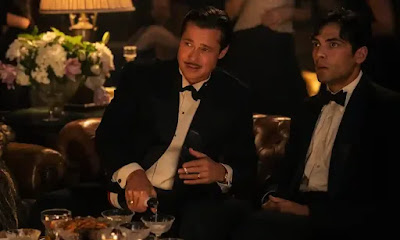
It pains me to say that Damien Chazelle hasn't made a wholly decent film since WHIPLASH and it's clear where he's gone wrong. WHIPLASH was tight as a drum, taut with tension, constructed with precision and escalated from a whisper to a bravura climax. It centred on a single story and a single relationship that captured us and spat us out at the end, exhausted and exhilarated. By contrast, BABYLON starts at eleven and keeps on going, throwing everything at the screen in bravura set piece after bravura set piece. Some of it works. In fact the first 100 minutes or so is some of the most impressive cinema I've ever watched. But it all goes wrong when Tobey Maguire appears on screen. No disrespect to Maguire but his performance is clearly a misdirected misfire of epic proportions that jumps the shark, or leaps over the alligator, or whatever. And the film never gets back on track. After that it's just overlong repetitive unnecessary coda after coda culminating in one of the most patronising epilogues of all time. Yes, Chazelle, we get that you're telling the story of SINGIN' IN THE RAIN as tragedy rather than comedy. We. Get. It. We are clever. Stop trying to hammer it home. Stop trying to big yourself up.  Stop trying to place yourself at the heart of the unending unspooling of cinematic history because you are doing yourself no fucking favours.

Anyways. Long pause for breath. Let's talk about the stuff that is absolutely amazing in this film. Let's talk about a film that is in love with what film means to its audience, and the madcap pioneers who made it all happen, but is also under no illusions about the cruelty and crassness and exploitation of the industry itself, as depicted in its earliest scene where an elephant shits over the audience. 

We open with a 30 minute bacchanalia at a movie producer's house in proto-Bel Air, surrounded by desert scrub and bristling in saturated dry heat.  Everyone is part-naked, coked-up and fucking. Jean Smart's thinly veiled Hedda Hopper-style gossip columnist wants to see the secret room upstairs where the producer keeps the underage girls. A thinly veiled Fatty Arbuckle is getting pissed on by a wannabe starlet who is soon to OD, and will be smuggled out by cover of elephant. 

Lest we think Hollywood has corrupted these people, Chazelle shows us they started out corrupt.  Margot Robbie's wannabe starlet and Clara Boy cipher Nellie LaRoy arrives at the party wearing nothing and looking for drugs, and when she gets her big break she decides to bear her iced nipples: she's no naive innocent and no-one is forcing her to be lewd.  As a result, it comes as something of a surprise in the film's second act when she seems shocked and saddened at being called "low" - so saddened that she acts out by trying to wrestle a snake, leading to perhaps the coolest, crudest and sexiest meet-cutes of all time. Thankfully Nellie's attempts at reformation are short-lived. She doesn't progress or learn or grow. Maybe a drug and gambling addict can't - at least not in an environment of enablement where every set has a friendly dope-pedlar. In her fragile vulnerability and incapacity to escape herself I found myself thinking of Elizabeth Short, now known as the Black Dahlia, another vulnerable woman who came to Hollywood for stardom.  There but for the grace of God.  When LaRoy disappears into the night, high as a kite, dancing to the music in her head, was any other ending ever possible? Or maybe the other ending is that ascribed to LaRoy's mother, institutionalised. Maybe Hollywood is to be lauded for at least allowing a "wild child" to be wild?

Similarly, Chazelle has cast newcomer Diego Calva for his dreamy eyes, but his Manny Tores is shrewd from the start. It's his idea to use the elephant as cover and he will literally do anything for access to a movie set including disavow his own family and racial heritage. So it comes as no surprise that an hour later into the film he will cruelly decommission Nellie's lover and Anna May Wong cipher Lady Fay (Li Jun Li) as inconveniently gay at a time when the wild west of Hollywood is about to be self-policed by the prurient Code.  I was happy when Manny came a cropper and didn't buy into the importance of his epilogue redemption. Do I give a shit that Manny now sees the magic of film? Or understands his former colleagues' place in its history? No.  And his casual dismissal of Lady Fay echoes Chazelle's inability to give Li Jun Li the story she deserves because of the constraints of the story he is telling. She has to escape to Europe for a career when the Code cuts her short. And so she disappears from BABYLON much to its loss. The same holds for Olivia Hamilton who plays an early female silent film director. This film cannot say much about her because Hollywood did not allow her to thrive. But it was wonderful to see  the early female directors recognised. 

In fact, the irony is that the least corrupt characters are arguably the old-hands: Jean Smart's gossip columnist and Brad Pitt's kind-hearted old-fashioned silent star, loosely based on John Gilbert. They love the movies for what they are - honest working class entertainment providing an escape for the lonely and poor.  Pitt's Jack Conrad gets one of the best scenes in the film when he tells his thespian fifth wife that the audiences a Broadway show pulls would be considered a flop in Hollywood. And it's heartbreaking to see him fail to make the transition to sound, and the toll this takes on him in his final scene.  It's even more heartbreaking because we know that while Jean Smart offers him immortality in exchange for heartbreak, those early nitrate films barely survive and are rarely seen. It was a bum deal, and somehow Jack Conrad always knew it. 

But Jack Conrad's self-managed exit from the stage isn't the films most heart-breaking moment. That is reserved for Jovan Adepo's jazz trumpeter Sidney Palmer. He starts the film at the aforementioned bacchanal and ends up benefiting from the move to sound films, earning vast amounts of money but at the cost of enduring patronising white folks at a fancy country club dinner where Nellie, perhaps viscerally expressing what Sidney is feeling, ends up projectile vomiting over the pretentious cunts who act as gatekeepers. Later, he will be asked by Manny (a fellow minority presence in Hollywood but in full denial of his ethnicity) to black up so that his face doesn't look too white on screen.  No cinema in the South will show an integrated band.  Manny, by this time fully a tool of the system, emotionally blackmails Sidney and tells him the whole band will be out of a job if he doesn't comply and you can see every calculation - emotional and logical - that Sidney goes through - and what it costs him - with no words but etched on his face as he plays the trumpet.  It's a brutal scene that will stay with me for a long time. Thank Christ Sidney escaped to Harlem and got back his self-respect. But again, how sad for us and the film that he has to perforce leave our screens, yet another reason why its final hour is  - with the exception of Jack Conrad's exit - woeful.

So this isn't a terrible film, as many reviewers would have you believe. It's a brave bold beautiful disgusting chronicle of a brave bold beautiful disgusting set of people who wanted to create art, make money and make us laugh and often exploited people - and themselves - in order to do so.  Their aim, Chazelle's aim in highlighting what they endured, is noble. And if the film makes just one person pick up an autobiography of Clara Bow, or find an old clip of a silent film on BFI Player, then it's all worth it.

BABYLON is rated R and has a running time of 189 minutes. 

Wednesday, October 17, 2018

FIRST MAN


Damien Chazelle's FIRST MAN is a superb return to form after the mis-step that was LA LA LAND.  He tells the story of Neil Armstrong's moon-walk with a series of strong directorial choices that create a very intimate, almost melancholy picture that nonetheless manages to be literally awesome as we step onto the lunar surface. It's a film that's assured, mature, and emotionally resonant while never being mawkish. One can just imagine what this project might have been like in someone like Spielberg's hands.

As the film opens, Neil and Janet Armstrong (Ryan Gosling and Claire Foy) are coming to terms with the imminent death of their little girl Karen from cancer.  Neil - a talented engineer and test pilot - applies for NASA's Gemini space programme almost as a distraction.  The couple and their 5 year old son will have to move town, and it will be, in Janet's words "a new adventure". As the years and test flights progress, we come to know and feel a camaraderie with Neil and his colleagues.  They all seem to live close by to each other, and when fatalities occur, they share that pain.  This film invites us to share not only Neil's journey but also that of his wife - apparently she really did drive to Mission Control to demand their turn her squawk box back on during a particularly perilous flight!  The impression we get is that Neil was always a pretty buttoned up guy - that he channelled his grief into his work - and found talking to his kids about the chances of him not coming back pretty hard. 

The beautiful thing is that these home-life scenes of quiet melancholy lay the foundations of the emotional payoff on the moon.  Those scenes are absolutely breathtaking - and even though we know the outcome - they still manage to be tense.  The first moment when we switch from the Super-16 grainy footage from Earth to the IMAX footage on the moon is a truly WOW! spectacle. But even then, there's something deeply personal and even introspective about it. The camera is on Neil's helmet - and so his reflected shadow on the moon - and we see him just take a moment to take it all in.  There's then a beautiful personal moment (apparently fictionalised but at this point who cares) that perfectly caps all that has come before.  And then we're home.

The result is a very moving film that pays tribute to the men who sacrificed their lives and didn't make it - and a film that does what I LOVE - which is to briefly but effectively open up its focus to events outside the bubble - to show the controversy of spending so much money on the space programme during a contentious war. It's also a film that uses music beautiful - whether weaving in the Armstrong's beloved but whacky theramin-heavy space track - or subtly referencing Kubrick with a waltz as a space-ship docks. 

FIRST MAN is rated PG-13 and has a running time of 141 minutes. It is on release in the USA and UK.

Saturday, October 07, 2017

BATTLE OF THE SEXES - Day 4 - BFI London Film Festival 2017


Co-directors Jonathan Dayton and Valerie Faris (LITTLE MISS SUNSHINE) and screenwriter Simon Beaufoy (SLUMDOG MILLIONAIRE) have created an immensely likeable and uplifting movie in BATTLE OF THE SEXES. It's the story of an infamous exhibition tennis match played in the mid-70s between one of the all time greats of women's tennis - Billie Jean King (Emma Stone) and an ageing former Grand Slam winner Bobby Riggs (Steve Carell).  Both are absolutely fascinating characters.  Riggs is a paunchy fifty year old on a second marriage to a rich woman (Elisabeth Shue).  He has a gambling habit and a love of the limelight, and while earning a pittance on the seniors tour become irked that the women are demanding more money.  Those women are led by Billie Jean King - who in a no-nonsense straightforward way asks why, if the women sell as many tickets as the men, they don't get paid as much? What's more, King is willing to back herself - setting up a rival women's tour with tennis promoter Gladys Heldman (Sarah Silverman). In doing so, she goes head to head with the misogynistic head of the USLTA Jack Kramer (Bill Pullman). The set up of the film is thus an exhibition match between Riggs and King where she has to win to rescue the reputation of women's tennis and indeed make a point about equality to the millions of people watching on TV.  But as she rightly points out, the real point to be made is against Kramer and his ilk rather than the buffoon-like Riggs. 

Behind the scenes we also have intense emotional battles. As the world now knows, King, though married to the deeply supportive and remarkably accommodating Larry, is equally gay. In the course of the film she begins a passionate affair with the tour hairdresser Marilyn (Andrea Riseborough), something that Larry tacitly condones, but that is hidden from the press and King's parents.  The more fascinating reaction is that of King's rival Margaret Court, who is a wife, mother and apparent homophobe. Having done a quick bit of internet research about her, I can't help but think that it let Court off very lightly.  Arguably the more fascinating relationship, because it's less well-known, is that of Riggs and his wife.  She is evidently a strong woman, and analyses their relationship very clearly.  She loves his humour and large personality, but hates his gambling and general unreliability.  Although one of the smaller roles in the film, Elisabeth Shue imbues it with such humanity and compassion that it really was the stand out part of the film.  

As for the rest, well it's all very well done. And Stone absolutely gets some of the physical mannerisms of King and Carell is almost spookily similar to the real-life Riggs. Is the direction pioneering or meaningfully interesting? No not really. But that's what this film is.  To quote Meester Phil, this is the two hour and one minute version of the one minute forty second trailer. This is a movie that really just tells a good story well - it doesn't over-complicate it, and it's a good time. 

BATTLE OF THE SEXES has a running time of 121 minutes and is rated PG-13.  BATTLE OF THE SEXES played London and Toronto 2017 and is already on release in the USA, Canada, Australia and New Zealand. It opens in Brazil on October 19th, in Hong Kong on November 2nd, in Spain on November 10th, in Germany on November 16th, in France, the Netherlands, Singapore and the UK on November 24th, in Argentina on November 30th, in Colombia on December 7th and in Poland on December 8th.

Friday, October 07, 2016

LA LA LAND - BFI LFF 2016 - Day 3


Here’s the thing. I love classic Hollywood musicals of the Ginger Rogers - Fred Astaire variety and I love classic tragic Hollywood romances like Casablanca. I even love jazz - and not the smooth jazz muzak that this movie decries but actual jazz. I also thought that Damian Chazelle’s WHIPLASH was by far the best movie I watched in 2015. I was one of the people in the Odeon Leicester Square who gave it a ten minute standing ovation at last year’s London Film Festival and then bounced into the afterparty in a wave of energy inspired by its audacious premise, breakneck pace, astounding acting and cinematography. So to say that I was looking forward to his next feature, LA LA LAND, was an understatement. As we entered the festival, LA LA LAND rolled into town on the adulation and plaudits received at Toronto and Festival Director Claire Stewart announced to the audience that this was the “hot ticket” of the festival.

But, dear reader, I hated LA LA LAND from its opening moments, and while my feelings toward it softened through its two hour run-time, I feel it is a deeply flawed, over-ambitious, uncontrolled, mis-conceived film. I am calling The Emperor’s New Clothes on the critical acclaim.

Sunday, January 03, 2016

JOY

There's this thing David O Russell does where he captures the gonzo craziness of everyday family life in real families - where's the too much to do and not enough time, and a lot of love but also a lot of bickering and irrational emotional lashing out.  He somehow captures the too many loud voices and freewheeling chaos. He did this is SILVER LININGS PLAYBOOK and does so again at the start of JOY, where we see Jennifer Lawrence's harassed single mom cut her fingers on a shard of glass as she mops up a spill and get the inspiration for the miracle mop.  The movie starts with such energy and such crazy larger-than-life characters that I was prepared to let myself get swept up on the wave of this most improbable biopic. I loved that Joy had an estranged latino husband (Edgar Ramirez) who still somehow had her best interests at heart. And that her feckless father (Robert de Niro) has a hardball rich widow girlfriend (a scene-stealing Isabella Rossellini) who didn't give Joy a dime without asking some tough questions.

But somewhere after the first half hour the movie descends into a pretty cheesy underdog story in which every set piece is predictable.  How did we somehow know that when Joy first appears on TV home sales network she's gonna bomb, or that she's gonna triumph when she realises that she needs to take off all the wardrobe and make-up and just be a housewife on TV?  And it's all too predictable that her family are gonna become jealous and try to rip Joy off or otherwise put her in a precarious situation.  And maybe that's the problem with the latter half of this film.  Joy is perfect.  She survives and survives and survives despite her feckless family and thieving manufacturers.  And at the end of the day it's her ever loyal ex-husband and best friend who stick by her, because why?  I just felt the movie kind of ran out of steam. Yes Joy is successful and saintly in helping other single moms find their dreams. But where's the resolution?  I also feel - and maybe this is unfair - that I've seen too much of Jennifer Lawrence and Bradley Cooper on screen together to the point that I found whatever manufactured sexual tension might have been between the two characters hard to stomach.  I feel that this small David O Russell repertory company needs to be disbanded for its own good.

JOY has a running time of 124 minutes and is rated PG-13. It is on global release in the USA, Greece, Israel, Canada, Denmark, Norway, Sweden, New Zealand, Egypt, France, the UAE, Bahrain, Germany, Hong Kong, Hungary, Iraq, Jordan, Kuwait, Lebanon, Oman, Qatar, Taiwan, South Africa, Austria, Estonia, Finland, the UK, Ireland and Latvia. It opens later in January in Jamaica, Trinidad and Tobago, Australia, Colombia, the Czech Republic, Macedonia, the Netherlands, Portugal, Serbia, Singapore, Slovakia, the Ukraine, Bulgaria, Spain, Mexico, Pakistan, Poland, Romania, Turkey, Belgium, Argentina, Bosnia, Bolivia, the Dominican Republic, Peru, Puerto Rico, Uruguay, Venezuela, Brazil, Russia, Slovenia, India, Lithuania, Italy and Ecuador. It opens in February in Chile, Croatia, Malaysia, the Philippines, South Korea, Thailand, Vietnam and Kazakhstan; and in Indonesia in March.

Friday, December 13, 2013

AMERICAN HUSTLE


AMERICAN HUSTLE has swagger and style and enough hairspray to raise the Titanic. It has whizz bang energy and crazy characters high on their own con. There are times when it's outlandish hype slips into self-conscious kitsch - times when the performances are so balls-deep in crazy you wonder if the movie has just become BAD, but it's so fun, so bizarre, so outlandish you can't help but stick with it. 

So what's the skinny?  AMERICAN HUSTLE is a very loose retelling of the Abscam scandal of the late 1970s - an FBI sting operation that spiralled out of control, eventually targeting US senators and congressmen with a fake Arab sheikh offering cash for a passport.  The whole thing was murky as hell.  I mean, the guys took the bribes, but this was entrapment and selection of targets as an artform.   In this version of the story, the original conmen are Irving Rosenfeld, played by Christian Bale, and his partner Sydney, played by Amy Adams. They're caught on a small time charge by FBI agent Richie DiMaso (Bradley Cooper), who gets so glamoured by their lifestyle that he decides to become part of the con, using them to entrap politicians.  Key among them is a New Jersey mayor, Carmine Polito - a mobbed up man, to be sure, but one who genuinely speaks from the heart when he says he wants to use the fake Sheikh's money to reinvigorate his home town.

Director David O Russell is far less concerned with the technicalities of the plot and the con than with the characters and their conscious and subconscious motivations. This is absolutely right.  And ironic.  In a movie so concerned with surface - the hairstyles, the clothes, the moves - there is no superficiality.  When a character extravagantly combs over his hair, or creates a tight perm, or wears a dress cut to the navel - they're becoming a character and the whole point of the movie is to watch them reimagine themselves as they'd like to be. So when the movie becomes a cheap melodrama, that's maybe because that's how these characters see themselves - as the stars of their own C-list caper movie.

Another delicious irony - the most honest man in the film is the original conman, Irving Rosenfeld.  And when I say honest, what I mean in the context of a film about self-delusion is that Irving is totally self-aware.  He knows he's a schlubby conman.  He knows he's going to be ensnared by his manipulative wife forever. And he knows he can stay safe by staying small, and not letting greed get the better of him. He's even self-aware about his weakness - his need to disguise his baldness.  This gives Irving a kind of wisdom and humanity that's lacking in the other, almost universally more narcissistic characters.  He's fully aware that Carmine Polito is a good man dirtying his hands to do good works, and is the only character who shows any kind of moral courage in warning him off.  There's a kind of brilliance in Bale's understated performance - the flash of knowledge that passes across his face as he acknowledges that DiMaso is out of control and makes the call to effectively switch sides.  And, yes, I see the added irony of calling Bale's performance subtle. But it is. Under the weight gain, and the combover, and the velvet wide-lapel suits, it's a great subtle performance. 

By contrast, we have Brad Cooper in appropriately manic mode as Richie DiMaso, the henpecked mama's boy who sees the glamorous "Lady Edith" (Sydney's con character) as his ticket to reinvention as a kind of John Travolta in Saturday Night Fever, super-cool, super-macho, big-time PLAYA. He over-reaches in a way that Irving never would - to Lady Edith - to Senators - and his tragedy is that unlike Irving he really can't handle reality. 

Irving's wife Rosalyn is as deluded as Richie but to gloriously comic effect. She's a young single mother so fortunate as to have Irving provide and adopt her son.  But in her mind, she's always in the right, always responsible for the good things, never responsible for the bad, and a star in her own universe.  Jennifer Lawrence is so unbelievably hilarious and captivating in her few scenes that she threatens to unbalance the movie just as she unhinges the con, and if her Oscar nomination last year was generous, this year it will be thoroughly deserved. 

Sadly, Lawrence's incadescent Rosalyn put Amy Adams "Lady Edith" in the shade.  Adams, cast against time as the vamp, just can't carry off the super sexy outfits and in the inevitable final act confrontation between Irving's lover and his wife, it's Rosalyn/Lawrence who comes out triumphantly on top.  In fact, they seem to be in different films - and maybe that's the point.  Adams/Edith is playing in a romantic tragedy whereas Lawrence/Rosalyn is in a lurid supersexy melodrama. Adams has the  emotional crisis, but Lawrence has all the fun. 

All the way through watching AMERICAN HUSTLE I felt like I was right on the edge where so bad it's good becomes just bad.  But the more I think about it, the more I think that's the point. These characters are all, more or less, actors, hustlers, putting a con on themselves and us. Some do it better than others.  And David O Russell has made a movie that isn't so much his take on the Abscam scandal, as a patchwork of all these hustlers own perceptions of their con.   Maybe I'm being generous. And if I'm wrong, there are times when the performances and the direction in this film are so broad and pastichey and kitschy they are bad.  But if I'm right, then this is a film working on a meta levels of brilliance while all the time being entertaining in the most basic of ways. 

AMERICAN HUSTLE has a running time of 138 minutes and is rated R in the USA and 12A in the UK.

AMERICAN HUSTLE is on limited release in the USA and Australia. It opens on December 20th wide in the USA and in the UK. It opens on December 26th in Israel, Singapore and Vietnam; on December 31st in Taiwan; on January 1st in the UK and Italy; on January 2nd in Lebanon; on January 9th in Greece; on January 17th in Romania; on January 23rd in Argentina, Croatia, the Czech Republic, Denmark, Hungary, Portugal, Serbia and Turkey; on January 31st in Japan; on February 5th in France; on February 7th in Brazil and India; on February 12th in Belgium and Germany; on February 21st in Finland and Sweden and on March 20th in the Netherlands.