It pains me to say that Damien Chazelle hasn't made a wholly decent film since WHIPLASH and it's clear where he's gone wrong. WHIPLASH was tight as a drum, taut with tension, constructed with precision and escalated from a whisper to a bravura climax. It centred on a single story and a single relationship that captured us and spat us out at the end, exhausted and exhilarated. By contrast, BABYLON starts at eleven and keeps on going, throwing everything at the screen in bravura set piece after bravura set piece. Some of it works. In fact the first 100 minutes or so is some of the most impressive cinema I've ever watched. But it all goes wrong when Tobey Maguire appears on screen. No disrespect to Maguire but his performance is clearly a misdirected misfire of epic proportions that jumps the shark, or leaps over the alligator, or whatever. And the film never gets back on track. After that it's just overlong repetitive unnecessary coda after coda culminating in one of the most patronising epilogues of all time. Yes, Chazelle, we get that you're telling the story of SINGIN' IN THE RAIN as tragedy rather than comedy. We. Get. It. We are clever. Stop trying to hammer it home. Stop trying to big yourself up. Stop trying to place yourself at the heart of the unending unspooling of cinematic history because you are doing yourself no fucking favours.
Anyways. Long pause for breath. Let's talk about the stuff that is absolutely amazing in this film. Let's talk about a film that is in love with what film means to its audience, and the madcap pioneers who made it all happen, but is also under no illusions about the cruelty and crassness and exploitation of the industry itself, as depicted in its earliest scene where an elephant shits over the audience.
We open with a 30 minute bacchanalia at a movie producer's house in proto-Bel Air, surrounded by desert scrub and bristling in saturated dry heat. Everyone is part-naked, coked-up and fucking. Jean Smart's thinly veiled Hedda Hopper-style gossip columnist wants to see the secret room upstairs where the producer keeps the underage girls. A thinly veiled Fatty Arbuckle is getting pissed on by a wannabe starlet who is soon to OD, and will be smuggled out by cover of elephant.
Lest we think Hollywood has corrupted these people, Chazelle shows us they started out corrupt. Margot Robbie's wannabe starlet and Clara Boy cipher Nellie LaRoy arrives at the party wearing nothing and looking for drugs, and when she gets her big break she decides to bear her iced nipples: she's no naive innocent and no-one is forcing her to be lewd. As a result, it comes as something of a surprise in the film's second act when she seems shocked and saddened at being called "low" - so saddened that she acts out by trying to wrestle a snake, leading to perhaps the coolest, crudest and sexiest meet-cutes of all time. Thankfully Nellie's attempts at reformation are short-lived. She doesn't progress or learn or grow. Maybe a drug and gambling addict can't - at least not in an environment of enablement where every set has a friendly dope-pedlar. In her fragile vulnerability and incapacity to escape herself I found myself thinking of Elizabeth Short, now known as the Black Dahlia, another vulnerable woman who came to Hollywood for stardom. There but for the grace of God. When LaRoy disappears into the night, high as a kite, dancing to the music in her head, was any other ending ever possible? Or maybe the other ending is that ascribed to LaRoy's mother, institutionalised. Maybe Hollywood is to be lauded for at least allowing a "wild child" to be wild?
Similarly, Chazelle has cast newcomer Diego Calva for his dreamy eyes, but his Manny Tores is shrewd from the start. It's his idea to use the elephant as cover and he will literally do anything for access to a movie set including disavow his own family and racial heritage. So it comes as no surprise that an hour later into the film he will cruelly decommission Nellie's lover and Anna May Wong cipher Lady Fay (Li Jun Li) as inconveniently gay at a time when the wild west of Hollywood is about to be self-policed by the prurient Code. I was happy when Manny came a cropper and didn't buy into the importance of his epilogue redemption. Do I give a shit that Manny now sees the magic of film? Or understands his former colleagues' place in its history? No. And his casual dismissal of Lady Fay echoes Chazelle's inability to give Li Jun Li the story she deserves because of the constraints of the story he is telling. She has to escape to Europe for a career when the Code cuts her short. And so she disappears from BABYLON much to its loss. The same holds for Olivia Hamilton who plays an early female silent film director. This film cannot say much about her because Hollywood did not allow her to thrive. But it was wonderful to see the early female directors recognised.
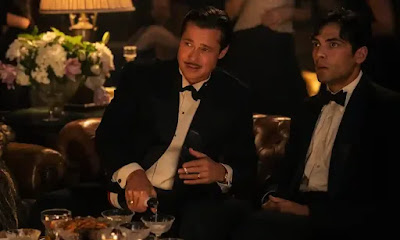
In fact, the irony is that the least corrupt characters are arguably the old-hands: Jean Smart's gossip columnist and Brad Pitt's kind-hearted old-fashioned silent star, loosely based on John Gilbert. They love the movies for what they are - honest working class entertainment providing an escape for the lonely and poor. Pitt's Jack Conrad gets one of the best scenes in the film when he tells his thespian fifth wife that the audiences a Broadway show pulls would be considered a flop in Hollywood. And it's heartbreaking to see him fail to make the transition to sound, and the toll this takes on him in his final scene. It's even more heartbreaking because we know that while Jean Smart offers him immortality in exchange for heartbreak, those early nitrate films barely survive and are rarely seen. It was a bum deal, and somehow Jack Conrad always knew it.
But Jack Conrad's self-managed exit from the stage isn't the films most heart-breaking moment. That is reserved for Jovan Adepo's jazz trumpeter Sidney Palmer. He starts the film at the aforementioned bacchanal and ends up benefiting from the move to sound films, earning vast amounts of money but at the cost of enduring patronising white folks at a fancy country club dinner where Nellie, perhaps viscerally expressing what Sidney is feeling, ends up projectile vomiting over the pretentious cunts who act as gatekeepers. Later, he will be asked by Manny (a fellow minority presence in Hollywood but in full denial of his ethnicity) to black up so that his face doesn't look too white on screen. No cinema in the South will show an integrated band. Manny, by this time fully a tool of the system, emotionally blackmails Sidney and tells him the whole band will be out of a job if he doesn't comply and you can see every calculation - emotional and logical - that Sidney goes through - and what it costs him - with no words but etched on his face as he plays the trumpet. It's a brutal scene that will stay with me for a long time. Thank Christ Sidney escaped to Harlem and got back his self-respect. But again, how sad for us and the film that he has to perforce leave our screens, yet another reason why its final hour is - with the exception of Jack Conrad's exit - woeful.
So this isn't a terrible film, as many reviewers would have you believe. It's a brave bold beautiful disgusting chronicle of a brave bold beautiful disgusting set of people who wanted to create art, make money and make us laugh and often exploited people - and themselves - in order to do so. Their aim, Chazelle's aim in highlighting what they endured, is noble. And if the film makes just one person pick up an autobiography of Clara Bow, or find an old clip of a silent film on BFI Player, then it's all worth it.
BABYLON is rated R and has a running time of 189 minutes.


