Showing posts with label war. Show all posts

Monday, May 30, 2022

OPERATION MINCEMEAT***


In 1943 the Allies were desperate to land troops in mainland Europe and open up a second front against the Axis powers, and the most obvious candidate was an amphibious landing in Sicily. The problem is that this was equally obvious to the enemy.  So, British counter-intelligence cooked up a cockamamie scheme to convince Hitler that the invasion would actually take place in Greece. The schemers did this by taking a dead Welsh man and floating him into harbour in Spain, disguised as a drowned Royal Marine Officer complete with locked attache case containing the fake plans. Why Spain? Because it was a technically neutral country filled with agents, double agents and triple agents, where the British felt they could map out the path of the fake intel all the way from Spanish fisherman to Hitler himself.  This operation was dubbed Mincemeat, and in Ben Macintyre's wildly popular non-fiction account of the ruse, he argued that it was the most successful intelligence operation in history. Who can tell? We can for sure say that by allowing the Allies to land on a less well defended beach, Mincemeat saved Allied lives.

This new film adaptation of the story is compelling when it sticks to the espionage plot.  John Madden (SHAKESPEARE IN LOVE) does a good job of telling a complicated story and while it does rather drip with British heritage derring do, it's not as jingoistic as it might have been.  Madden and screenwriter Michelle Ashford manage to add shades of nuance with the casting of Mark Gatiss as the potentially treasonous brother of the naval officer in charge of the deception (played by Colin Firth).  I wish they had explored this subplot further. Rather, they waste their time adding a fictional romantic triangle between Montagu - his nerdy colleague Cholmondely (Matthew MacFadyen - SUCCESSION) and their subordinate Jean Leslie (Kelly Macdonald - BOARDWALK EMPIRE).  I felt this love story was rather tacked on and artificial and simply distracted from the real meat of the story.  It was actually far more interesting to see what was happening in neutral but spy-ridden Spain and I was pleasantly surprised to see the rather frank depiction of how the British attache (Nicholas Rowe) was pleasuring his former handler into taking the bait. 

In the supporting cast I thought Jason Isaacs rather wasted in the role of the British military commander unimpressed by the Mincemeat plan. By contrast Johnny Flynn (EMMA) was having great fun as a young pre-James Bond Ian Fleming. But Penelope Wilton (DOWNTON ABBEY) was the real moral heart of the film as the secretary of the espionage unit.  The sight of her, on the eve of the Sicily landing, praying fervently in the office that the Germans had taken the bait, was genuinely moving and brought home the true stakes of the deception.

OPERATION MINCEMAT has a running time of 128 minutes and is rated PG-13. It is now on release in cinemas and on streaming services.

Sunday, October 31, 2021

49th PARALLEL***** - Pantheon Film Of The Month


49th PARALLEL aka THE INVADERS
is a fascinating piece of British propaganda from 1941, with a deeply nuanced view of World War Two, but ultimately arguing for the US to enter the war. It was created by the iconic pairing of Michael Powell (director) and Emeric Pressburger (writer) who went on to create masterpieces like THE RED SHOES.  Behind the lens, we have a young David Lean as editor and DP Freddie Young, both of whom would go on to collaborate on LAWRENCE OF ARABIA. And on screen, we have Laurence Olivier with a laughable Quebecois accent, as well as Leslie Howard (GONE WITH THE WIND) and the legendary Anton Walbrook.

The plot is radical insofar as it centres the narrative on a handful of Nazi submariners who come ashore in Canada and have to journey incognito to the US which is still neutral. On the way, they meet Olivier's Quebecois trapper who doesn't even know the war has started, and posits the radical idea that all men must have some goodness inside of them, for he wouldn't shoot Polish women and children. That said, as propaganda, the film is careful to show him as saying his loyalty is to Canada and thus Britain, not to France, as an ally of Germany. 

As the film goes on, the Nazis take shelter with a kind of German emigre mormon community, and one of them starts to question what they are doing, which again feels radical for a propaganda film and reflects all the nuance and humanity that Pressburger (an "enemy alien" - ludicrous - in Britain at the time). But as these things go, naturally the Nazis must come to a bad end, and show the valiance of the Canadians along the way. This is most eloquently and powerfully displayed in Anton Walbrook's monologue roughly half-way through the film, where he explains why immigrants left famine and persecution in Europe and came to Canada for peace, security, tolerance and freedom. It remains incredibly stirring stuff.  

It's equally impressive to consider how this film was made - partly funded by the UK taxpayer - filmed on location in Canada when travel was both restricted and dangerous - with an international cast of major talent, often working at half scale or donating their fees to charity. Freddy Young's black and white photography is superb and most of all, we have a score by Ralph Vaughan Williams. It is no surprise that this film was a huge commercial success, and apparently remains once of the highest grossing British film in the US of all time.

49th PARALLEL was released in 1941 and won the Oscar for Best Original Screenplay. 

Friday, October 06, 2017

JOURNEY'S END - Day 3 - BFI London Film Festival 2017


Saul Dibb (SUITE FRANCAISE, THE DUCHESS) has directed what is the stand out film of this year's festival to date, an adaptation of R C Sherriff's stage play JOURNEY'S END.  This powerfully tragic tale of men on the front line in World War One has been brought from stage to screen still depicting the claustrophobia and tension of trench warfare without ever feeling "stagey" or merely a west end show with a camera put in front of it. Rather, Dibb uses his Welsh location to good effect - his film beautifully depicts the mists rising above the trench, and one can almost feel the damp, stale air.  And his use of candlelight inside the dug-out is atmospheric and sometimes even beautiful. 

The movie begins with a naive new officer requesting to join C Company in St Quentin, France, just as the troops are rotated onto the front line. Raleigh (Asa Butterfield) is full of that Dulce Et Decorum Est spirit, but is shocked to find that his schoolboy mentor Stanhope (Sam Claflin) has become a superb commander but also a cynical and volatile alcoholic - something that Stanhope is painfully aware of and scared Raleigh will tell his sister, Stanhope's beloved.  Thus it falls to Stanhope's two junior officers to take Raleigh under their wing - there's the affable, modest, epitome of the stiff-upper-lip, "Uncle" (Paul Bettany) and the working class jovial Trotter (Stephen Graham).  The officers are rounded out by Hibbert (Tom Sturridge) - a ladies man who may or may not be faking neuralgia to get away from the front - something that Stanhope is not having anything of.

Much of the action takes place in and around the officer's dugout as they unwillingly accede to an order for a near-suicide mission to fetch intelligence from enemy lines; and then as the men face a heavy bombardment for the start of the German's Spring Offensive. I found myself physically tensing throughout, I was so involved in the fate of the characters. In such an intense environment, one sees Uncle adopt an air of calm indifference and studied bonhomie to offset Stanhope's nasty aggression.  And it's the play between the two that's really at the heart of this film.  If Bettany's performance is the most instantly likeable it's Claflin who steals the movie. There's a deep and desperate vulnerability to Stanhope that reasserts itself in the film's final scenes. It's a bravura and committed performance that deserves award season recognition. 

JOURNEY'S END has a running time of 107 minutes and played Toronto and London 2017. It will be released in the UK on Feb 2nd. 

Monday, October 07, 2013

HOW I LIVE NOW


HOW I LIVE NOW is a deeply odd film - half teen angst romance, half dystopian road movie.  In the first half, precocious teen actress Saoirse Ronan (ATONEMENT) plays the rebellious American teen Daisy who is shipped by her uncaring father to stay with her country bumpkin cousins in England.  At first, she's cool and aloof but is soon won over by their ramshackle charm - especially that of the brooding eldest son (and her first cousin) Edmond, played by George Mackay (SUNSHINE ON LEITH).  The backdrop to this sunkissed coming-of-age summer is an impending war.  What I really like is that because these kids are in the country, rather than in some sprawling urban metropolis, we're not seeing those standard shots of terrorist bombs in London. Rather, we're seeing fighter jets fly over head and small kids say, "wow, that's cool" before running off to a picnic.  

Once the war comes, the surrounding topsy-turviness allows Daisy and Edmond to have a taboo relationship and to commit, in their narcissistic teen angst, to make their way back to the farm if they are split up, which naturally they soon are.  What then follows is a kind of road movie through wartorn Britain, where we see the standard, rather lazy shots of cars overturned on motorways, and troops rounding up civilians.  There are hints at how the terrorists have brought England to its knees - and apparently much of Europe too - by poisoning the water supply, for instance.

Each part of the movie worked well enough on its own terms.  Ronan is a good enough actress to bring greater authenticity to the love story than the kids in TWILIGHT ever did.  And I liked the hints and glimpses of the dystopian England and found them to be truly sinister.  I even liked the fact that director Kevin Macdonald was allowing his heroine to be spiky and selfish rather than an instant maternal figure for her little cousin.  But the two halves of the film just didn't cohere.  And despite some strikingly gruesome visuals, I never felt the heroine was in genuine peril - or at least enough peril to make the final road movie genuinely thrilling.

All in all, a rather disappointing film, then - bulging with interesting ideas but lacking in follow through. 

An audio review of this movie is available below:


HOW I LIVE NOW has a running time of 101 minutes and is rated 15 in the UK. It played the Toronto Film Festival in 2013 and is currently on release in the UK, Ireland and Hungary. It will be released in the USA and Russia on November 8th, in Greece on November 14th and in France on February 19th. 

Sunday, October 14, 2012

London Film Fest 2012 - Day 5 - THE SAPPHIRES


So I went to what I thought was going to the press screening of the Sundance acclaimed John Hawkes starrer, THE SESSIONS, but it turned out I was actually at the press screening for THE SAPPHIRES.  My bad, but ins way good, because it meant I came to the film without a clue, with no preconceptions, and totally open to it. And what a ride it was!  Because while dressed up in the narrative structure of a romantic comedy, this movies just unique:  telling the true story of a 1960s Aussie aborigine girl band and their feckless Irish manager performing soul music for the US troops in Vietnam.


The result is a genuinely funny, feel good movie that's full of great tunes, but that doesn't gloss over the grim politics of the time: he racism towards Aborigines, and African Americans, and the horrors of Vietnam.  It even touches on perhaps the most shameless chapter in Aussie history, when fairer skinned Aborigines were forcibly separated from their parents and "civilised". 

Kudos to Aussie director Wayne Blair and to writers  Tony Briggs (real life son of one of the Sapphires) and  Keith Thompson for finding that perfect balance between joyful energy and political awareness.  I also thought the production design of wartime was impressive, particularly given the film's low budget. In front of the camera, Chris  is utterly charming as the Irish manager - seriously, is he the most charming man in cinema today?  And as the four girls, Deborah Mailman, Jessica Mauboy,  Shari Sebbens and Miranda Tapsell all do a fine job.

Of course there are gripes.  The girls often resolve arguments by singing, even in the much flagged unescorted drive to a gig, the sense of peril is never that high, and more often that not it's painfully obvious that the girls are lip synching.  Still, it's testament to the film's energy and joy that one of that bothered me too much.

THE SAPPHIRES played Cannes, Toronto, Telluride and London 2012. It was released earlier this year in Australia and France and is currently on release in New Zealand. It opens in the UK and Ireland on November 7th, in Germany on February 7th and in the Netherlands on 21 February 2013.

Saturday, October 23, 2010

London Film Fest 2010 Day 11 - ROUTE IRISH


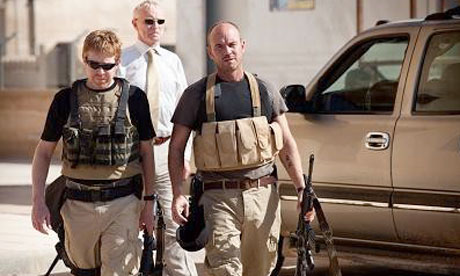
Ken Loach is one of Britain's most uncompromising directors. His films are political, unblinking, and have a relentless focus on the reality of working class life. Even his most recent film, a comic fantasy called LOOKING FOR ERIC, was firmly rooted in the everyday petty humiliations and victories of life as a postman in a Northern town. It was, then, only a matter of time before Ken Loach gave us his take on the war in Iraq. And with his typical perception for what is at the core of an issue, he goes straight for the one truly unique facet of this war - the widespread use of mercenaries. This outsourcing of state-power - this compromise of the idea that in liberal democracies the elected government is the only legitimate source of violence - because it is only the government that can be held to account for its abuse - is absolutely key to understanding Iraq. It is the abuse of this power, widely reported in the more thoughtful media, that serves as a kind of short-hand for all the abuses of power that have come to characterise the war in Iraq. Power abused, violence unchecked, and all for no end other than the perpetuation of power and the amassing of wealth.

Unfortunately, the insights that Loach and his regular screen-writing partner, Paul Laverty, bring to the Iraqi war have not resulted in a compelling film. In fact, I found ROUTE IRISH to be near unwatch-able - it fails as a thriller; it contains a truly risible love story; and suffers woefully from the heavy-hand of didactism.

The story begins with the death of a mercenary called Frankie on Route Irish - the road from Baghdad airport to the Green Zone. His best friend Fergus, also a squaddie turned gun for hire, decides to investigate the death, convinced that the company they worked for is covering up foul-play. Fergus investigates with the help of Frankie's widow, Rachel, and the translating skills of a local Iraqi refugee. Sure enough, the video on the phone is compromising.

Let's break down why the film fails. First, it fails as a thriller. We all know the mercenaries will have committed some heinous crime against innocent Iraqi civilians and Frankie too - after all, we've all seen wikileaks and it's not like Ken Loach is going to side with the neo-cons, is it? Second, it fails the test of simple logic. Once Fergus finds the damning video, why doesn't he put it on the web? This is what his Iraqi helper tells him to do. It's what Rachel tells him to do. Fergus refuses. He says he wants to get more, better evidence. But we know what's really going on. Loach and Laverty want to extend the film - draw out the narrative - so that they can show Fergus' moral disintegration - show him resorting to torturing a witness. Or whatever. Simply put: in the age of Wikileaks, I can't take any movie seriously that doesn't just dump the evidence on the web as soon as possible.

This brings us to the central failing of this film: the lack of emotional grip at its heart. After all, in a world of wikileaks - years after Brian de Palma's REDACTED - what can a movie like this really teach us? Nothing about the facts. Anyone who wants to know can find out. So the reason to watch a movie like this can only be because empathy with well-written characters can teach us something about ourselves and give us an emotional insight that mere documentary evidence cannot give. But ROUTE IRISH fails on that score too. It's characters are too crudely, thinly drawn to be of interest. I didn't buy into Fergus. I didn't buy into his slow decline into torture. And I certainly didn't buy into his clichéd relationship with Rachel. Mark Womack (Fergus) portrays anger, frustration and guilt by shouting loudly. Andrea Lowe is wooden and two-dimensional as Rachel. The casting of British stand-up comedian John Bishop as Frankie is a distraction.  Too little space is given to the Iraqi refugees. Most damning, one of those characters actually asks Fergus why he is obsessed with the death of one Brit when so many Iraqis are dying. Isn't it just another act of chauvinism to have another film from a Western point of view? Loach never answers this point.

ROUTE IRISH is, then, a complete failure. A failure in execution at every level. I was sadly disappointed.

ROUTE IRISH played Cannes 2010 and was released in Norway in September. It will be released in France on March 16th 2011.

Monday, March 22, 2010

GREEN ZONE - too simplistic, too late

GREEN ZONE is Matt Damon and Peter Greengrass' risible attempt to sucker the fanbase of the BOURNE films into watching a movie with a more avowedly political subject matter. Which just goes to show that the mainstream audience isn't that dumb. Just because it's got shaky handheld camera work and Matt Damon running around looking earnest and puzzled, doesn't mean that a movie is suspenseful or fundamentally politically interesting. I think the basic problem with GREEN ZONE, other than that it's not BOURNE 4, is that it's trying to make something we now taken as read look interesting. Yes, yes, it's a crying shame that we were taken into war in Iraq on the false premise that the Iraqis had weapons of mass destruction. But, seven years later, I think the public is too jaded to really care. We were lied to - we're in a mess - now what? Kathryn Bigelow broke through the apathy with her micro-psycho take on the archetypal figure in a street-fighting war - the bomb disposal expert. Her film, THE HURT LOCKER, was tense, but also took us into a side of the war that we genuinely might not have know about before. But GREEN ZONE, for all its earnest good intentions, tells us nothing new, and shows us nothing new. Roger Ebert says that GREEN ZONE looks at war in a way no other war film has, insofar as the US is the dupe not the hero. I beg to differ. Hollywood has been making great films about the vicious lie at the heart of most wars for decades, not least about Vietnam and more recently with THREE KINGS. Ebert also damns with praise here: "By limiting the characters and using typecasting, he [Brian Helgeland] makes the deceit easy to understand". Respect to Ebert, but no. If you have to debase yourself with typecasting, then you're just not up to the job. And at any rate, this film really just isn't that complicated. The trick missed is to show the personal human price paid. As THE HURT LOCKER took inside the insane world of the lead character, we should've seen more about how a stand-up guy like Damon's CWO Roy Miller would've reacted psychologically to realising that he'd been duped. What happens when the naive man grows up? That to me is more interesting than how fast and where he runs around.

GREEN ZONE is on release in Australia, Kazakhstan, Russia, Singapore, Canada, Finland, Indonesia, Norway, the Philippines, Spain, Sweden, the UK, the USA, Egypt, Germany, Kuwait, Switzerland, and Austria. It opens this weekend in Denmark, South Korea and Estonia. It opens on April 14th in Belgium, France, Argentina, the Netherlands and Brazil. It opens in Italy on April 23rd, in Turkey on April 30th, in Japan on May 14th, in Hungary on June 3rd and in Poland on June 4th.

Monday, December 14, 2009

AVATAR - you can have too much of a good thing

AVATAR is the much hyped new film from writer-director and special effects obsessive James Cameron - the man who brought us TITANIC, ALIENS and TERMINATOR. Let us say that James Cameron has consistently pushed forward the technology of film, and has produced consistently thoughtful sci-flicks. Indeed, I would argue that he deserves more kudos than Spielberg - creating fewer but more consistently entertaining and polished blockbusters. But let us also admit that Cameron is the master of hyping himself, and has saddled us both with Celine Dion and with a 130 minute movie of arse-numbing proportions.


First, the praise. AVATAR is a technical marvel. Not because it does anything new - rather, it pulls together all of the advances of the last five years and pushes them further and does them better than anyone else. The 3-D is immersive rather than trying to shock us. The CGI is photo realistic. The characters and animals have weight and heft. The natural science detailing on the plants and animals is breathtaking. Fantastic creatures seem real. It is easy to mock a director who goes to the lengths of actually inventing a new language for his fictional race, the Na'vi. But it works. Much like LORD OF THE RINGS, AVATAR works because it makes us believe in an alternate world, and through believing, we care about its future.

AVATAR is also tightly structured and directed so well that it maintains momentum throughout its runtime (which is not to say it couldn't have done with being a good forty minutes shorter). Cameron may be a master of CGI but he never forgets that story comes before technical wizardry. The movie plays a three-act drama. We are in a dystopian future where humans live on a dieing world, and have colonised a planet called Pandora, in order to mine a precious metal, whose main deposits lie underneath the "hometree" of the indigenous Na'vi people. In Act One, the audience invests its sympathy with the hero and heroine. A disabled jarhead pilots an avatar Na'vi body in order to infiltrate the tribe and negotiate a relocation by any means necessary. Problem is, he becomes fascinated by their respect for nature and falls for a Na'vi chick. In Act Two, the stakes are established. The army, impatient for profits, decimates the hometree, scattering the Na'vi people, and destroying their trust in the Jarhead. The science team establish that the whole ecosystem of the planet is connected and a powerful source of energy. In Act Three, we have the dramatic climax and resolution. The Na'vi regroup and with their human allies take on the colonials.

The strength of the AVATAR story is that James Cameron knows who to weave successful aspects of genre fiction into his more modern allegory of environmental degradation and ruthless military exploitation. We have a good old-fashioned romance between the jarhead and the Na'vi chick. We have a coming of age story, as the jarhead learns the rules of the new world. We have a buddy movie as the jarhead bonds with the science officer. And finally, we have a spiritual story of redemption. I love the fact that Cameron is willing to tackle both issues of science, politics and religion in the same film - to that end, it reminded me a lot of the better aspects of Ronald D Moore's BATTLESTAR GALACTICA.

Given all these positives, it isn't a surprise that I had a good time watching this flick, even though it did seem just too long to spend in a cinema for what should just be a bit of entertainment, albeit intelligent entertainment.

But there are negatives. AVATAR features some of the most hokey dialogue and two-dimensional characterisation seen on film since STAR WARS. And maybe that's no coincidence. Maybe when a writer-director is having to balance different genres, a large cast, action, technology and romance, it's just too much to ask to have good dialogue and nuanced characterisation too? But then again, BATTLESTAR GALACTICA did, by and large, pull that off. One of the strengths of that series was its ability to present conflicted characters who changed, evolved, and felt three-dimensional. By contrast, in AVATAR, you're either a righteous hippie earth-child or a cigar-chomping, profiteering rat-bastard. And characters say the stupidest things. Towit, jarhead to Na'vi chick: "why didn't you kill me?" Na'vi chick to jarhead: "Because you have a big heart." I mean, no-one, not enough imaginary aliens, speaks like this! There's also something slightly hypocritical in a movie that thinks nasty evil people who blow shit up are bad, but nevertheless wants us to be excited by a final act which is basically about people blowing shit up in more and more noisy ways.

Ultimately, AVATAR is such a feat of imagination that, like STAR WARS IV: A NEW HOPE, it survives the hammy dialogue and weak characterisation. It's nice to spend time in this world. It would've been even nicer to have been all done in two hours.

AVATAR is on global release.


Wednesday, November 25, 2009

Preston Sturges Retrospective 6 - HAIL THE CONQUERING HERO

HAIL THE CONQUERING HERO! is a movie that prefigures films like THE FLAGS OF OUR FATHERS but is all the more impressive because it was made while World War Two was still raging and because, in contrast to Clint Eastwood's earnest dirge, it dares to treat its subject comedically. Preston Sturges is arguably at his most political in the tale of a young soldier called Truesmith (Eddie Bracken) who is demobilised on a humbug and confused for a war hero. Pretty soon, egged on by "Sarge" Heffelfinger (Sturges regular William Demarest), Truesmith is the town hero. His mother's mortgage has been paid, and he's being offered the mayorship.

Despite its superficially syrupy concerns - the love story with the hometown sweet-heart - the humility of the naive protagonist - HAIL THE CONQUERING HERO is one of the most subversive movies ever made, especially when you consider the timing of the release. Preston Sturges satirises everything that makes up the iconic American ideal - smalltown values, sentimental treatment of the family home, hero-worship, and the ease with which the democratic political process can be corrupted. The dialogue is razor-sharp witty but also dangerous! A perfect combination.


HAIL THE CONQUERING HERO was released in 1944 and was nominated for a Best Screenplay Oscar in 1945 but lost to biopic WILSON.

Wednesday, October 14, 2009

London Film Fest Day 2 - THE MEN WHO STARE AT GOATS - A Funny Idea In Search Of A Plot

From the producer of GOOD NIGHT, GOOD LUCK and the writer of SIXTY SIX, comes a directorial debut that is uneven, misguided and ultimately unengaging, despite occasionally very funny scenes indeed.

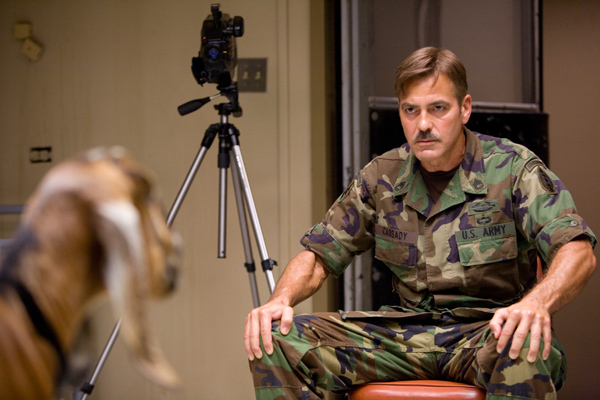
The film is about as convincing as Ewan MacGregor's dodgy American accent. He stars as a naive young journalist who goes to Iraq when his wife dumps him. He takes up with a strange man called Lyn (George Clooney in a "trying-to-be-goofy" moustache). Lyn used to be part of a secret US military programme that was training soldiers to use paranormal powers (mind-bending) and so become "Jedi". The title of the film comes from an experiment whereby the Jedi soldiers would try to kill a goat by staring at it. As the Jedi and his acolyte cross Iraq looking for the US Army psych-op/PR-op base, the movie periodically flashes back to the story of how this bunch of kooks got government funding and were ultimately taken down by a cynical soldier jealous of Lyn's power (Kevin Spacey.)

Now, given the sheer ridiculousness of the premise, we could have had a seriously wacky, funny movie. People might reference the Coen Brothers because of Clooney, but I could imagine Guy Ritchie in the old LOCK-STOCK days handling the voice-over and the freeze frames brilliantly. Sadly, director Grant Heslov has neither the flair nor the confidence to pull off the kind of bravado-film making needed to sell such a ludicrous (even if true) concept.

As for the modern day footage in Iraq, as I said before, Ewan MacGregor is mis-cast, while Kevin Spacey and Jeff Bridges are type-cast as the Antagonist and The Dude respectively. The plot seems to meander aimlessly, just like their journey in the desert. Worse still, when Heslov does try to show something serious - something that's meant to shock - like an IED explosion or incarcerated, tortured Iraqis - the scene is trivialised by the surrounding ludicrous material.

The upshot is that this is a movie that works neither as a comedy nor as a provocation about the war in Iraq.

THE MEN WHO STARE AT GOATS played Venice and Toronto 2009. It will be released on November 6th in the USA: November 19th in the Netherlands; December 4th in the UK; December 24th in Slovenia; January 2010 in Italy, Sweden, Switzerland and Norway; February 2010 in Turkey; and in March 2010 in Germany.

Wednesday, October 22, 2008

London Film Festival Catch-Up - MIRACLE AT ST ANNA

MIRACLE AT ST ANNA is a big, baggy war epic about the African-American experience in World War Two. Writer-director Spike Lee tackles big themes intelligently and just about keeps a hold of all the complex material in the movie.

The key question the movie asks is what stance African-American soldiers should have taken during the war. After all, in the US they were facing extreme racism - as shown in a pivotal scene in the centre of the film in which German POWs are treated better than African-American serving officers. And even when they were fighting, we see white commanding officers treat the African-American troops with disdain - actively putting their lives at risk because they fundamentally don't accord them the same value. So how far should the African-American soldiers identify with and support the war effort? The argument is played out in the conflict between Bishop Cummings (Michael Ealy) and Aubrey Stamps (Derek Luke). Bishop is in the war for what he can get - which is a good time where possible. He isn't going to try to get on with his white senior officers. By contrast, Stamps sees the war as a means to self-advancement. He wants to do well and get ahead, believing that the war will fundamentally change attitudes back home.

A second question the movie deals with is how far we should take direct action for a just cause when innocent people will be hurt by it. The Italian partisans in the movie are fighting against the Germans, but the villages they hide out in are subject to vicious retaliation. The partisan leader, Peppi Grotto (Pierfrancesco Favino) feels immense guilt for having indirectly caused the massacre of innocent villagers.

The third question the film deals with is the question of faith. Throughout the film, one of the most apparently dim-witted of the soliders, Sam Train (Omar Benson Miller) believes that the marble statue that he is carting around is a lucky charm. It's easy to mock train because he's such a dolt, but the statue does serially provide a sort of protection to whoever is holding it. It even allows one of the soldiers to survive the campaign and live to a ripe old age in New York when, in the movie's framing device, he finally takes revenge on the partisan who betrayed them.

The guts of this film are well executed and intelligently told. Spike Lee is at his best when he's confronting the subtle tensions in race politics. But there's too much romantic sentimental jibberish that muddies the movie. Most egregiously, the relationship between Train and a little Italian boy he's taking care of is sweet - and speaks to the mythology of the statue - but is deeply distracting. It's also weird that in a movie of subtle conflicts and flawed characters, Spike Lee has created a mythic simple-minded good guy. Train seems two-dimensional compared to everyone else in the film. The second major flaw is the denoument - which is pure unadulterated schmaltz that seems about as realistic as the final scene in Shawshank (which I think everyone agrees was unnecessary.)

MIRACLE AT ST ANNA played Toronto and London 2008 and was released last month in the US.

Wednesday, October 15, 2008

London Film Festival Day 1 - FROST/NIXON never convinces

You should marry that woman. She comes from Monaco. They don't pay any taxes there.FROST/NIXON never convinces in its assertion that the 1977 TV interview between the British talk-show host and the disgraced ex-President was a pivotal moment of catharsis for the US public. Indeed, playwright and screen adaptor Peter Morgan (THE QUEEN) diminished his case by pandering to the “all or nothing” school of melodrama. It’s not enough that Nixon is fighting for rehabilitation and Frost is fighting for his reputation as a serious journalist. Nixon must be seen as a man on the psychological edge – making drunken midnight telephone confessions. Frost must be seen a playboy dilettante who stands to lose all his TV shows and his personal fortune if the interview is a failure. Moreover, in a particularly crude narrative choice (whether based in reality or not), Morgan decides to give Frost a third-act montage (so beautifully spoofed in TEAM AMERICA WORLD POLICE) wherein the talk-show host goes from zero knowledge or interest in the mechanics of Nixon’s skulduggery, to uncovering deep truths thanks to a bit of all-night study and black coffee. I also found it implausible that years after the scandal broke; a single document in a public library would be uncovered and force the confession of a President.

Despite all this, the film does get near to an emotional truth. Nixon finally confessed to the cover up because he was tired of lying. Not because of Frost’s new found skill as a crack cross-examiner. The film also gets near to an even more important and significant truth: that Nixon was tremendously insecure; resented the way in which elites bent the rules (notably JFK’s dubious presidential victory); and thought that was simply how you had to play the game. The tragedy is that he was a hard-working and intelligent man who had tremendous insight into Cold War relations but that he made poor decisions because paranoia and a sense of entitlement had trumped his personal morality.

Frankly, I don’t think you needed to artificially inflate the importance of the Frost-Nixon interview; the stakes for David Frost; or the importance of that final shred of evidence (all very Perry Mason). You certainly didn’t need to make some sort of cod psychological link between Frost and Nixon as insecure boys-made-good who’ll never quite be accepted by the establishment. Nixon is the story and when this movie focuses on Nixon it’s brilliant. Frank Langella’s performance is captivating. But frankly, there’s too much dancing around until we get to it.

FROST/NIXON opened London 2008. It opens in the US on December 5th and in Australia on December 26th. It opens in Spain and the UK on January 9th; in Belgium and France on January 14th; in Finland on January 23rd and in the Netherlands on January 29th. It opens on February 6th in Sweden and Norway and on January 12th in Germany, Hungary and Denmark. It opens in Argentina on February 19th.

Tuesday, September 30, 2008

ALEKSANSRA / ALEXANDRA - alpha gamma agit-prop

ALEXANDRA is the latest movie from Russian auteur Aleksandr Sokurov, known in the West, if at all, for his movie RUSSIAN ARK. RUSSIAN ARK is a technical tour-de-force - a feature-length movie comprising a single tracking shot that winds it way around the Hermitage. Technical achievement aside, RUSSIAN ARK is a surreal and evocative work that manages to capture something of the shifting use and symbolism of that building and with it, the shifting social and political life of Russia itself. The slow steady camera movement, lack of conventional narrative, and snatches of brief conversations work well in RUSSIAN ARK. The simulatenously tight and loose structure leaves the audience space to work out the meaning of the film.

Sokurov's latest film, ALEXANDRA, adopts some of the same techniques as RUSSIAN ARK but without the technical conceit. As with RUSSIAN ARK we have a focal character who ambles through a set without much purpose or direction - alighting on conversations here and there - allowing us to weave our own narrative. The French marquis of ARK is replaced by an indefatigable grandmother, Alexandra, who is visiting her grandson at an army camp in Chechnya. She wanders around, asking basic questions of officers and grunts, shuffling into town, taking tea with the locals, and shuffling back. The movie shuffles about too, almost listless in the perishing heat of the desert, and drowned in sepia-tint and a rather mawkish orchestral score.

At first, I was frustrated by the lack of pace and purpose in the film, but after half an hour or so I was lulled into its somnabulent pace and tuned my eyes and ears to the small details that Alexandra was picking up on: the terminal exhaustion, constant hunger and grim resignation on both sides of the war. And, as Sokurov makes clear, this isn't just about the Chechen war but war in general. Sometimes it takes an obstinate, simple woman to ask the obvious questions and point to the painful truth of a situation - the reality behind jingoistic Russian nationalism. Finally, I found myself if not quite enjoying ALEXANDRA, at least admiring its intentions and innovative style. As a cineaste, it was definitely worth watching, but the occasional viewer may find it a stretch.

ALEKSANDRA played Cannes, Toronto and London 2007. It was released in Greece, France, Belgium, Russia and Poland in 2007. It was released earlier this year in the Netherlands, the US and Turkey and is currently on release in the UK.

Tuesday, September 16, 2008

LADIES IN LAVENDER - soporific schmaltz

Yes, yes, Dame Judi Dench and Dame Maggie Smith are simply marvellous actresses and it's interesting to see Charles Dance turn his hand from acting to directing. It's even rather nice to seen a costume drama set, not in a country house, but in a charming cottage on the English coast. But oh my word, this movie takes a long time to make it's rather slight emotional point. The bat's squeak of emotion barely survives the two-hour run-time.

The plot, such as it is, involves a young Polish man (Daniel Bruehl in a thankless role) who is washed up on the English coast in the middle of the last century. He is taken in by two old spinsters. The elder (Maggie Smith) is kind but reserved. The younger (Judi Dench) forms a strange attachment to the young man, becoming irrationally jealous when he forms an attachment to a young German woman (Natascha McElhone). It turns out that Judi Dench's character is trying to recapture a youthful passion. This is all very sad, but frankly, not enough to set the world alight, and certainly not enough to engage my sympathy or interest.

LADIES IN LAVENDER played Toronto 2004 and was released that year. It is available on DVD.

Monday, July 21, 2008

CSNY DEJA VU - Neil Young throws down again

CSNY DEJA VU isn't a movie about forensic scientists, as one colleague of mine erroneously believed. It's a documentary by and about Neil Young - legendary folk-rock musician, political protester, and all round rebel. As part of Crosby, Stills, Nash and Young, he wrote one of the best known and most heart-felt rock anthems of all time - "Ohio". Nearly forty years later, it's a different war but the same old fear and loathing, and Neil Young is angry. So angry that he dashed off an album, "Living with the war", in 2006, corralled his old band-mates, and hit the road again. The band are under no illusions about their capacity to inspire a political movement. Moreover, they know that in many cases they'll be preaching to the choir. What they want is to get the choir off their asses.

The tour starts off looking creaky - much like the sixty-something band members. Worse still, as the band moves to the south, they get nervous about the reaction they might get to songs with lyrics such as:

"Let's impeach the President for lying / And misleading our country into war
Abusing all the power that we gave him / And shipping all our money out the door

Let's impeach the president for hijacking / Our religion and using it to get elected
Dividing our country into colors / And still leaving black people neglected."

As you might imagine, the band are greeted with as many boos as cheers. Plenty of people resent having politics forced on them for the price of a $100 concert ticket. But the reaction, as chronicled by ABC embedded war reporter Michael Cerre, isn't universally negative. There are plenty of war veterans who feel that CSNY articulates their angst.

Now, I'm a great Neil Young fan, and I agree wholeheartedly with his views. But the documentary felt cobbled together and never gained traction with me. I couldn't help but wonder if it would have been more effective as a straightforward concert film, along the lines of Jonathan Demme's HEART OF GOLD. These songs are so effective, and their staging to powerful, that I may well have been more moved by hearing them through without the video diary interruptions.

CSNY DEJA VU played Sundance and Berlin 2008 and is currently on release in Germany and the UK. It opens in the US on Friday.

Sunday, July 20, 2008

STANDARD OPERATING PROCEDURE - brutal, brilliant documentary

This is not prisoner abuseSTANDARD OPERATING PROCEDURE is a documentary about the Abu Ghraib torture and prisoner abuse scandal. It is directed by Errol Morris - the film-maker who brought us a stunningly candid interview with former US Defense Secretary, Robert McNamara. Morris' documentary, THE FOG OF WAR, allowed McNamara to walk us through his decisions to escalate the war in Vietnam. It transformed my rather thin understanding of the period, and my prejudice against McNamara, into empathy and sympathy. Part of the reason why THE FOG OF WAR was such a good documentary was that Morris allowed his documentary subject the room to feel comfortable and be himself. Moreover, in sharp contrast to the high-concept documentaries of Michael Moore, Morris' doesn't loom large over his films. The subject is centre stage and the documentarian is as neutral as possible.

Those sterling qualities are what make STANDARD OPERATING PROCEDURE a tremendous film. Morris goes straight to the people at the heart of the biggest moral quandries of our time and gives them a comfortable environment in which to explain themselves. There's no hectoring, no crude politics - people are left to damn themselves with their own excuses or gain our sympathy in turn. The subject matter is also similar to THE FOG OF WAR. McNamara is a poster-boy for liberal hate for his involvement in Vietnam. Lynndie England, Charles Graner, Sabrina Harman, Ivan Frederick, Megan Ambuhl et al are even more notorious as the cocky, smiling sadists, posing with Iraqi prisoners in humiliating sexual positions for their own kicks.

Morris interviews many of the key participants, though not Charles Graner, who seems to have been the ringleader, because he's still in jail. Morris wants to get behind the infamous photographs. Photos don't lie, but they are simply a snapshot. You don't see the before and after, the cajoling, the nervousness, the regret or the defiance. So he just turns the camera on the people involved and lets them calmly explain what was going on when the photographs were taken, inter-cutting this with the actual footage, re-enactments, and a subtle score from Danny Elfman.

Lynndie England feels very strongly that she was the victim of the cajoling of her domineering boyfriend. She makes excuses but doesn't seem particularly contrite. She regrets her life being ruined so young, but does she really recognise why people were so horrified? Doesn't seem so. Megan Ambuhl and Javal Davis make exuses too. Then again, they come across as more cogent. You get the feeling that they knew what they were doing wasn't morally correct but that they had reasoned that in "the fog of war" all gloves are off. Sabrina Harman, on the other hand, does seem to regret what happened. She seems to acknowledge that she crossed a line: that at some point, she knew she had done wrong and that she was going to be punished. The only person who I felt genuinely sorry for - apart from the Iraqis, of course, was Janis Karpinski - the commanding officer at the prison. She comes across as a woman of real integrity and honour who was treated very poorly by the hierarchy eager to be seen to react.

Watching STANDARD OPERATING PROCEDURE is a brutal experience because you are constantly exposed to gruesome footage of people being sadistic and then making excuses. You're seeing humanity at its worst. But what's even more shocking is that, in the final analysis, these US soldiers - some of them very young - some of them clearly under the impression that their behaviour was sanctioned - were hung out to dry. And, after all, aren't they partly right? The photograph shown above wasn't one for which they were prosecuted. No. This wasn't "prisoner abuse". This was Standard Operating Procedure. This was sanctioned. And if we've fallen to the point where this is allowed, who's to judge what isn't?

STANDARD OPERATING PROCEDURE played Berlin 2008, where it was the first documentary to be nominated for the Golden Bear. It was released in the US, Germany and Belgium earlier this year. It opens this weekend in Australia and on July 18th in the UK.

Friday, June 27, 2008

LES FEMMES DE L'OMBRE / FEMALE AGENTS - straightforward recreation of wartime heroism

Start the war with the Germans, finish with the English - a typical French attitude!FEMALE AGENTS is a no-nonsense World War Two spy thriller. The film-makers don't try anything fancy in terms of visual style, narrative structure or performances. However, the true story upon which the film is based is interesting enough to maintain interest throughout the two hour run-time.

Five young French women are recruited by the British secret service to rescue a geologist from a German military hospital. It is imperative that they do this before the Germans realise that he has been surveying the beaches of Normandy before the D-Day landings that will liberate Europe. It is crucial that the Germans continue to believe that the main invasion will come at Calais. The agents rescue the geologist easily enough, but then have to assassinate the German soldier who has extracted his secret. There are several attempts in a beautifully recreated wartime Paris, culminating in a very effective final showdown in a misty train station.

FEMALE AGENTS works well as a thriller but I like it even more for the fact that its protagonists aren't simple caricatures but real people with conflicted motives and developing characters. The ending may have been a touch sentimental, but I was so carried away by the film that I felt it utterly justified.

FEMALE AGENTS was released in France and Belgium earlier this year. It is currently on release in the UK and opens in the Netherlands in October.

Friday, June 20, 2008

THE EDGE OF LOVE - Keira Knightley rises to mediocrity

Never ask for directions in Wales, Baldrick. You'll be washing spit out of your hair for a fortnight.Hard-drinking, womanising poet fucks wife and ex- in Welsh squalor. Cuckolded husband understandably pissed off at funding menage a trois while fighting WW2, returns with psychological trauma and loaded gun. Cillian Murphy phones in perf. as English cuckold; Matthew Rhys suitably charming as Dylan Thomas; Keira Knightley surprisingly not a disaster as The Ex, including plausible Welsh accent; Sienna Miller steals show as discarded wife despite complete lack of Irish accent. Highlight of film is close-up of Miller cryng, book-ending scene wherein she is betrayed. Other 100 minutes desperately dull despite visual flourishes.

THE EDGE OF LOVE is on release in Ireland and the UK. It opens in Australia in August and in New Zealand in October.

Saturday, May 31, 2008

Random DVD Round-Up 3 - BATTLE FOR HADITHA

BATTLE FOR HADITHA is Nick Broomfield's recreation of the infamous incident when US marines killed 24 Iraqi civilians after one of their own had been killed by a roadside IED. The movie is a fictional recreation that tries to look as much like a documentary as possible - following in the footsteps of Broomfield's GHOSTS and Paul Greengrass' UNITED 93. I was impressed by Broomfield's careful examination of the issues and his balance in analysing the motivations of the marines, the insurgents and the local residents. He has created a film that has less immediate impact that Brian de Palma's searing REDACTED, but poses more painful questions and has, perhaps, a more long-lasting emotional impact.

The movie has three strands. The first follows the US marines. Their motivations for enlisting vary from merely escaping poverty to those that like to "hunt". They are patriotic, yes, but more than that, loyal to their friends. When they see one of their own blown up, they want revenge. The means by which they exact revenge are brutal and indiscriminate but, on the day, they are praised by their ranking officers for having "kept their heads". Only later, when the events are exposed on TV, are the marines indicted for murder. Broomfield therefore poses the crucial question of who bears responsbility. Were the soldiers really just rogue? Or were they following Standard Operating Procedure sanctioned from the very top? Broomfield shows us clearly just how savage the marines have been. But he also shows the pressure they are under, the training they have received, and the guilt they feel after the event.

The second strand focuses on the two insurgents who plant the bomb. I was surprised by the fact that insurgents don't look like the image I have of Al Qaeda extremists. Rather, these two men look relatively westernised, drink and watch videos and they themselves view Al Qaeda as nutters. The elder of the two is ex-Iraqi army, angry at the US for having dissolved his regiment, paid him off and then destroyed his country. They perceive the US as using Iraq as a cash-cow - handing lucrative contracts to US corporations rather then employing local people. Once again, Broomfield shows scrupulous balance. He condemns the men as bombers, and while they evidently feel guilty about the Iraqis who have died, they still go on to use an orphaned girl in a propoganda video.

The third strand focuses on the local residents. I found this the most fascinating because news stories rarely focus on the bystanders. In fact, they are not passive victims but also face a profound moral choice. If you see insurgents planting a roadside bomb what do you do? Tell the US, and face the wrath of the insurgents, or let the bomb explode, and face the wrath of the US?

Altogether, BATTLE FOR HADITHA is an impressive, even-handed treatment of delicate and complicated issues. It's an important, well-made movie that deserves a wide audience.

BATTLE FOR HADITHA played Toronto and London 2007. It was released in Spain in 2007 and in France, the UK, Poland and the US earlier
this year. It is now available on DVD.

Friday, May 30, 2008

Random DVD Round-Up 2 - LAKSHYA / PURPOSE

Main Aisa Kyu Hoon?Farhan Akhtar's first film was the light-hearted but realistic romantic comedy DIL CHAHTA HAI. He returned in 2004 with an altogether different film - LAKSHYA. The film follows a young spoiled man (Hrithik Roshan) who has no motivation or purpose in life, much to the annoyance of his family and his politically aware girlfriend (Preity Zinta.) He joins the army, quits, but is shamed into returning. Inspired by his commanding officer and acquiring a new sense of patriotism he ends up fighting in the notorious Kargill incident.

LAKSHYA deserves praise on many fronts. First, the hero and heroine are fully-rounded characters that show real development as the movie progresses. Preity Zinta has the chance to portray a strong, independent, modern woman - a chance that is all too rare in Bollywood. She gives a good natural performance. But the stand out is Hrithik Roshan as the hero. He makes the transition from love-able fool to man of integrity believable. Added to that, he performs one of the stand-out pieces of dance in modern Hindi cinema - the award-winning routine to the song Main Aisa Kyun Hoon. I was watching a Shah Rukh Khan movie recently just after watching Lakshya and realised just how far ahead of the other Bollywood heroes Hrithik Roshan is. Some actors can dance okay - some actors can act really well (not least Saif Ali Khan) - but few combine the two skills.

LAKSHYA is also a great technical achievement for Hindi cinema. The film-makers seem to have paid a lot of attention to the mechanics of the battle and DP Christopher Popp uses awesome crane shots to depict the mountainous terrain of Kashmir. The Indo-Pakistani border has never looked so magnificent. But what's really great is that the cinematography isn't just there to look pretty but to make a point about the strategic importance of the hill that Hrithik's troops are trying to retake.

Perhaps the only possible criticism of this film is that it is definitely trying to inspire patriotism and some might find that a little manipulative or xenophobic. However, I believe that LAKSHYA stays firmly on the right side of the line between patriotism and jingoism. It's certainly a lot less bombastic than the bloated J P Datta epic, LOC KARGILL.

LAKSHYA was released in 2004 and is available on DVD.