Showing posts with label russia. Show all posts

Saturday, October 05, 2019

CITIZEN K - BFI London Film Festival 2019 - Day Three


Acclaimed documentarian Alex Gibney returns to the festival with his film about Putin's transformation of Russia from flawed fragile democracy into authoritarian state as seen through the lens of his persecution of oligarch Mikhail Khodorkovsky. As one would expect from Gibney we get a meticulously organised  and compelling story that starts, as it should, with the fall of the Soviet Union in the early 1990s and the wild west capitalist period that saw a handful of visionary and ruthless businessmen buy state assets at a steal. This is not hagiography  - Gibney rightly shows Khodorkovsky and the other oligarchs to have been single-minded acquirers of wealth, who themselves manipulated the election of Yeltsin and then his successor Putin, thinking they could control him as a guarantor of their wealth. Of course, they utterly underestimated Putin, who never got over the collapse of the Soviet Union and has sought to essentially recreate its control over its citizens and its sphere of influence. He set about systematically seizing their assets, chasing them out of Russia, and if they didn't shut up in exile, having them murdered. 

The problem was Khodorkovsky. He didn't leave Russia. He didn't shut up. Put on various show trials he was imprisoned for a decade and only freed when Putin needed good PR during the Sochi Olympics. The implication of his continued political activity is clear - he will probably end up being murdered in London too. And tragically, it feels as if he's not having much impact anyway. The "political theatre" in Russia continues - Putin's rule seems secure and even his presidential opponents are curated by him to perform in the charade of a free election

My criticisms of this documentary are twofold. First of all, I didn't really get a sense of what motivates Citizen K. Is he outraged at Putin and a passionate believer in democracy? Or is he just pissed off someone took his money? Even after a lot of interview footage I really didn't get a clear take.  Second, if you've followed this story at all, there's nothing new in this film.  That said, it is well organised and concise so if you were coming to the issue with no prior knowledge it would make an excellent primer. 

CITIZEN K has a running time of 128 minutes. The film played Venice and London 2019 but does not yet have a commercial release date.

Sunday, July 21, 2019

KURSK: THE LAST MISSION aka THE COMMAND


In the wake of watching and obsessing over HBO's superb CHERNOBYL I thought I'd check out thew new film by Thomas Vinterberg - KURSK: THE LAST MISSION aka THE COMMAND.  As with Chernobyl, it's a tale of tragic loss of life in a Soviet/post Soviet system that is riddled with poor quality equipment, poor maintenance, bad decision making, cover ups, and honest working class men betrayed by their superiors.  In this case, the men are submariners running a test exercise in the Barents Sea. This may be 2000, over a decade after Chernobyl, but it's a similar story - an initial accident confounded by an unwillingness to do the right thing immediately. The Russians don't have rescue vessels of their own, having sold them for hard cash (they were taking rich tourists down to see the wreck of the Titanic.)  And when the British and the Norwegians offer help, the Russians refused at first - an unforgivable delay.

Vinterberg's film is a straightforward and earnest affair.  He does well at capturing the claustrophobia and camaraderie of the submarine and Matthias Schoenaerts (Vinterberg's FAR FROM THE MADDING CROWD) is really superb as the charismatic protagonist. The film feels less authentic and more broad-stroke heroes and villains when it gets out of the submarine.  Max von Sydow is straightforwardly the bad guy as the Russian admiral who refuses help.  Colin Firth is straightforwardly decent and square-jawed as the British naval officer trying to help. It's a shame that the script doesn't quite allow for any convincing character building.

KURSK: THE LAST MISSION is rated PG-13 and has a running time of 117 minutes. It played Toronto 2018 and was released in the USA last month and in the UK this week.

Saturday, October 06, 2018

PUTIN'S WITNESSES - BFI London Film Festival 2018 - Preview


PUTIN'S WITNESSES is a fascinating documentary that gives genuine insight into one of the most powerful men in the world today - Vladimir Putin. It's based on footage taken by Ukrainian journalist Vitaly Manskiy when he was the head of docs for Russian state TV in 1999 and 2000.  This was the crucial period in which the first President of the new post Soviet Russia - Boris Yeltsin - stage managed the rise to power of his anointed successor - a then unknown ex KGB agent.  Yeltsin carefully crafted a shock resignation on New Year's Eve 1999 and handed power to Acting President Putin - giving the latter a clear 6 months to campaign before the next presidential election - gaining credibility by being seen with world leaders such as Tony Blair - and the full power of the state media. 

What's amazing is just how much access Manskiy had by virtue of being a trusted journalist.  Often-times we see Putin address Manskiy informally but via the camera, and it's as if he's directly addressing us and explaining his view of politics and his aims for Russia. This young, already slick politician comes across as scarily charming, persuasive but also highly explicit about his aims for Russia.  This is shocking because at the time pretty much everyone in the West saw Putin as "our man" - a continuation of Yeltsin - pro democracy, pro capitalism, pro trade - a person we could do business with. I can''t tell you how many investment bank research reports I read to this effect. And yet here we have Putin very clearly stating that his goal is to make Russia a strong power once again - a feared power - and that the national interest - the state's interest will always trump individualism.  And this is exactly what he has proceeded to do - erode individual freedoms and pursue a policy of restoring the sphere of influence over the old USSR. 

Monday, August 27, 2018

RED SPARROW


I sat down to watch RED SPARROW with limited expectations given the poor reviews and controversy surrounding the Jennifer Lawrence spy thriller.  But I found the film to be beautifully cast and acted, superbly photographed, evocatively scored, with a script that was intelligent and provocative and a directorial eye that rightly forced us to address all of the darkness inherent in the #metoo movement. I have since read some of the reviews and it feels as though many people are utterly missing the point of this slippery film.  But I would urge you to watch it, and to keep your wits about you and your loins girded.  No other film better speaks to our times.

The movie opens in contemporary Russia where Jennifer Lawrence's prima ballerina Domenika (shades of BLACK SWAN - Darren Aronofsky was originally attached to the film!) is savagely injured on stage and her career ruined.  Facing eviction and no means of supporting her sick mother (Joely Richardson - saying more with one look than many actresses with pages of screenplay), Domenika is lured into working for her uncle (Matthias Schoenaerts - a dead ringer for a young Putin), the Deputy Director of the Russian secret services. He essentially pimps her out to an oligarch, deliberately putting in the way of sexual assault. When Domenika then becomes witness to that oligarch's murder she is given the non-choice of being assassinated herself, or joining the Russian SS4 spy school and essentially continuing her career as a spy/whore for her country.  Her specific mark is an American CIA agent based in Budapest, played by Joel Edgerton, who is running a mole in the Russian secret service. Her task is to seduce him and get the name of the mole. Meanwhile, she runs a side-con, offering him the information that a senior American official is selling state secrets.  

Let's start with the unequivocally good stuff. This is a movie that looks gorgeous. Every detail of the shabby 70s looking Budapest and Russian apartments contrasted with the ornate Russian government offices and ballet theatres is sumptuous and evocative, creating a world that I utterly believed in.  The cinematography and editing is similarly superb - particularly in the opening scene that intercuts the ballet accident and a spy meeting in Gorky Park that goes wrong. Even that name is evocative - and this is a film that clearly knows and respects the history of its genre, complete with a final handover scene straight out of SMILEY'S PEOPLE. Moreover, with the exception of a few very violent set-pieces this is not really an action movie at all. It's a genuinely tricksy intelligent spy thriller that has you genuinely guessing as to which side Domenika is on, and who the mole is.  It has the confidence to make its audience work hard, and to confirm a theory with a simply subtle smile between two characters rather than with heavy-handed exposition. 

And now to the controversy. RED SPARROW is a film about how men exercise power over women, subtly, obviously, through coercion or outright aggression, and more often than not through sexual violence.  This sexual violence graphically shown and so it should be  - to show the sheer fear of a woman physically assaulted by a powerful man - and to contrast with how Domenika slowly takes back that sexual and intellectual power from pretty much every man in the film.  It is - then - a film that doesn't shy away from showing scenes of rape, attempted rape, and sexual manipulation and humiliation. But each time, there is a power shift.  And how refreshing to see a woman's sexual power explored on film by an actress who was firmly in control of the film's development and her own nudity.  In other words, this isn't - per many reviewers - a sexist film - but a film about sexists.  It's a film about a woman's political awakening. And that couldn't be more relevant. 

RED SPARROW has a running time of 140 minutes and is rated R. The film was released in cinemas in March 2018 and is now available to rent and own. 

Thursday, April 06, 2017

THE STUDENT


THE STUDENT is a tough, challenging, brilliant and depressing film about the battle between scientific knowledge and rising religious extremism that is colouring debate around the world.  Set in contemporary Russia it focuses on a teenage boy who suddenly adopts extreme religious views that manifest as homophobia, misogyny and creationism. This puts him in opposition with his high school science teachers and fellow students who wear revealing clothes and have sexual relations with each other. It also earns him a disciple in the form of teenage boy who is in love with him, provoking a strange and ambiguous response in the protagonist.  What's fascinating is seeing the response of those around him. His mother is exasperated but powerless. The high school kids take compromising videos of him but it doesn't seem to come to much. The science teacher is driven to near madness. But the liberal consensus is depicted as powerless to resist. The authority in the movie is the headmistress, often shown in an office beneath a picture of Vladimir Putin.  She sides with the pupil, noting that even in America, the government allows the teaching of creationism.

The resulting film is a damning indictment of religious extremism and the lack of backbone in liberal society to resist it. It's also a fascinating depiction of an aspect of contemporary Russian society, but poses difficult questions to western viewers about how far such currents are gaining ground in our own countries. I found it to be fascinating, disturbing, compelling, strange and yet too familiar by turns.  Not to be missed. I would also give special praise for the director who manages to take a stage play out of the theatre where so many of them stay and give it a real visual flair and dynamism. 

THE STUDENT has a running time of 118 minutes and is not yet rated.   The movie played Cannes and London 2016 and opened last year in Estonia, Belarus, Russia, Italy, France and Greece. It opened earlier this year in Hungary, Norway, Germany, the Netherlands, and the UK. It opens in the USA on April 21st and in Poland on May 19th.

Monday, February 06, 2017

LADY MACBETH


Nikolai Leskov's nineteenth century Russian novel about a bored housewife driven to an affair is given the big screen treatment in debut-feature director William Oldroyd's handsome and beautifully acted new film.  The story is transposed to northern England but kept in period and stars the charismatic and intense Florence Pugh (THE FALLING) as the titular wife, Katherine, married off to the son of a local landowner and expected to provide an heir despite his evident distaste for her.  Bored literally to sleep and sexually frustrated, she begins an affair with the groomsman, Sebastian (Cosmo Jarvis), with a recklessness that draws the attention of the household staff and eventually her father in law and husband who return home in succession to restore discipline. So far so predictable - this is the stuff of Bovary and Chatterley. What's different here is that Katherine is an incredibly strong - perhaps controversially strong - character, who will not allow herself to be betrayed and tossed aside as Emma Bovary was.  And for those familiar with the Leskov text, or indeed the Shostakovich opera, screenwriter Alice Birch makes narrative choices that further emphasise the control and power that Katherine exerts.

Sunday, May 03, 2015

CHILD 44


CHILD 44 is a handsome, well-acted thriller set in 1950s Soviet Russia, direct by Daniel Espinoza (SAFE HOUSE) from a script by Richard Price (CLOCKERS) based on the book by Tom Rob Smith. 

Hardy stars as Leo Demidev, a Soviet war hero and member of the Soviet security forces, supposedly happily married to his beloved wife (Noomi Rapace) until his war-time friend's child is murdered.  Sent in to persuade the grieving parents that it was just a tragic accident, Leo soon realises that the reality of his marriage, and the reality of the crime, is corrupted and compromised by the insidious Soviet paranoid political culture.

The wonderful thing about the film is that the personal and the criminal are completely intertwined because in the paranoid Soviet police state, both are political.  Leo and Raisa's relationship is constrained by the expectations that people have of the type of men who do his job and they are both vulnerable to denunciation from colleagues.  Similarly, this film cannot be a simple police procedural in a political system that categorises murder as a crime of decadent capitalist states.  The system is perfectly explained and embodied by Gary Oldman's General Nesterov.  He begins the film unwilling to investigate the serial killing of children because it puts his job and his colleagues at risk.  But we soon realise that he is a canny operator, able to bend the rules and find the truth.  And the journey of the film is that of Leo Demidev, who must also become hardened and suspicious and learn to play the system, as embodied in Charles Dance's high ranking officer, to his advantage. 

Hardy's performance is stunning once you settle in to his accent.  I love seeing this rather simple-minded war hero deconstructed in a pivotal central scene, and then recreated as a savvy criminal investigator. The picture of his marriage as complex and nuanced is one that is rarely seen on screen. I was also impressed by Joel Kinnaman as the ruthlessly ambitious officer and by Paddy Considine, in a desperately pathetic performance as the killer.

Overall, this is the kind of thoughtful, layered cinema once wants to see more of. Kudos to all involved. 

CHILD 44 has a running time of 137 minutes and is rated R. The film is on release in the UK, USA, Belgium, France, Greece, Hong Kong, Hungary, Israel, Kuwait, Singapore, Finland, Ireland, Cambodia, Pakistan, Estonia, Lithuania, Mexico, Poland, Philippines, Denmark, Italy, Norway and Sweden.  It opens in Argentina, Croatia, Macedonia, the Netherland, Serbia, Turkey, Brazil and the Czech Republic in May, in Germany, Portugal, Slovakia and Spain in June, in Japan, Peru and Australia in July and in Chile in August. 

Sunday, January 04, 2015

LEVIATHAN


You can listen to a podcast review of this film here:


Cinema is rich in films that tell the story of simple men who dash themselves against the rocks of misfortune:  of impotence in the face of corrupt authority and arbitrary fate.  Good men are not rewarded:  justice is not done.  In general, I find such tales uncomfortable viewing.  In fact, I find them sadistic.  You take a good man and watch him suffer for two hours with the director casting himself as the uncaring and inscrutable God of the Book of Job.  So why is it that while I found the Coen Brothers' A SERIOUS MAN and INSIDE LLEWYN DAVIS unappealing I was bowled over by LEVIATHAN?  I suspect it's because there is no knowing, snide humour in LEVIATHAN, although it is sometimes funny in a low-key way.  Consequently, rather than being outside of the movie laughing at its central character's misfortune, we are inside the movie, sympathising with him. Or maybe it's because the subject matter is so much more urgent when situated within contemporary Russia, a totalitarian kleptocracy worthy of the movie's title.   At any rate, I am not alone.  LEVIATHAN has garnered critical acclaim and awards wherever it has been shown.  And in a brazen act of co-option is the official nomination of Russia for the Academy Awards.  It's featured in many a critic's Best of 2014 list and you'll be hearing more about it as awards season gathers pace.  All of this is justified.

Saturday, November 12, 2011

iPad Round-Up 3 - THE WAY BACK

Yet another heartfelt, earnest political drama with impeccable production values but no soul.  THE WAY BACK is a movie I admired more than enjoyed - a movie whose run-time dragged, whose journey was interminable, whose real historic story seemed somehow absurd and beyond human endurance when shown on screen.  

In post-WW2 Siberia, a rag-tag group of prisoners - political and hardcore thugs, plus one random girl - do the unthinkable - they escape by walking across a continent, 400 miles and 5 months, through Russia into China and then India. They talk - explaining the obvious.  They walk.  They survive.  But there are no emotional truths, no small practical details of how they survived, to immerse us in their story.  

Peter Weir (MASTER AND COMMANDER, THE TRUMAN SHOW, DEAD POETS SOCIETY) has a real mis-step with this clunking film - over-burdened by its political and attempt at spiritual significance.  Wasted performances by Jim Sturgess, Colin Farrell, Mark Strong, Ed Harris and Saiorse Ronan. Only Russell Boyd 's cinematography is memorable, but that certainly isn't enough to warrant a viewing of this tedious film.

THE WAY BACK played Telluride 2010 and opened worldwide in the first half of 2011. It is available to rent and own. THE WAY BACK was nominated for Best Make-Up at the 2011 Oscars but lost to THE WOLFMAN.

Tuesday, October 18, 2011

London Film Fest 2011 Day 7 - ELENA


Russian auteur Andrewi Zvyagintsev (THE BANISHMENT, THE RETURN) has crafted a tense, deliciously minutely observed character drama in ELENA. It begins slowly with the quiet observation of a quietly luxurious but emotionally empty life. A sixty-ish neat woman, Elena (Nadezhda Markina) is more like a live-in maid to her rich husband Vladimir (Andrei Smirnov), although later we will see that there is real intimacy and sympathy between them. Still, for all that, Vladimir holds Elena at a distance, she isn't family in thee same way as his dissipated and angry daughter Katya - again a rounded character - she hates her father but they also share real sympathy. And if Elena comes second to Katya - as is made clear in the will he tells Elena he is about to sign - Vladimir has even less time for Elena's wastrel son and grandson, who live in a crummy Soviet era apartment, sponging off Elena for cash. With a few brief but effective scenes, we learn that Elena is a good woman, who cares deeply for her family, and completely believe in her desperate actions as the film reaches it's final third. 

ELENA is thus a psychological study of compelling credibility but also a fascinating look at the contrast between those who have made it in the new Russia and those still living in comparative poverty in the old Soviet structures. The implied social critique is that in a society of graft, success comes to those who play the game. Vladimir played it in his way and now Elena, her possibilities circumscribed by her age, gender and situation, must take her chances too. The power of the film comes from the superb central performances in combination with Mikhail Krichman's camerawork and Zvyagintsev's framing of the luxurious apartment and the claustrophobic Soviet block. This is also one of the rare occasions where I really responded to a Philip Glass, and didn't find it overwhelming.

ELENA played Cannes where Andrew Zvyagintsev won the Un Certain Regard Jury Prize. It also played Moscow, Toronto and London 2011. It was released in Russia last month and opens in France on March 7th 2012.

Friday, October 15, 2010

London Film Fest Day 2010 Day 3 - SILENT SOULS


Aleksei Fedorchenko's SILENT SOULS is a breath-takingly brilliant movie. Miron (Yuriy Tsurilo) is burying his wife Tanya (Yuliya Aug) with the help of his employee and friend Aist (Igor Sergeyev). He is doing so according to the mystical funeral rites of the Merjan people, a Finnish ethnic group based in Western Russia. As he does so, Miron shows us his love for Tanya, taking us into the intimate details of their lives together. And Aist, in his beautiful narration, gives us a heart-felt lament not just for a love that no longer exists, but for a culture and ethnicity that no longer exists. It's as though, in committing Tanya to the water, they are saying goodbye to the Merjan culture itself.

The movie is quiet, melancholy and beautiful. Cinematographer Mikhail Krichman uses CinemaScope to immerse us in the landscape and Andrei Karasyov's score centres us in the folk music of the area.There are many scenes that feel strange and surreal. The overall effect is one of a hypnotic lament.  I often find it hard to describe films that I have a strong emotional reaction to - to break down exactly why I love a film so much. It's far easier to criticise. So all I can do is exhort you to see this film - and if possible on a big screen. It's truly a pantheon film of the future.

Additional tags: Aleksei Fedorchenko, Denis Osokin, Yuliya Aug, Igor Sergeyev, Vikto Sukhurukov, Yuriy Tsurilo, Andrew Karasyov, Mikhail Krichman, Sergei Ivanov

SILENT SOULS played Venice 2010. It does not have a commercial release date yet.

Saturday, February 20, 2010

THE LAST STATION - patronising and superficial

THE LAST STATION is a lavishly produced but patronising biopic of Leo Tolstoy's last years - when he was the world's most famous author, but had turned his back on literary fame to pursue a life as a natural philosopher and advocate of interior spirituality and an austere life of renunciation. The movie is written and directed by Michael Hoffman - a director with a somewhat patchy history. In the early 1990s, he directed the scabrous network TV satire SOAPDISH but then settled into much more banal fare such as the Clooney-Pfeiffer rom-com ONE FINE DAY and the warmly photographed but morally equivocal curio THE EMPEROR'S CLUB. THE LAST STATION is also a rather odd film. The warm glow of its lavish photography (Sebastian Edschmid) and the beautiful production design (Patrizia von Brandestein) lend the whole enterprise a Merchant-Ivory glow. Who wouldn't want to be sitting in the real Yasnaya Polyana drinking tea with jam and listening to opera? Everything is wonderfully appointed and nothing more so that the fine cast. There may be grumblings about Anthony Hopkins and Meryl Streep pulling out of their roles as the ageing Lev and his wife Sofya, but their replacements, Christopher Plummer and Helen Mirren are no less weighty. And in his typical role as callow naive voyeur we have James McAvoy, fresh from his apparent success in ATONEMENT, as Lev's secretary Valentin. This being a sort of Merchant Ivory world in which weighty literary stuff slips easily down the throat, Valentin has a love interest - an independent young woman called Masha (ROME's Kerry Condon). Naturally, in a world where all intellectual brain-ache has been banished, we shall be led through the story by our charming ingenu Valentin, and have the larger issue of Love versus Rules thought through by Valentin and Masha.


The tragedy of this film is that it had the real locations and a fine cast and production team at its disposal but chose to create nothing more complicated than a soupy melodrama. Sofya is the matriarch who loves her husband and is proud of his fiction but is contemptuous of the men who would turn his Confession into dogma, and steal her children's inheritance into the bargain. This could have been tragic: a woman of genuine nobility and strength forced to flatter and manipulate and throw hysterics in order to be heard. But Helen Mirren's broad performance plays right out of the newspaper reports that Chertkov would've been planting. Plummer's Tolsoy could have been more tragic still - a deperately intelligent man who is forced to hurt the one he loves in order to move forward with what he thinks is his larger plan - or a tragic buffoon manipulated by the ideologues who want to use his name and claim the copyright on his novels. Who knows? Michael Hoffman makes him a jovial old cock, but nothing more. He never acts but is acted upon. It is a curious void at the centre of the film. I have little to say about the character of Valentin other than that this is a rather stereotypical role for McAvoy and rather unworthy of the opposing (and fictional) character Masha. Kerry Condon is impressive - the only actor who seems to be embracing some kind of truth, but she has little to do. And as for Paul Giamatti's Chertkov, wouldn't it have been more interesting to make him sympathetic? To have us believe that he genuinely cares for, and believes in, Tolstoy, rather than being a cartoon-villain puritan and chancer.

What I'm trying to say is that, at the start of this film, we have established the dramatic tension within ten minutes. Sofya loves Tolstoy and wants his attention and his money. Chertkov loves Tolstoy and wants his name and his money. Sofya shouts and schemes. Chertkov wheedles and schemes. Tolstoy hobbles about between the two and then carc's it in a provincial train station. If you want to make a movie on this subject matter that sustains itself for two hours you have to be willing to dig deeper into motives and to play in shades of grey. You have to be willing to roll up your sleeeves and deal in moral ambiguities as well as in moral certainties. You can't just loll about in beautifully photographed countryside bouncing the same argument back and forth like the world's most dull tennis match.

Additional tags: Michael Hoffman, Kerry Condon, Patrick Kennedy, John Sessions, Sergei Yevtushenko, Sebastian Edschmid, Patrizia von Bradenstein

THE LAST STATION played Telluride 2009 and was released in the US, Canada, Germany and Austria earlier this year. It is currently on release in the UK and opens next weekend in the Netherlands. It opens in Singapore on March 4th and in Switzerland on April 1st. Helen Mirren and Christopher Plummer have been nominated both for Golden Globes and Academy Awards.

Tuesday, June 09, 2009

Overlooked movie of the month part two - TRANSSIBERIAN

After the freakish psychological horror of THE MACHINIST, Brad Anderson, made a more quiet, more realistic but equally unnerving thriller called TRANSSIBERIAN. Set aboard the infamous Russian train, the movie sees an apparently squeaky clean couple returning from missionary work, caught up in an international drugs heist. The tension builds slowly in classic Hitchcock style - the "otherness" of foreigners who don't speak your language is used to great effect. Woody Harrelson is convincing as the warm-hearted, naive Yank, clutching his Baedeker, but it's Emily Mortimer who steals the film as the seemingly fragile wife who is transformed by her entanglement with a mysterious Spanish lotharia and a laconic Russian copper (Ben Kingsley). TRANSSIBERIAN is a rare film that has something to say about modern Russia and a thriller that is genuinely tense and unnerving. My only criticism is that, in contrast with THE MACHINIST, the ending is a little too neat and the shooting style a little too Hollywood-conventional.


TRANSSIBERIAN played Sundance and Berlin 2008 and was released in the USA, Spain, Belgium, Greece, Germany and Turkey in 2008. It opened in Hungary, the Netherlands and Israel earlier this year. It is now available on DVD.

Tuesday, September 30, 2008

ALEKSANSRA / ALEXANDRA - alpha gamma agit-prop

ALEXANDRA is the latest movie from Russian auteur Aleksandr Sokurov, known in the West, if at all, for his movie RUSSIAN ARK. RUSSIAN ARK is a technical tour-de-force - a feature-length movie comprising a single tracking shot that winds it way around the Hermitage. Technical achievement aside, RUSSIAN ARK is a surreal and evocative work that manages to capture something of the shifting use and symbolism of that building and with it, the shifting social and political life of Russia itself. The slow steady camera movement, lack of conventional narrative, and snatches of brief conversations work well in RUSSIAN ARK. The simulatenously tight and loose structure leaves the audience space to work out the meaning of the film.

Sokurov's latest film, ALEXANDRA, adopts some of the same techniques as RUSSIAN ARK but without the technical conceit. As with RUSSIAN ARK we have a focal character who ambles through a set without much purpose or direction - alighting on conversations here and there - allowing us to weave our own narrative. The French marquis of ARK is replaced by an indefatigable grandmother, Alexandra, who is visiting her grandson at an army camp in Chechnya. She wanders around, asking basic questions of officers and grunts, shuffling into town, taking tea with the locals, and shuffling back. The movie shuffles about too, almost listless in the perishing heat of the desert, and drowned in sepia-tint and a rather mawkish orchestral score.

At first, I was frustrated by the lack of pace and purpose in the film, but after half an hour or so I was lulled into its somnabulent pace and tuned my eyes and ears to the small details that Alexandra was picking up on: the terminal exhaustion, constant hunger and grim resignation on both sides of the war. And, as Sokurov makes clear, this isn't just about the Chechen war but war in general. Sometimes it takes an obstinate, simple woman to ask the obvious questions and point to the painful truth of a situation - the reality behind jingoistic Russian nationalism. Finally, I found myself if not quite enjoying ALEXANDRA, at least admiring its intentions and innovative style. As a cineaste, it was definitely worth watching, but the occasional viewer may find it a stretch.

ALEKSANDRA played Cannes, Toronto and London 2007. It was released in Greece, France, Belgium, Russia and Poland in 2007. It was released earlier this year in the Netherlands, the US and Turkey and is currently on release in the UK.

Saturday, June 07, 2008

The Vladislav Moudrykh* Memorial Review - MONGOL

As an armchair military historian an avid player of Medieval Total War II (does my geekdom know no bounds?) I can't think of a movie more designed to appeal to me than MONGOL - the first in a three part biopic of Gengis Khan. In the twelfth century, this man united the fractious Mongol tribes under his leadership by a mixture of savage physical force and strict adherence to the rule of law. By the time he died he'd conquered most of Central Asia. His descendents' Empire ran from China to Eastern Europe. The tragedy for historians is that Gengis Khan lived in a community rich in oral tradition but without a written record of great deeds. Accordingly, the history of Gengis Khan is largely made up of myth and patriotic legend. To some he is a hero - to others, a butcher.

Sergei Bodrov's film leans heavily toward the former interpretation although, as the film ends before Gengis starts invading his neighbours, it could be that Bodrov will paint a more balanced picture in future films. Still, it's interesting that Bodrov chooses not to show Temudjin killing his brother on a hunting trip....

Other than that exclusion the film is actually rather less bombastic than one might have imagined. In fact, Temudjin spends most of the film getting his arse kicked by a variety of angry tribesman, foreign powers, and even his blood brother! Temudjin is also portrayed as being firmly under the thumb of his deceptively quiet-spoken wife, Borte. All this adds up to a far more engaging, human picture than I had expected. I especially loved the charismatic, insouciant blood brother Jamukha, played by Honglei Sun - a total scene stealer.

Hillarious inter-marital escapades aside, MONGOL also boasts some of the most stunning cinematography and costumes I've ever scene. You leave the film having a real feel for the lifestyle of medieval Mongols and half falling in love with the landscape. Kudos to Sergei Trofimov (of the WATCH movies) and Rogier Stoffers (DISTURBIA.)

Overall, MONGOL is deeply entertaining, has some suitably gory battle scenes, but also lots of quietly funny family drama. I think it's a bit of a shame that the Oscar nom has led the PR guys to pimp it out as an art-house movie. It could've had the appeal of a GLADIATOR. I'm certainly looking forward to the sequel.

MONGOL played Toronto 2007 and opened in Russia in 2007 and was nominated for the Oscar for Best Foreign Language Film. It was released earlier this year in Turkey, Japan, France, Belgium and Italy. It opened this weekend in the UK and US and opens next week in Australia. It opens in Israel on July 10th, in Germany and the Netherlands in August and in Norway on September 5th.

*This review honours Vladislav Moudrykh, Fellow Scoundrel and Peasant Outreach Officer, 1998-2002, Missing, Presumed Fed.

Sunday, March 16, 2008

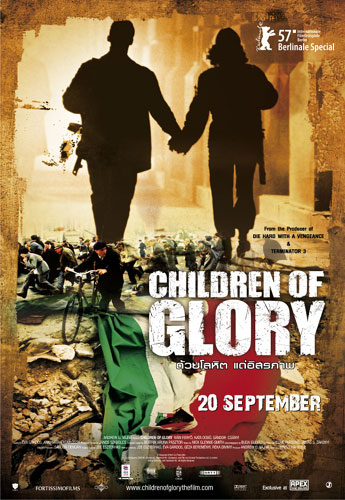
CHILDREN OF GLORY/SZABADSAG, SZERELEM - a partially successful movie about the Hungarian Uprising

There are no bears in Hungary. Unless we've crossed the border into Romania, in which case there ARE bears. If we're in Serbia, then... I don't know.CHILDREN OF GLORY is a bombastic, self-consciously epic film from the pen of Joe Eszterhas of BASIC INSTINCT fame. He brings a mainstream Hollywood, glossy sensibility to the deathly serious subject matter of the Hungarian Uprising of 1956 and the blood in the water incident at the Melbourne Olympics. I have mixed feelings about the glossy style of this film. Perhaps superimposing a schmaltzy love story onto this material will win it a wider audience - and frankly, this is such an important subject that you could take the view 'by any means necessary'. But I also felt a little uneasy, especially in the final scenes, that the movie had reduced something important to a sort of under-dog sports-movie finale.

The movie opens with the Hungarian water-polo team playing a rigged match in Moscow. Evidently the Soviets will not lose to a satelite state. Upon their return, the team are upbraided by the secret police for rubbishing their hosts and our beautiful hero, a fictional composite called Karcsi Szabó (Iván Fenyö) is initially happy to comply. Being an Olympic sportsman brings him privilege and protects his family. Our hero gets drawn into the student protests against Soviet occupation when he spots a pretty protestor called Viki (Kata Dobó). Through her, he finds that he actually does believe in fighting for freedom even it means sacrificing his place in the Olympic team.

The protests spill into a wider Hungarian uprising and the Soviets mobilise their tanks. But in a cruel twist of history, the Hungarians are fooled by a temporary withdrawal and appeasement. Thinking they have won, Karsci goes to the Melbourne Olympics to win glory for his newly free country. But Viki is left behind as the Soviets renege on their promises and send in the tanks. She continues to fight, hoping the Americans will intervene.

As the revolution is crushed, we move to the Olympics for the obligatory Hollywood adrenaline packed finale. The water-polo team triumph, despite a vicious attack on Karsci in the water. But the simplistic end of the film seems thin and unsatisfying. Can we really take any comfort from a sporting triumph when we've just seen Hungarians butchered? And what will become of our hero? We know his friends will defect but the movie doesn't bother to tell us whether he goes back to Budapest.

Still, I can't help but think that it's worth watching CHILDREN OF GLORY. It's handsomely shot and you certainly get a feel for how a student protest spilled out into a wider protest. I like the little details. Moreover, while the love story may seem a little cheap by the end of the film, there's no doubt that it provides a useful hook upon which to hang the audience's interest for the majority of the film.

CHILDREN OF GLORY opened in Hungary and the USA in 2006. It played Berlin 2007 and opened in Thailand, Sweden and Japan. It is currently on limited release in the UK.

Monday, December 24, 2007

9th COMPANY/9 ROTA - Full Metal Jacket in Afghanistan

9th COMPANY is a worthy Russian addition to the genre of film that takes a mixed bag of raw recruits, hurls them into basic training and then watches them grow up in a futile war run by incompetents. In this case, our band of soldiers come from Siberia and they have been shipped to Uzbekistan to prepare for the Afghan war, already in its tenth year. The film is notable for its honest script (no shortage of vulgarity and barracks humour) and the fact that this is maybe the first time Western audiences will see what the harsh Uzbekhi landscape (which also stands in for Afghanistan) looks like. In addition, there is a chilling training meeting where a hardened officer attempts to explain to his recruits what it means to fight in an Islamic country and against Islamist fundamentalists. Lessons that have not yet been learned. Geo-politics aside, viewers will empathise with the lads - their camaraderie is infectious - and enjoy the lavish photography of the battle-grounds and some really first class special effects. Director and actor Fyodor Bondarchuk (son of Sergei) handles the choreography of big artillery and planes well. I could, however, have done without the manipulative score and the over-use of slo-mo and extreme close-ups in the opening sequences. Apparently there are doubts about the historical veracity of the final battle, but I think the movie works equally well as a metaphor for the way in which ordinary soldiers are used by their commanders.

9th COMPANY was released in Belarus, Kazakhstan, Russia, Ukraine and Estonia in 2005 and in Finland and Poland in 2006. It played Canned 2006. It was released in the UK and Belgium in 2007 and is available on DVD.

Monday, October 01, 2007

DAY WATCH/DNEVNOY DOZOR - what's with the Dallas ending?!

The world is populated with superficial bastards who judge people on the size of their tits or the size of their wallets. I, on the other hand, judge people on how they answer the following question: "Who are the three greatest military generals of all time?" So it was with not a little excitement that I watched the prologue to DAY WATCH unfold, featuring Tamerlane the Great, ruler of Central Asia, architect of the golden city of Samarkand and creater of Tamerlanian chess. Tamerlane is after the Chalk of Fate. (Like most things in this Russian fantasy world, it feels like it should be capitalised.) The Chalk of Fate allows you to do cool stuff like change the course of your life. Cool that is, until it all goes Bobby Ewing. Other than that, contemporary Moscow is same-old same-old. There are vampires and witches and whatnot and they are split into two camps - Light and Dark - held in a truce that is policed by the Night Watch and Day Watch respectively. Neither side can break the truce for fear of inciting armageddon.

The movie looks great with lots of CGI where a little would do. Most of the best bits are in the trailer. If you think it looks cheesy and OTT you're missing the point. Vampires, Dark Others, Light Others and whatnot drive around in cool cars and kick ass, usually to a rubbish thrash-metal sound-track. They even make Anton (hero) and Olga (leader of good guys' girlfriend) swap bodies, enabling a truly low-rent girl-on-girl love scene with Sveta (the Luke Skywalker of this set-up). I haven't seen anything that crappy since Whoopi/Demi/Swayze got it on in GHOST. The plot, for what it's worth, sees Anton framed for murder by the Day Watch who are just itching to break the truce and start a war. After all, they have Anton's son Yegor on their side, and he's a potentially war-winning Great Other. The only glitch is that the Night Watch also have a potential Great Other in the shape of Sveta. Cue the compulsary final show-down in which Timur Bekmambetov has a lot of fun blowing shit up.

I have to say I was a bit less impressed with DAY WATCH than its predecessor. Maybe I'd just seen it all before? The ending didn't help but even before then it seemed a bit thin. Nonetheless, these movies are perfect for the times when you just need Pure Trash Entertainment. And they always have that little bit extra. I especially like the subtle spoofing of Communist-era bureaucracy as well as New Russian vulgar consumerism.

For hardcore fans, here are some supplementary notes:

First, some things you won't find in the British theatrical release. Thanks to the distributors, Fox Searchlight, you won't find an extra 20 minutes of footage that make the plot feel ever so slightly less random. You won't find a lot of one of the coolest characters in NIGHT WATCH, Bear. (Also, we note that Ignat is still a non-person.) You also won't find a lot of the magic and thoughtfulness that you get in the novels. Perhaps the biggest change from novel to screen is in the role of Anton's son Yegor. In the novels, he's a relatively low-level Other and flip-flops rather charmingly in neutrality for as long as possible. In the movie, he's a Great Other who will be pitted in battle against Sveta. As a result, Anton's visit to the witch earlier on in the story, takes on a mythic importance and leads to a somewhat DALLAS ending....

DAY WATCH/NIGHT WATCH 2/DNEVNOY DOZOR was released in Belarus, Kazakhstan, Russia, Ukraine, Armenia and Estonia in 2006. It was released in Egypt, the US, New Zealand, the Philippines, Argentina, Taiwan, Poland, Germany, Spian, Sweden, Greece and Malaysia earlier this year. DAY WATCH played London's Fright Fest last month and is released in the UK, Singapore and Mexico this week. It opens in Turkey, Australia, Norway and Brazil later in October, in Hong Kong on November 1st and in France on March 12th 2008.

Wednesday, May 09, 2007

Pantheon movie of the month - REDS

What makes a pantheon movie? Quite simply, that I find nothing in any of the parts of the film that I would alter. Perfection of directorial vision, performances and technical mastery of the medium. Finally, that the combination of all these factors should render a whole that is innovative, ambitious and affecting.

REDS fits the bill. It is Warren Beatty's masterpiece. He began the project in the early 1970s, when his struggle to reconcile his immense fame as an actor with his left-wing politics led to him to the example of the Greenwich Village radicals of the 1910s and 20s. In particular, he focused on the figures of John "Jack" Reed and Louise Bryant. Beatty began interviewing famous artists, journalists and political activists who had known the pair, and formented the idea of an epic political and romantic movie starring himself as Reed and his then lover, Julie Christie, as Bryant. It is testament to Beatty's star power than he managed to shake down the ultra-capitalistic studio system for $35m to finance his epic.

Beatty was truly the father of the project - raising the money, co-writing, directing and starring in it. He shot the film over a year and released it in 1981. It was a difficult shoot. Beatty was uncompromising about his vision for the film, shooting multiple takes that exhausted his actors and crew and coming into conflict with the pantheon cinematographer, Vittorio Storaro (LAST TANGO IN PARIS, APOCALYPSE NOW.) For the record, the static framing at the start of the film is Beatty's vision. The dynamic camera movements in the latter half are all Storaro - not least the iconic scene where Beatty rides alongside the train.

The resulting film vindicated Beatty's faith in the project. REDS received Oscar nominations in all the major categories, and remains the only film to be nominated for all four acting gongs. In the end, Beatty won Best Director, Storaro won for Best Cinematography and Maureen Stapleton, who plays the ballsy political activist, Emma Goldman, won Best Supporting Actress. Otherwise the film lost out to ON GOLDEN POND (unfairly) and to CHARIOTS OF FIRE (another fine film). Most absurdly, Jack Nicholson, who plays Bryant's lover and playwright Eugene O'Neill, lost out to Sir John Gielgud for ARTHUR.

Since then, the movie has rather slipped out of the general public's consciousness in contrast to other epics like DOCTOR ZHIVAGO. Perhaps this is because viewers are put off by what they perceive will be Beatty's polemical left-wing stance. Or perhaps they are put off by the length per se - the movie is best shown in two parts of an hour and a half each. Part of the reason may also be that Beatty did not allow the movie to be cut down in length for TV. At any rate, the film is available on DVD now, and holds up perfectly well.

So who are these people that they should provoke such an epic movie? Jack Reed was a privileged Harvard man who scorned the establishment for a life as a radical journalist. He was a man of great personal charisma, with a talent for putting himself where the action was and reporting back to the American literati. Reed is famous, if at all, for documenting the Bolshevik Revolution in a piece of outstanding journalism, Ten Days That Shook The World. Upon his return from Russia, however, he got enmeshed in factional struggles within the emerging American Left. He returned to Russia to bid for his particular party to be sanctioned by the Comintern and, by way of a Finnish prison, eventually died in Russia. He was buried in the Kremlin walls - the only American to have achieved this (dubious?) honour.

Warren Beatty plays Reed as a sincere, earnest, charismatic playboy turned radical. The charm comes from the fact that Beatty plays Reed as well aware of the difficulty and often the ridiculousness of his position as a Rich Communist and American in Revolutionary Russia. Beatty's Reed has an energy and excitement about him that is contagious, whatever your political views. Indeed, as someone who professes political beliefs on the right, I was pleasantly surprised by just how restrained Beatty was. There is very little polemic in REDS. Rather, we are presented with a more complicated character study, of which politics is only one part.

If REDS is a character study rather than a political tract, it is a study not just of Jack Reed but also of Louise Bryant. Reed's character is rather fixed throughout the film. We meet him as a fully formed radical, confident of his place in the liberal intelligentsia and on the world stage. By contrast, Louise Bryant is a work in progress. She begins the film as an aspiring journalist in Oregon. She escapes her conventional marriage thanks to Reed's attentions and joins him in the Village. She finds herself way over her head, patronised and dismissed by all Reed's friends. In fact, while Reed is clearly in love with her (these scenes are some of the most wonderful I have seen depicting a free and frank adult relationship) he has no illusions about her talents and her ambitions.

As the Village de-camps to New England, Bryant finds herself abandoned by the ambitious Reed as he begins organising left-wing politicos around the US. She begins an affair with Eugene O'Neill, before abandoning him for Reed. The scenes between Diane Keaton and Jack Nicholson and Warren Beatty respectively are brilliantly acted and emotionally brutal. There is a candour and authenticity that is breathtaking. Even later in the movie, when O'Neill and Bryant meet again, the conversation is as violent as a the lyrics to LIKE A ROLLING STONE. That Keaton and Nicholson did not get Oscars is an absolute crime against cinema.

The small steps by which Bryant becomes a fully-fledged wartime journalist in Europe and then Russia are all documented here. She finds her confidence as a writer and as a more equal partner to Jack. It's an utterly compelling character arc and a love story populated with real, complicated, flawed people. And what a backdrop! As the second half of REDS unfolds we find ourselves witnesses to the Bolshevik Revolution, in conversation with Lenin, Trotsky and Kerensky, and at the very edge of political action where theory becomes practice. In particular, there is a startling cameo from Jerzy Kosinski as Zinoviev.

As the movie unfolds, Beatty intersperses the action with his talking heads, or "witnesses". This helps keep the movie grounded and stops it from feeling too self-consciously "epic". As a result, unlike the more mannered melodramatic epics of the studio era, REDS does not feel dated to the modern viewer. In fact, in its depiction of the conflict between the art and politics; between career and marriage; and between sexual liberation and the need for commitment and companionship; it is as relevant to modern working men and women as it ever was.

REDS was originally released in 1981. It is available on DVD.

Wednesday, January 31, 2007

Sergei Bondarchuk's WAR AND PEACE (1968)

Sergei Bondarchuk's seven hour retelling of Tolstoy's WAR AND PEACE is how cinema should be: an all-engulfing total experience. Filmed with a budget that would be unthinkable today over five years in authentic locations, the movie simply feels real. Young Natasha Rostov ages before our eyes. When an abductor tries to tempt her away he is chased off through six foot high snow in the Russian winter. A royal ball sees real couples dancing the polonaise properly in a real palace. But where the film really benefits is in the battle scenes where Red Army units don histroric uniforms and essentially re-enact sequences. And by re-enact, I mean literally fire canon, mount cavalry charges and get thrown from horses. The smoke is intense, the feeling of organised mayhem overwhelming and when horses throw men they genuinely look spooked by the sound of the canon. The injury count must have been very high, and the movie certainly would not pass the animal cruelty lobby's critical eye.

And, of course, the film benefits from having time to breathe. This is not to say that the novel is not abridged. Prince Bolkonsky and Count Bezukhov's adventures with Napoleon get heavily reduced, which is rather sad. But the adaptation does succeed in picking out the major storylines and giving them enough room to develop. So, for instance, the scene where Natasha and Nikolai go hunting with their Uncle is shown in full - recreating an old-fashioned hunting scene which would not exist today. It is a glorious luxury. Or imagine the fact that the Battle of Borodino gets a full ninety minutes in Part Three! Fans of military history will be in heaven.

In broad terms, the movie focuses on battles and love stories rather than side-plots and political intrigue. (Plot spoilers follow so those familiar with the text can see what has been excised.) Part One sees the dashing Prince Bolkonsky - already bored with his pretty wife - leave Russia for the Battle of Austerlitz - where Napoleon routs the Austro-Russian alliance. His friend Pierre Bezukhov is transformed from a drunken illegitimate son to a Count and foolishly marries a beautiful but unfaithful woman. His friendship with the Rostov family, and their little daughter Natasha increases. In Part Two, a widowed Prince Bolkonsky falls in love with an older Natasha and embarks upon a long engagement before returning to the front. She is seduced by Bezukhov's brother-in-law in an act of revenge and is shamed in Bolkonsky's eyes. Pierre is sympathetic. Thus ends four hours of cinema! In part three, we see Pierre at the bloody Battle of Borodino and in part four, the storylines are rationalised.

(Spoilers over) Cinematically, apart from the epic scope of the film, it benefits from an outstanding cast, and ridiculously high quality production values. The battle scenes are shot with a real understanding of military history. However, the film rather presupposes that the audience know the story. Everything is very subtle - glances and whispers - rather than Hollywood spoon-feeding. If you are unfamiliar with the text you should probably watch the Hollywood version first! Jorim was rather lost - the motives for the malicious seduction of Natasha were, for example, lost on him. The other confusion arises from the rare but annoying bit of Soviet propoganda. This occurs after the Battle of Borodino where a marginal French victory is turned into a victory for the Soviet fatherland! Five minutes failure in seven hours, though, is perhaps excusable.

The filming style is beautiful - and you should really try and see this on the big screen if it comes your way. However, the cinematographer' strength is also his weakness. The camera is ever fluid, wandering through balls and soirees like an author noticing little occurences here and there. It brings a feeling of immediacy and intimacy. However, sometimes, the camera movements are simply too rough, too quick and disorienting - as though the cameraman lacked the right equipment.

Overall, though, this is truly epic, total cinema. No other film will ever quite match up to it. It becomes the benchmark - more than Citizen Kane, Dr Strangelove or any other pantheon film. An outstanding achievement.