Friday, February 29, 2008

THE ACCIDENTAL HUSBAND - meh

Patrick is dumped by Sophia on the advice of super-rational talk-radio love doctor Emily. So Patrick hacks the marriage license database so it looks like Emily's already married to him, throwing a spanner in the works of her marriage to perfect gentleman Richard. Emily spends time with Patrick in the process of obtaining an annulment. Guess what happens next!

This romantic-comedy slips by merrily enough for the first half hour because Uma Thurman (Emily) and Jeffrey Dean Morgan (Patrick) are charming. Patrick's Indian neighbours also have some fine comedy moments. But as the novelty of the odd-couple pairing wears off the mechanics of the plot become tedious in the extreme. All this will-she won't-she crap is a waste of time.

I also found myself mildly irritated that a lot of rom-coms start off with a high-functioning rational woman and then take a malicious pleasure in watching her life get messed up by a child-like bloke who she should ultimately take pity on. Dumbing down to his level will make her life complete! It's the same old story in KNOCKED UP and, to a lesser extent, in JUNO. Enough already. I can also detect a worrying and cynical trend in post 9-11 Hollywood to make characters they want us to think are decent, warm-hearted guys New York fire-fighters.

THE ACCIDENTAL HUSBAND is on release in the UK. It opens in France on April 2nd; in Brazil on April 11th; in the USA on August 15th and in the Netherlands on August 28th.

Wednesday, February 27, 2008

A partial review of MY BLUEBERRY NIGHTS


Wong Kar Wai has made some great movies in the past, not least the pantheon film, IN THE MOOD FOR LOVE. His movies are known for their lavish attention to production design; beautiful women in stunning dresses and the mesmerising control of Christopher Doyle's cinematography. They also contain some out the great performances of Asian cinema, not least Tony Leung in IN THE MOOD FOR LOVE and 2046. Sadly, MY BLUEBERRY NIGHTS, his first English-language, American-set movie, is a travesty. In fact. I walked out of MY BLUEBERRY NIGHTS after forty-five minutes. I had wanted to leave after ten minutes, but willed myself to keep sitting there, hoping that the movie would pick up. It didn't.

The problems are manifold. The script has no narrative drive; characters speak in banalities; Norah Jones, Rachel Weisz and David Strathairn over-act; one suspects that Norah Jones actually cannot act; Jude Law can't maintain a Northern English accent; Rachel Weisz can't do a Southern American accent; Darius Khondji's cinematography is deliberately stylised but looks cheap and amateurish (how many ways can you film someone through a window or reflected in glass, or shot from a CCTV camera?).....Net result: I had zero interest in continuing to watch Norah Jones' heartbroken waitress drifting through different bars, moping at various uninteresting characters.

Essentially, this is a movie that is badly written, badly acted and badly filmed.

MY BLUEBERRY NIGHTS opened Cannes 2007 and was released in Canada, Finland, France, Belgium, Norway, the Netherlands, Greece, China, Singapore and Estonia in 2007. It opened earlier in 2008 in Hong Kong, Latvia, Turkey, Russia, Switzerland and Bulgaria. It is currently on release in the UK and opens in March in South Korea, Colombia, Argentina, Italy, Brazil and Japan. Finally, it gets a limited release in the US on April 4th.

Tuesday, February 26, 2008

MARGOT AT THE WEDDING - a step back from SQUID

MARGOT AT THE WEDDING is a film about a selfish, hateful novelist who arrives at her sister's house and proceeds to hurt everyone in her path, not least her own son. She is a rather savage figure, and despite the fact that writer/director Noah Baumbach creates a realistic, fully-fleshed portrait, I found it hard to have any empathy for her or to be interested in what she did. Some way through the film, another callous author (Ciaran Hinds) brutally exposes Margot (Nicole Kidman) at a public reading. I thought this might have been cathartic. Up until that point, I would have happily slapped Margot myself, so presumably I would have enjoyed seeing her skewered? But I felt neither happiness at, nor sympathy for, her downfall. Just mild irritation that I had to witness yet another selfish, hateful novelist inflicting pain on others.

So what is there to hold our interest in this film? Jennifer Jason-Leigh gives a wonderful performance as Margot's kind-hearted but weak-willed younger sister, Pauline. Despite all the punishment Margot deals her, Pauline still loves her and listens to her. Jack Black is also marvellous in a small role, playing it relatively straight. He seems all the more funny the more he is hemmed in by a stern script and director, and he plays one of the few love-able characters in the movie.

Other than that, MARGOT AT THE WEDDING is a pretty dismal affair. And that
extends to the production design and the camera-work. DP Harry Savides has treated the negative to give the scenes a dull, mono-chrome look, and interior scenes in particular look murky and uninteresting.

The movie seems like a step backward from THE SQUID AND THE WHALE. That movie was far from perfect, but it did capture my interest and the cutting observations of human frailty were tempered by something like human warmth. By contrast, MARGOT feels misanthropic. And the little flaws that marred SQUID are magnified in MARGOT. The final scene is a case in point. Baumbach doesn't seem to be able to restrain himself from big dramatic flourishes at the end of his films. They feel stagey and heavy-handed.

MARGOT AT THE WEDDING played Telluride and Toronto 2007. It opened in the US last year and is currently on release in Australia. It opens in the UK on February 29th and in Belgium and the Netherlands in March. It opens in Denmark on April 11th and in Norway on May 9th. It opens in Spain on June 6th. MARGOT AT THE WEDDING is also available on Region 1 DVD.

Saturday, February 23, 2008

THE EDGE OF HEAVEN/AUF DER ANDEREN SEITE - contrived cultural drama

AUF DER ANDEREN SEITE is not a poor film by any means, but I don't think it lives up to the art-house hype. Certainly, in a year of 4 MONTHS, 3 WEEKS, 2 DAYS; NO COUNTRY FOR OLD MEN and THE DIVING BELL AND THE BUTTERFLY, I find it hard to believe that Fatih Akin won Best Screenplay at Cannes 2007.

The movie is set in contemporary Germany and Turkey. An old Turkish man in Bremen offers a Turkish prostitute a place in his house in return for exclusive services. At first, it seems a rather naive, romantic gesture. She is being harassed by religious fundamentalists so she accepts. We have been forewarned by a surtitle that the woman will be killed but I love how writer-director Fatih Akin still manages to take the audience by surprise. Sadly, credible surprise soon turns to contrived implausible events. It starts when the old man's grown son goes back to Turkey to find the dead woman's daughter. Rather improbably, he gives up his job as a German professor and impetuously buys a book shop in Istanbul.

The second segment centres on the dead women's daughter, a radical political agitator on the lam from the Turkish police. She hops a plane to Hamburg and is taken in by a sweet German languages student, much to her conservative mother's disgust. The two girls begin an affair, but the radical is soon deported and the German follows her to Istanbul. She remains in Istanbul for months, trying to fight her lover's incarceration. Improbably, she finds herself lodging with the old Turkish man's son.

The third segment of the movie sees all the story-lines come together in a manner that was so contrived as to be alienating. I left the cinema admiring Fatih Akin's ability to portray modern Turkish life, but less convinced that he had said anything particularly meaningful about racial and nationalist politics. The story, which had begun so promisingly, had disappeared into a small, trite, neatly-packaged box. Still, the movie is almost, but not quite, worth seeing for Patrycia Ziolkowska's heart-wrenching performance as the love-lorn German girl, Lotte, and the brilliant sound-track.

AUF DER ANDEREN SEITE/THE EDGE OF HEAVEN played Cannes 2007 where Fatih Akin won Best Screenplay. It also played Toronto 2007 and Berlin 2008. It opened in 2007 in Germany, Sweden, Turkey, Italy, Belgium and France. It opened earlier in 2008 in Norway, Greece, Jong Kong, Portugal and the Netherlands. It is currently on release in the UK and opens in March in Finland, Spain and Israel. Finally, it opens in the US on May 21st.

Wong Kar Wai retrospective - 2046

I once fell in love with someone. I couldn't stop wondering if she loved me back. I found an android which looked just like her. I hoped she would give me the answer.
After the perfection of IN THE MOOD FOR LOVE came the sequel, 2046 - a reflexive, rambling film that was ultimately a failure despite its ravishing visuals. Tony Leung reprised his role as Chow, now living in the Hong Kong of the late 1960s. He lives in a seedy hotel, next to room 2046 - a metaphor and focus for all his regrets and sexual yearnings. At the same time, he's writing a sci-fi novel set in 2046 - a place where you can relive your dreams in perpetuity. In this strange world of past, present and future, Chow meets a parade of beautiful, mysterious women, each dressed to perfection and photographed in a state of heightened beauty. If all these themes and striking images had been harnessed to empathetic characters and a proper story, Wong Kar Wai might have given his fans a film to treasure. Instead, the movie feels self-indulgent and unsatisfying. And, to paraphrase an interview with DP Christopher Doyle during a retrospective at the National Film Theatre, somewhat redundant. Wong Kar Wai said everything he needed to in IN THE MOOD FOR LOVE.

2046 played Cannes and London 2004 and is widely available on DVD.

Friday, February 22, 2008

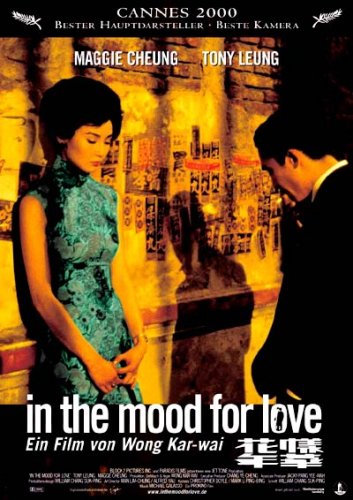
Pantheon movie/Wong Kar Wai retrospective - IN THE MOOD FOR LOVE/FA YEUNG NIN WA

As though looking through a dusty window pane, the past is something he could see, but not touch. And everything he sees is blurred and indistinct.

IN THE MOOD FOR LOVE is one of the most beautiful and touching movies of recent years. It is quite simply a story of unconsummated love between a man, Chow, and a woman, Li-zhen, who decide to rise above the pettiness of the world that surrounds them. They first meet in the cramped apartment building that they share - surrounded by nosy neighbours and the noise and fast pace of Hong Kong in the 1960s. Tony Leung plays Chow as a weary, hard-bitten newspaper man. The emotional range he conveys and the empathy he evokes in the audience won him the Best Actor prize at Cannes in 2000. Though a married man, he becomes transfixed by his glamourous new neighbour. They spend time together and the sexual tension is evident. The discovery that his wife and her husband are having an affair changes everything. At once, the tension is heightened as they play-act the roles of their spouses - indulging in dialogue they would so dearly love to be for real. And yet, they cannot now consummate their relationship because that would be as cheap as the world that surrounds them.

The story is reminiscent of BRIEF ENCOUNTER, but the resulting film couldn't be more different. The movie feels like a lament to a lost age. Wong Kar Wai delights in the fashion, interior decor and music of the 1960s. The movie is quite self-consciously retro, whereas BRIEF ENCOUNTER is delightful because it is so definitely of its time. The feeling of self-indulgence in IN THE MOOD FOR LOVE is heightened by the fact that Wong Kar Wai seems content to meander through his sets and linger in places he has no business being. So, Christopher Doyle's camera will gently move through corridors, into bedrooms and cramped kitchenettes. Sometimes, the action will be off screen or reflected in mirrors. The whole movie seems to live in a world where colours are brighter, movement is slower and emotions are inescapable. And that's what transforms a basically simple story into an unforgettable tragedy, making IN THE MOOD FOR LOVE a true pantheon movie.

IN THE MOOD FOR LOVE was released in 2000 and won Best Actor and the Technical Prize at Cannes. It is widely available on DVD, but if you ever have the chance to see it on the big screen you should definitely avail yourself of the opportunity.