Showing posts with label leonie benesch. Show all posts

Sunday, February 09, 2025

SEPTEMBER 5*****


SEPTEMBER 5 is a stunning film depicting the horrific and murderous attack on Israeli athletes at the 1972 Munich Olympics by the Palestinian terrorist group Black September. Where Kevin Macdonald's superb and comprehensive documentary ONE DAY IN SEPTEMBER gives us all the angles and the whole story, this new film tells the story from the perspective of the ABC sports journalists who were in the Olympic Village.  As it happened, this was the first Olympics that took advantage of satellite broadcasting to bring live coverage to the world.  As a result, this was the first terrorist attack broadcast live to the world - well before Mumbai or 9-11.  And it created both iconic images which are used as live in this film - but also deep moral questions about how far live coverage enables and recruits for terrorists.

As the film opens we are in the dark, claustrophobic ABC sports-room recreated by director Tim Fehlbaum in precise detail.  The journalists hear shots fired and suddenly realise they are in the midst of an attack.  They have to figure out how to wheel heavy camera equipment out to the village to shoot footage of the apartments where the Olympians are being held.  And they have to wrestle satellite slots to broadcast what they have.  In a powerful and pivotal performance, Leonie Benesch (THE WHITE RIBBON) plays a young German journalist who has to become an impromptu translator, listening in to police radio and local news reports.  Meanwhile, the always brilliant Peter Sarsgaard plays the Sports-journo boss who has to wrestle with his home news team who argue that mere sports reporters are out of their depth, and retain control of "his" story.  

There are two iconic and notorious moments. The first is when the journalists realise that the terrorists are actually watching their footage, and can see German cops attempting a rescue operation, because no-one switched off the TV feed to the apartment block. It's then that we get that iconic image of the hooded terrorist looking out of the apartment window and straight down the barrel of the TV camera.  The second iconic and notorious moment is when an ABC journalist (played brilliantly here by John Magaro) chooses to relay an unconfirmed report that all the sportsmen have been released alive and well. He wants the scoop. Simple as. 

Kudos to Fehlbaum, his production team and in particular his editor Hansjoerg Weissbrich, for creating a film of such taut, spare, suspense and high stakes.  The look and feel of it take you right into 1972 and into the fast-paced need for judgment.  It gives you sympathy for real people making tough choices in uncharted territory. Most of all, I loved the way in which the real footage of on-air broadcasts was seamlessly woven into the fictional recreation. So you can see Magaro's character speaking apparently to an on-air presenter and that presenter relaying the information he has been given. It's a masterclass of editorial brilliance.

SEPTEMBER 5 is rated R and has a running time of 95 minutes. It played Venice, Toronto and Telluride 2024. It was released in the USA on January 17th and in the UK on February 6th.

Wednesday, October 21, 2009

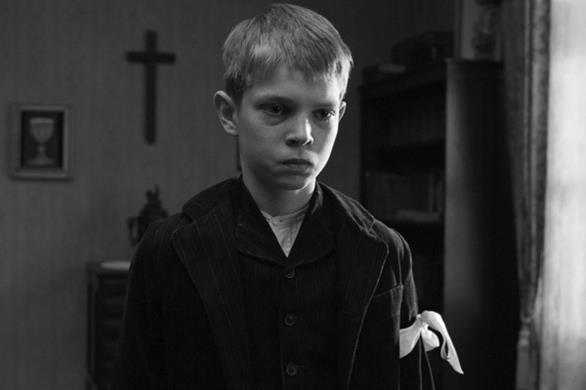
London Film Fest Day 8 - THE WHITE RIBBON - DAS WEISSE BAND


Michael Haneke makes films that toy with the audience - whether with malicious black humour in FUNNY GAMES or with subversive, slippery political provocation in CACHE/HIDDEN. He hates clear-cut answers and stories that claim that life is more simplistic than it really is. He is concerned with human nature and the cruel violent and sexual impulses that lie behind the facade of bourgeois life. All these preoccupations are visible in his beautiful, disturbing, Palme d'Or winning new film DAS WEISSE BAND - A GERMAN CHILDREN'S STORY.

In terms of toying with the audience, this starts with the very title of the film. DAS WEISSE BAND or THE WHITE RIBBON is translated for non-German audiences, but the beautifully written sub-title isn't. Haneke claims that this is because the story should resonate for people whichever country they are from, rather than being read as a particularly German fable, but then why have the sub-title there at all, untranslated and provocative. The games continue with the first image of the film, shot in pristine black-and-white. This serves as a distancing device that panders to our images of the early twentieth century, in black and white photos. The distancing also comes through the employment of a voice-over from one of the characters in the film, who admits in the first line of the film that he can't be sure that he's remembering events correctly after all this time. In other words, nothing we are to see can be taken at face value.

The tale that unravels is certainly concerned with sexual violence and cruelty. It is set in a North German town in the year before World War One, but could easily be depicting a world from centuries before. The town is oppressed financially, under the feudal system under the Baron, and by the fierce religious morality enforced by the town priest. A young boy is forced to wear a white ribbon to remind him of the purity to which he should aspire. But more violently, each night his hands are tied to the side of the bed by his pastor-father to stop him from masturbating. Naturally, this being Haneke, superficial rigid morality disguises physical and moral corruption - incest, murder, arson, theft, adultery. Adults brainwash children, but act like wilfully, as children. Children are either presented as cherubic paragons of virtue or as sinister and in mobs. For every scene that is heartbreakingly beautiful there is a scene that is perverse and frightening.

There is no doubt that DAS WEISSE BAND is a great, beautiful, challenging, multi-faceted film. You can watch it for the sheer joy of the composition of the photography, or for the tense portrayal of an oppressed society. No doubt some will watch it, reductively, as a story of how the generation who became Nazis was formed. But this movie is much richer, and more applicable, than that.

THE WHITE RIBBON played Cannes, where it won the FIPRESCI prize and the Palme d'Or, and Toronto 2009. It was released in September in Germany and Austria. It is currently on release in Belgium and France and opens next week in Greece and Italy. It opens in the UK on November 13th, in the Netherlands on November 19th, in Sweden on December 11th, in Norway on December 26th, in the USA on December 30th and in Russia on January 12th.