Showing posts with label austria. Show all posts

Friday, October 07, 2022

CORSAGE - BFI London Film Festival 2022 - Day 3


CORSAGE is a stunning piece of imaginative film-making from writer-director Marie Kreutzer, featuring a memorable performance from Vicky Krieps (THE PHANTOM THREAD) as the iconic Austro-Hungarian Empress Sisi.

Kreutzer's approach is to take a bold ahistorical approach to get to the emotional truth of an incredibly famous, beautiful woman, trapped in a loveless marriage and burdened by the obligations of her public role.  It is similar in approach - though bolder in its leaps of imagination - than Sofia Coppola's MARIE ANTOINETTE - far more successful than Pablo Larrain's hysterical SPENCER, though less honest in its treatment of Sisi's eating disorder.  The key difference is that in both of those movies, the central women were depicted as passive victims, whereas Krieps' Sisi is the architect of her own liberation.

The movie opens with Sisi about to turn 40 in 1870s Vienna, the mother of a teenage Crown Prince and a precocious and dutiful daughter. She is obsessed with her weight, skin and youth, starving herself and riding, fencing and doing gym exercises to maintain her figure. She doesn't want to have sex with her husband, but is also jealous of a young girl that he flirts with. At first we think she is in love with her riding instructor but then realises she just gets off on him (and her husband) looking at her adoringly. As with Princess Diana, we get the impression that she is both trapped by society's superficial and unreal expectations of her, but that she has also internalised these misogynistic expectations of beauty and turned into a narcissist. Certaintly, her treatment of her confidante and lady in waiting speaks to her putting her own happiness before that of all others. 

The wonder of Krieps performance is that Sisi never seems passive or a victim even when she is: she's actually spiky, bitchy, rebellious and wild, to the point of neglecting her duties with her indulgent cousin Ludwig of Bavaria. She's also incredibly athletic and not lying when she says she's a better rider than her instructor. It helps that Kreutzer chooses not to show us the excesses of Sisi - her absurd hair and beauty regimen - her more waspish comments about fat people - her serial infidelities. This is a much less extreme and yet more extreme Sisi - less fat-shaming and more feminist -  one more palatable to contemporary tastes. 

As to the rest of the film I love that Kreutzer shows us people in full costume dress with retinues of obsequious servants but places them in derelict locations filled with anachronistic props. It sounds too on the nose, but it actually works really well to underpin how rotten the edifice of the central European monarchy was at that stage, and the sham of these great imperial monarchs with their rotten teeth and fake beards.  Kreutzer's Sisi just takes that fakery one step further. 

CORSAGE has a running time of 113 minutes. It played Cannes, where Vicky Krieps won an acting prize. It is playing in Official Competition at the BFI London Film Festival. It will be released in the USA on December 23rd and in the UK on December 24th.

Wednesday, November 21, 2018

THE WALDHEIM WALTZ - UK Jewish Film Festival


THE WALDHEIM WALTZ is a quietly powerful and beautifully curated documentary by journalist Ruth Beckermann about the election campaign of the late 80s Austrian President Kurt Waldheim.  It opens and closes with Beckermann's own black and white footage of the diplomat turned politician and later the public reactions to revelations that he had - at best - falsified his war record and - at worst - been implicated in war crimes against partisans, and of being part of the Nazi apparatus that facilitated the deportation of Jews from Salonika. Beckermann rightly shows how the war record of Waldheim is, in a sense, not the most important point.  The real crime is his seeming inability to tell the truth - his continual plea that the Austrians should also be seen as victims - and how this reflects the wider weirdness that Austrians have around their record during World War Two.  A commentator at the time rightly points out that the Allies let Austria off the hook with the concept that they were the "first victim" of Hitler. And indeed this may be right when we consider the Austrian State. Nonetheless, once the anschluss was completed, Austrian individuals were, just as Germans, members of the Nazi armed forces, intelligence services, the SS, and were of course implicated in war crimes. Not least Waldheim's one time boss, Alexander Loehr.  

Perhaps the most haunting this in this film is not Waldheim's slippery smugness, but the continued anti-semitism in 1980s Austria.  The coded language when Waldheim or other commentators speak of a small minority of influential people in the media attacking Waldheim is dog-whistle speech. Even worse, the blatant anti-semitism in the streets of Vienna. When man asks an anti-semite what makes him feel so complacent that he can shout anti-semitic abuse in St Stephen's Square. The unspoken response is that he feels sanctioned by the election of a man he thinks shares his views. 

Beckermann chooses to only use footage up to the and shortly after the election of Waldheim and barring a few comments about her own footage she does not editorialise about what this shameful episode might say about contemporary Austria or politics more widely.  Certainly, there are lessons one might draw about Trump sanctioning a renewed confidence among American white supremacists.  But far more disturbingly, I would want to know whether this kind of base-line historical equivocation and knee-jerk racism still exists in Austria. Is there still an older generation that thinks the Jews had it coming? If the attitudes hadn't changed between 1946 and 1986 have they really changed now?  Is the way the Holocaust and Austria's role in it is taught in schools there different?  Or is the convenient denial still present?  

THE WALDHEIM WALTZ has a running time of 93 minutes. It played Berlin 2018 where it won the Original Documentary Award. It played Sheffield DocFest earlier this year, and is currently playing at the UK Jewish Film Festival.  It is the official submission of Austria for the Oscars 2019. 

The 22nd UK International Jewish Film Festival takes place between 8th-22nd November 2018 at cinemas across London, Manchester, Leeds and Glasgow http://ukjewishfilm.org/

Wednesday, September 30, 2015

MY NAZI LEGACY - BFI London Film Festival 2015 - Preview


David Evans' documentary is the most affecting I have seen in the festival previews to date.  It is devastating in its simplicity of concept and relentlessness of investigation. The narrator and key protagonist is Phillipe Sands, a famous human rights lawyer based in the UK who, in turns out, had family killed in the Holocaust and a grandfather who survived but was understandably reluctant to speak about his experiences. The power of the documentary is that is chronicles Sand's encounter with two sons of high ranking Nazi officials. The first, Niklas Frank, whose father Hans ran the General Government in Poland, has fully embraced his father's past to the point where he is almost obsessed with how much he despises him.  The second, Horst von Waechter, whose father was the Governor of Krakow and Galicia, steadfastly refuses to accept any evidence that his father had command responsibility for the mass murder of Jews, and welcomes anyone who will speak of him as a decent man, even if that man is wearing a swastika. 

Sunday, July 26, 2015

LAUDA: THE UNTOLD STORY


Niki Lauda was an Austrian Formula One driver in the 70s and 80s most famous for suffering an horrific crash at the Nurburgring in 1976.  His scalp, upper face and right ear were burned off, he inhaled toxic fumes that poisoned his body, and his lungs didn't work.  Not only did Lauda survive bet he went on to race at Monza just 33 days after the crash, placing fourth. He later retired from Formula One and went on to be a successful entrepreneur and retained an influence in racing.

His story, and particularly his rivalry with the flamboyant British driver, James Hunt, was recently told in fictionalised and simplified form by Ron Howard in RUSH.  And the wider story of how this crash was part of an era in which the car tech advanced faster than the safety controls, was told in the superb documentary, 1. That doc was a comprehensive and beautifully made story of the evolution of Formula One racing as something that could kill you to the safer sport we enjoy today.

Wednesday, October 15, 2014

IN THE BASEMENT / IM KELLER - LFF14 - Day Seven


Ulrich Seidl's IN THE BASEMENT is a slippery darkly comic movie satirising the popular image of Austrians post-Fritzl - as ex-nazis who do weird things in the basement.  It's presented as a documentary but is clearly a mockumentary that sends up the outside world's most absurd fears but each time with breathtaking technical poise that dares us to take it seriously. It's a superb and short cinematic joke but ultimately tells us something provocative about the prejudices we may hold about Austrians, and the prejudices Austrians may hold about themselves.

IN THE BASEMENT aka IM KELLER has a running time of 85 minutes.

Saturday, October 13, 2012

London Film Fest 2012 Day 4 - AMOUR


AMOUR is a typically austere, unflinching and technically formal Michael Haneke film.  His camera faces the protagonists head on and does not move, refusing to follow the action off screen, waiting for it to return to the original set-up.  As an audience, we are forced into that same immobility.  We are forced to slow ourselves down to the pace of this film, to live inside the four walls of the apartment, and endure what the protagonists endure.  

They are an old married couple (Jean-Louis Trintignant, Emmanuelle Riva) , still sympathetic, still vital, until she suffers a stroke and a failed reparative operation.  Promising not to take her to hospital again, and repulsed by the brusque carers, he takes on the burden of her care.  We feel her anger and indignity.  We feel his frustration and hopelessness.  Their daughter (Isabelle Huppert) also suffers but her pat solutions seem distance from the reality of her parents' situation. As with all Haneke, a quiet tension builds until a provocative final resolution.  It is a resolution that we have been guessing at and fearing since the prologue.  That it comes as less of a surprise does mt diminish it's force. 

That said, I did not find this film as convincingly deserving of its Palme d'Or as Haneke's THE WHITE RIBBON.  I felt that there was some repetition and tedium during its middle passage. Did we really, for instance, need so much time with Isabelle Huppert's character? Did we really need to see two nurses.  The film also felt a little bit like it didn't know how to end, and the scene that was finally chosen seemed somehow "small" in the context of the powerful emotions that proceeded it.

Still, Haneke that is not quite at the level of perfection of THE WHITE RIBBON and HIDDEN is still quality film-making, and after all we have something here That we do not see so often in his films, and perhaps in life: dangerously selfless love.


AMOUR  played Cannes 2012 where it won the Palme d'Or, and London 2012. It opened earlier this year in Germany, Hungary and Greece, and opens on Oct 24th in Belgium, france, Russia and Italy. It opens in Poland on Nov 2; in the Netherlands and the UK on Nov 16; in Sweden on Nov 23; in Portugal on Nov 29; in the USA on Dec 19; and in Denmark and Norway on Dec 25th.

The running time is 127 minutes.

Wednesday, October 21, 2009

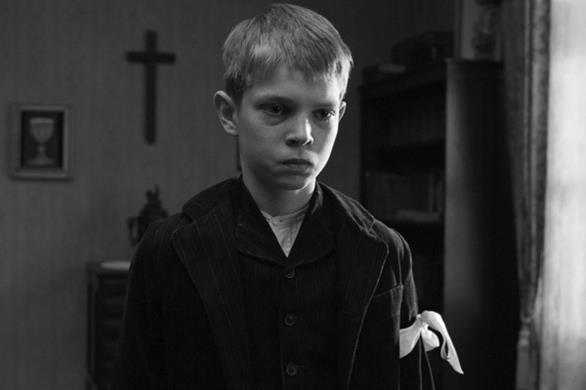
London Film Fest Day 8 - THE WHITE RIBBON - DAS WEISSE BAND


Michael Haneke makes films that toy with the audience - whether with malicious black humour in FUNNY GAMES or with subversive, slippery political provocation in CACHE/HIDDEN. He hates clear-cut answers and stories that claim that life is more simplistic than it really is. He is concerned with human nature and the cruel violent and sexual impulses that lie behind the facade of bourgeois life. All these preoccupations are visible in his beautiful, disturbing, Palme d'Or winning new film DAS WEISSE BAND - A GERMAN CHILDREN'S STORY.

In terms of toying with the audience, this starts with the very title of the film. DAS WEISSE BAND or THE WHITE RIBBON is translated for non-German audiences, but the beautifully written sub-title isn't. Haneke claims that this is because the story should resonate for people whichever country they are from, rather than being read as a particularly German fable, but then why have the sub-title there at all, untranslated and provocative. The games continue with the first image of the film, shot in pristine black-and-white. This serves as a distancing device that panders to our images of the early twentieth century, in black and white photos. The distancing also comes through the employment of a voice-over from one of the characters in the film, who admits in the first line of the film that he can't be sure that he's remembering events correctly after all this time. In other words, nothing we are to see can be taken at face value.

The tale that unravels is certainly concerned with sexual violence and cruelty. It is set in a North German town in the year before World War One, but could easily be depicting a world from centuries before. The town is oppressed financially, under the feudal system under the Baron, and by the fierce religious morality enforced by the town priest. A young boy is forced to wear a white ribbon to remind him of the purity to which he should aspire. But more violently, each night his hands are tied to the side of the bed by his pastor-father to stop him from masturbating. Naturally, this being Haneke, superficial rigid morality disguises physical and moral corruption - incest, murder, arson, theft, adultery. Adults brainwash children, but act like wilfully, as children. Children are either presented as cherubic paragons of virtue or as sinister and in mobs. For every scene that is heartbreakingly beautiful there is a scene that is perverse and frightening.

There is no doubt that DAS WEISSE BAND is a great, beautiful, challenging, multi-faceted film. You can watch it for the sheer joy of the composition of the photography, or for the tense portrayal of an oppressed society. No doubt some will watch it, reductively, as a story of how the generation who became Nazis was formed. But this movie is much richer, and more applicable, than that.

THE WHITE RIBBON played Cannes, where it won the FIPRESCI prize and the Palme d'Or, and Toronto 2009. It was released in September in Germany and Austria. It is currently on release in Belgium and France and opens next week in Greece and Italy. It opens in the UK on November 13th, in the Netherlands on November 19th, in Sweden on December 11th, in Norway on December 26th, in the USA on December 30th and in Russia on January 12th.

Wednesday, March 25, 2009

IMPORT/EXPORT - immigration agitprop from Austria's enfant terrible

IMPORT/EXPORT is Austrian auteur, Ulrich Seidl's, new agitfilm about the economic relationship between "old" and "new" Europe. It's an unflinching and sporadically very funny look at the profound economic and social disruptions that have come in the wake of the end of the Cold War and the extension of the European Union. The movie tells two symmetrical stories. A single-mother living in deep poverty in Ukraine can't make ends meet as a nurse. Refusing to become a sex-worker, performing over the web for rich Germans, she comes to Austria and works in an old-people's home. Her story is mostly tragic and realistic and will certainly resonate with those of us living in Western European capital cities benefiting from the influx of East European cleaners, plumbers and waitresses, half of them working well below their qualifications. At the same time, an Austrian father and step-son are disenfranchised in their own land - along with many Western European manual workers who have found themselves out-competed by cheaper, better trained and harder working eastern Europeans. They end up journeying to the Ukraine as truckers, and while their situation is laughably pathetic, they can still use their Euros to sexually humiliate local girls. The resulting film is provocative, handsomely shot, and more entertaining than the grim subject matter might suggest. Highly recommended.

IMPORT/EXPORT played Cannes and Toronto 2007 and opened in the Czech Republic, Germany, Austria and Greece last year. It opened earlier this year in Poland, Belgium, Sweden, the Netherlands, Russia and Romania. It is currently on limited release in the UK and is also available on DVD.

Monday, April 07, 2008

FUNNY GAMES (1997)

FUNNY GAMES is the original German language horror film that Michael Haneke recently remade as FUNNY GAMES U.S. Both movies are identical, barring the language and small differences in performance. In this version, we meet a prosperous couple and their young son travelling to their summer house on a lake. Two apparently polite young men ask to borrow some eggs. Their insistence is a little sinister, but I think Susanne Lothar is slower to exhibit her suspicions that Naomi Watts in the remake. Soon, the two youths are torturing the family for kicks, occasionally turning to the camera and breaking the fourth wall. Haneke teases the audience - first, by never actually showing the violence and second, by mocking our voyueurism.

On the whole, I prefer the remake and not simply because my German isn't perfect. Michael Pitt seems more self-assured than Arno Frisch as the lead torturer - he's more poised and more sinister. And if there's any single scene that defines this movie, it's the closing shot where the torturer looks directly at the audience. For that reason, the re-make just has the edge over the original.

FUNNY GAMES played Cannes and Toronto 1997.

Sunday, March 09, 2008

Overlooked DVD of the month - KLIMT

KLIMT is a wonderfully free-form movie from veteran film-maker Raul Ruiz. Released in butchered format in the UK last year, it's now available in a full two hour director's cut on DVD. The film is less of a standard biopic than an impressionistic, sometimes surreal visit with the Austrian artist. John Malkovich gives a wonderful performance in the central role. We see Klimt's foul mouth and short temper with the pretentious fools in cafe society. We see his childlike excitement, but also gentle discretion, over his many affairs. He fathers many children, sees them rarely, but when he does he has a great affinity with them. He is broad-minded, honest, but has that thin-skinned anger that people who have no time for convetional mores often have.

If you don't know much about Klimt prior to watching the film, you might feel a little lost. Ruiz assumes knowledge about the paintings, the people in Klimt's life and the "characters" of the day. I find this refreshingly unpatronising, but frankly, if you haven't heard of Wittgenstein or Schiele you might feel a little lost. In addition, Ruiz' film resists a straightforward linear narrative structure. We first meet Klimt on his deathbed and then skip back and forth through different scenes in his life. Some of these are presumably real, some are fantastic. To give two examples, Saffron Burrows plays an artist's muse who has seemingly two disinct characters - the "on-show" personality, and the private personality - and these are represented as two separate people. And Stephen Dillane plays an enigmatic figure who pops up throughout the film, commenting acerbically on Klimt's life and acting as a sort of ghostly companion.

To be sure, the film is far from perfect - if you want a sure vision and a film that feels like a composed, coherent unit, you'll have to look elsewhere. But the fun is in the feeling that anything could happen. Moreover, I did feel that I had gained an insight into the artist's personality and work. The tech package feels a little rough - or perhaps it's the DVD transfer that makes everything look muddy and under-lit? Still, the movie is well-worth checking out.

KLIMT was released in Austria, France, Germany, Poland, Portugal, South Korea and Japan in 2006. It was released in Spain, Estonia, the US and UK in 2007. It is now available on DVD.

Wednesday, October 10, 2007

THE COUNTERFEITERS/DIE FAELSCHER - a Holocaust movie that sparked the mother of all debate among my friends - SPOILERS alert

This review is written by Nikolai, who can usually be found here.

To say I was disappointed by Die Fälscher (The Counterfeiters) is an understatement. The film was awfully shot, had a weak plot, a terrible ending, and was generally devoid of any interest or originality. While some of the acting performances were excellent, and kept the film going (like Devid Striesow as Herzog) - much of the acting and dialogue was average to poor, with substandard characterisation and 2-dimensional subplots. It was predictable, plodding, and by the end I was praying for World War II to end - not to save the poor Jews at Sachsenhausen - but to be spared any more boredom.

The Plot

The plot follows Salomon Sorowitsch, one of the world's best counterfeiters - living the high life in Berlin before his arrest in 1936. As a Jew he is taken to a concentration camp - before being moved to Sachsenhausen along with several other inmates to take part in the biggest counterfeiting operation on record. The Nazi plan was to collapse UK and US economies by creating hyperinflation, as well as to purchase goods for themselves, by forging millions of pounds and dollars of currency.

Sorowitsch is put in charge, but one of his fellow inmates Adolf Burger (August Diehl) refuses to cooperate with the Nazis. Sorowitsch must walk the delicate line between not betraying Burger, not getting himself or his fellow employees killed, and not helping the Nazis too much. The kicker is that it's all based on a true story - but sadly in this case the truth was not stranger than fiction.

Poor cinematography - worse execution

The cinematography in Die Fälscher is nothing short of amateurish DV-quality - so much so that I almost suspected it was deliberately trying to make a point. But it wasn't making any point - it was just shit. The lighting was also horrible - the sound wasn't great quality - all in all this was one aesthetically ugly film.

But I would have been willing to forgive it had it been any good. Sadly, despite a fairly sound premise, it wasn't. The so-called moral dilemma at the centre of the plot was weak to start off with and was half-heartedly portrayed. The high ideal of dying for ones principle is brought up but never really explored - because no one dies, and our main protagonist didn't really have particularly praiseworthy principles jn the first place.

With the heart of the movie so poorly portrayed, we are left with little more than a shell - a plot and characters that are neither interesting or original. We have all seen cinematic Jews being brutally murdered before - and while it is still unpleasant to watch, it is hardly educational or edifying. I didn't care enough for the characters to be too bothered if they lived or died anyway - and while it's always emotionally easy to boo the Nazis and hiss the Baroness, it becomes quite boring after a while.

Moral cowardice of modern holocaust movies

And perhaps that is the greatest failure of this film - its moral cowardice. It's too easy to make a film about nasty Nazis and nice Jews - noone will criticise it because after all, who would criticise a holocaust movie? Yet this film had an opportunity to be daring. It could have made Jewish characters with genuine moral flaws, instead of Sorowitsch, a Han Solo lovable rogue type with sweet benevolent instincts just waiting to get out. It could have made ordinary Nazis, with their own moral dilemmas, instead of the foaming psychopaths and sociopaths that Nazis are always portrayed to be. It might even, shock-horror, have drawn parallels between the humanity of the Nazis and that of the Jews. That would have been daring. That would have been different.

What is most shocking, most frightening about Nazism and the holocaust isn't that the Nazis were a weird special breed of psychopaths or madmen - but rather that most Nazis were ordinary people who we'd bump into in the street and drink with in a pub. In "The Lucifer Effect", Phillip Zimbardo (the scientist who designed the Stanford Prison Experiment) analyses how ordinary, good people can do the most inhumane and atrocious things in the right circumstances. In "Why good people do bad things", psychoanalyst James Hollis discusses the same issue. The conclusions are clear - under the right circumstances, with the right authorities and dehumanisation in place - ordinary people will torture and maim and kill.

The terrifying thing about Nazis is that they're just like us - but that is too challenging for mainstream cinema. Nazis are systematically dehumanised in movies to make us all feel more comfortable with ourselves. But, just like the soldiers at Abu Graib and Guantanamo Bay, and the various secret prisons around the world where people are tortured, most of them are just ordinary folks. Jews are just ordinary folks too - and if the boot were on the other foot would likely behave just the same - it's just so happens they've been fucked over more times than most.

Appeasing the audience

This cowardice in film making permeates modern holocaust cinema - partially to please critics, and partially to appease audiences. The audience is allowed to identify with the imperfect but deep-down good Jew, and boo and hiss the nasty psychopathic Nazi, never having to confront the fact that they are booing and hissing a part of themselves that they are unwilling to face. Die Fälscher falls into the same trap - and paints the world in the simple colours of good versus evil, bravery versus cowardice, black vs white. In this sense it misses its only remaining opportunity to make a real impact on the viewer, and consigns itself and its flagrant flaws to the annals of quickly forgotten films.

Overall, I would give Die Fälscher 2 stars out of 5, and no more than that. The film has shocking production values, it's pretty boring, and does nothing new - fading into the background of a genre that is already well represented. Save your money for Ratatouille - Pixar never lets us down - and you might even learn something about cooking. One thing's for sure, you won't learn diddly squat from this effort.

THE COUNTERFEITERS played Berlin and Toronto 2007 and has already gone on release in Germany, Austria, the Czech Republic, Russia, Poland, Norway and Denmark. It goes on release in the UK on Friday, in the Netherlands on October 25th, in Belgium on December 19th, in the US on New Year's Eve and in Japan on January 19th 2008.


Bina007 adds:
I was very disappointed by this film. But you can't deny its merit in sparking a discussion about morality and cinema! Below are some interesting excerpts from the Scoundrels who joined Nikolai and myself at the screening......

First, from Professor007: "Interesting. I fully agree with the characterisation that ordinary people can turn pretty nasty when put under pressure to do certain things, independent of ethnic or religious background. However, this is exactly what I found the film actually captured quite well. Not all Nazis were shown as all-out evil and not all Jews were all good and great. In particular Sorowitch was shown to be a reasonably unpleasant character who mainly wants to save his own life. He shows some morality when confronted with the risk that one of his immediate mates could get killed but not because of some abstract reasoning that "out there" thousands of people are getting murdered. I think this is a very realistic depiction of human behaviour, and another example that often momentous results can happen not because someone actually cared for some high-level result to happen but out of much more personal motives. As for Burger, I wouldn't say he came out as the big hero of the story either and for me certainly wasn't the centre figure or moral centre of the film."

From Bina007, in response: "I think Burger is unquestionably the moral centre of the film. He's the one who want to sabotage the presses. When Zilinsky says "no-one wants to die for a moral principle", Burger replies "that is why the Nazi system works". To me, that sums up the moral centre of the film. After the counterfeiters are confronted with the real horror of the camps we see one of them start making excuses about how "they" sabotaged the process when really only Burger did this. He belatedly says Burger was a hero. As far as Sally is concerned, the film-makers soften up his character by showing his affection for Kolya, but that is standard formula. Still, it's fascinating to see that we all have such opposite views of what constitutes a moral centre!"

From the Professor's missus: "Anyway, just to prove we all sat in the same cinema and watched entirely different films, I found it very affecting. OK, so the framing device was lame and maybe they milked the death of Kolya too much, but it didn't strike me as a black and white picture, or even one with a clear moral centre. It's one of the few holocaust films I've seen which presented the camps from the point of view of simply staying alive - even Burger's actions could be seen from this position as survival was dependent on the allies winning. Certainly the Jews came across as a whole lot nicer than the Nazis (can't really imagine a reasonable film on the subject where this isn't the case...) but they didn't strike me as characters abiding by the usual "suffering makes you saintly" rule. It seemed more like what Orwell wrote about extreme poverty, that the most disconcerting effect on your personality is more or less being reduced to thinking about your next meal and nothing else. The guilt, horror and sheer degredation of the final scene when the two sets of prisoners finally meet was one of the more gut-wrenching moments in cinema I've seen in a while. If anyone can tell me what the obvious moral to that scene was, I'd genuinely be very interested. And on a random note, I really enjoyed the cinematography. I'm guessing the grainy, somewhat handheld look was deliberate as opposed to incompetence, to make it look like documentary/news footage and give a feel for the sordidness of it all. But that could just be the techie in me over-analysing...

From Nikolai, again: "Oh come come. The Jews were all lovely people under immense pressure. We can sympathise with every last one of them. Sorowitsch has a "prison" mentality – with loyalty to his friends and the people close to him. While he pretends to be self-centred, it is clear throughout that he has a big heart – through his affection for Kolya (short for Nikolai btw in Russian) – and through his refusal to betray Burger, even when under intense pressure to do so. Even the Jews that beat up Burger can be forgiven – after all, they were selected for execution – this massive strain on their characters was bound to make them crack. But even then, it was only at the point of death that they were willing to betray Burger to the Nazis. What lovely, deeply good and loyal people the Jews are. Burger himself is a moral hero – willing to die for his principles, knowing as he must that he will be betrayed by his colleagues in the end. What a great guy.

"And the National Socialists, well, they were horrible. Herzog is a truly self-centred opportunist – a typical criminal psychopath, not taking particular pleasure in killing, but doing it for his own gain and good. Then at the end, pitifully squealing for his own sake to Sorowitsch, who like a good forgiving Jew, lets him off the hook. The other Ns are brutal sadists, shooting, beating, verbally abusing and urinating on Jews for their personal pleasure. There is no ambiguity in the characters – none of the Ns are likeable or sweet in their own way – none of them have any redeeming features that we are made aware of.

"To be honest, this is yet another advert for Korean and Far East cinema, which is the only corner of the artistic world that is willing to take real risks with morally ambiguous heros, and sympathetic anti-heros. Films like Lady Vengeance make us challenge who we are – and how well we hold to our ideals of justice and rule of law when faced with a brutal murdering paedophile. The hero is understandable but deeply flawed, and does the objectively wrong thing. In Old Boy we see an anti-hero who is psychologically scarred by his past experiences in a way that is understandable – even though his actions subsequently are quite wrong. Western filmmaking around the holocaust is just an excuse for painting black and white moral pictures that appeal to the childish evangelicals across the pond – and that cannot be criticised by the more intellectual audiences in Germany or France for fear of moral outrage. In this sense it doesn't surprise me that the harshest critics of this film in our little audience were the cynical Brits – and that the Germans, Austrians (and to some extent the lone Jew) are its apologists – despite it being horribly flawed."

From Nikolai's missus: "Uh, Nikolai, the harshness of your critique probably has more to do with the fact that a) you and Bina are (I'd guess) probably far harsher film critics than the rest of us; b) your expectations of the movie were high high high from what you'd already heard about it; and c) you don't carry the inevitable traces of emotional identification that come with having any vestige of Jewish or German heritage. Not that these points have much bearing on the quality of the film, but as you acknowledged last night, it's damn near impossible for anyone that identifies with either Jews or Germans to separate themselves successfully from the Holocaust setting of the film and take an objectively critical stand.

"I'd agree that it didn't bring much new insight into the Holocaust, but in a way the film was less about the Holocaust than it was about the tension between taking the moral, principled stand - sacrificing self for the greater good - and acting out of self-interest. I totally disagree that the film showed the Jews as 'lovely people under immense pressure'. If they'd placed Burger as the protagonist, then yeah, that accusation would be accurate. But Sorowitsch was utterly morally ambiguous and emotionally impenetrable - a hard-edged professional forger who forsook the opportunity to be an artist for the opportunity to make money; who uses women as a reward for the money he's faked; the 'habitual criminal' who'll happily drink with anti-Semites, forge for them, do whatever it takes to ensure his own survival. The only one prepared to die for his principles was in fact Burger - and the story shows pretty harshly that his extreme position is also untenable; 'it would've suited you to be shot against a wall' points out Sorowitsch; the martyrs are as ineffective at changing an unfair system as those who go along complicit.

"And while the film didn't go anywhere near as far as you'd like in terms of investigating the humanity of the Nazis, their moral trials, it seemed to me that's what the scriptwriters were TRYING to do in parts - by showing Herzog's increasing desperation and sense of his own security under threat (even if they failed by succumbing to portraying horribly exaggerated stereotypes like Herzog's inane wife and children). The crux of the character arc was much like the story of Henry Sugar - the character we see at the beginning of the story would have played to win his ill-earned gains; the character we see at the end has (questionably) learned that it's blood money and needs to be lost. Classic Hollywood principles, I'm afraid, and whilst there was nothing about this film that was going to challenge those, the filmmakers are doing the same thing their characters are: simply making what the ruling majority - the mainstream paying cinemagoer - keeps asking for.


From Nikolai: "To defend a film on the basis that it is “what the cinema-going audience keep asking for” is nothing short of hypocrisy. You would never defend Harold and Kumar Get the Munchies on the same basis, nor would you stand up for “Scary Movie 4” because it’s what wa*ky American audiences love. Art is not measured by its popularity with the great unwashed, or by the receipts it takes in, but by its quality, originality, and capacity to move emotionally. While I disagree with Elodie, at least her argument was based around the fact that the film actually did something for her, even if I think she was rather naively taken in.

Nor does the argument “well, you’re just not Jewish or German, of course it’s not going to resound with you” hold water. Old family photographs might bring a tear to my eye because I was there, or I remember the people in them – but that doesn’t mean they’re art – it doesn’t mean I’m going to put them up at the National fu*king Gallery and pretend that they’re some sort of important statement because they made me cry. Films (and art in general) shouldn’t rely on a personal emotional connection from the viewer – certainly not if they are aimed at mass audiences.

As for the (scant) content of your argument, the idea that the Jewish characters were genuinely ambiguous is laughable. Sorowitsch is a cutey-pie hiding behind a hard-edged criminal façade. His treatment, constant care for, bartering for, and child-like rearing of Kolya is testament to this. His treatment of women is not shoddy at all – he doesn’t come across as a Bond-style misogynist, but rather someone who, through emotional scarring, has perhaps been unable to sustain long term relationships with the opposite sex. His loyalty to his friends in the prison environment is paramount throughout, as he defends Kolya when they first arrive at the death camp, and he even does his utmost to protect Burger, and indeed the other unfortunate inmate who gets shot for overhearing conversations between them in the shower scene. The guy couldn’t even spend the forged money after the war, even though it wasn’t really that ill-gotten, and we couldn’t have blamed him for enjoying it – that’s how great a guy he was. He is not a Shylock as you make him out to be, although the years of anti-semitism have clearly hardened him somewhat.

"Not once in the film do we see a Jewish character with any genuine moral ambiguity – rather we see pseudo-flaws that are as loveable as the genuine niceness in their characters. And I challenge you with Herzog to find a single scene, a single action, that was not borne out of psychopathic self-interest. “I manage people” – he says – very apt, since all his promises to Sorowitsch are false, and borne out of career minded selfishness. There is not a single feature that is likeable – all the way down to his OTT naïve wife and children. The other main Nazis around him are cruel sadistic animals – like other Nazis in films they are systematically dehumanised, we do not once see the person behind the mask.

"As for Professor007's missus' claims that even Burger could be seen as self-interested, these are clearly false. There is no way in the world that Burger could have believed that his actions would lead to an Allied victory and rescue prior to his demise. He must have known from the outset that, like Jesus before him, he would suffer under Pontius Pilate and be betrayed and denied like his own friends and comrades. But gaw-bless him he was willing to do it, because if you haven’t found something worth dying for, you haven’t found something worth living for – or some such hackneyed bullsh*t. In the end, it is his idealism that fully bring’s Sorowitsch’s good side out, tempered by a strong sense of realism.

"And unless you didn’t realise just how amazing Sorowitsch was – there’s an insulting end credit about how their heroic efforts delayed the Nazis in getting money and aided in their defeat – and god bless the Jews, they even felt guilty about the luxury they’d been living in when they met their fellow inmates, despite their great personal struggles and heroism.

"I’m sorry, but apart from its obvious flaws (the boredom, the half-hearted plot, the awful aesthetics, the sub-standard subplots, the poor framing), this film had not one shred of integrity or originality. It slots right in behind Schindler’s list as more pandering American wa*k that does nothing to examine the real causes of the holocaust, or the reality of Germany and Germans pre- and post-. And now I suppose you’re going to argue that Oscar Schindler was genuinely morally ambiguous?

"Thank goodness there are “harsh” film critics with such “very very very high” standards to redress the balance.

From Nikolai's missus: "Gosh. I hardly thought I was defending it, but perhaps I wasn't as clear as I might've been. My first paragraph was just responding to your point that "it doesn't surprise me that the harshest critics of this film in our little audience were the cynical Brits – and that the Germans, Austrians (and to some extent the lone Jew) are its apologists". It doesn't surprise me either; whilst your take on the film resounds with me wholeheartedly, I just wasn't sitting in the cinema thinking how shit the film was. I was squirming with the familiar anxiety that I get when watching or reading almost anything that convincingly evokes the period of the Holocaust. Which the film did (grainy filming and all). I envy your ability to be critically objective about it as a film; I just don't feel freed up with the same objectivity, I'm afraid.

"As for the moralising tone of the film, what I meant is that I thought the filmmakers tried to make it less simplistic, even if they failed. I'd be willing to bet good money that the screenwriters wrote the first pass of this thing with Burger in the lead role, then realised that it would be too heavy-handed with the moralising, and redrafted with the Sorowitsch character in the lead. I'd guess they were trying to construct his character with a dose of moral ambiguity - but do agree with your final analysis that simply failed, and in doing so, failed any audience looking for a more challenging story. Anyway, enough of this ... things to do... but good points well made Nik, as usual."


"From Our Dutch Correspondent: "The technical part of the film left quite a lot to be desired, photography was irritating at times, and otherwise uninspiring . Sound, make-upand the rest was pretty mediocre indeed. That leaves the script, which seems to be the main source of debate. The beginning detracts from the movie by betraying the end without adding something. The end was completely superficial, abrupt and incompetently filmed.

That leaves the bulk of the movie, which can be split in two parts. First, general holocaust misery, which for lack of originality, is reasonably competently told especially because you see relatively little of it, leaving some to the imagination. Most with some emotional attachment to the topic will still be moved even if there is little new to be seen. As the film almost exclusively focuses on people who are in a comparatively priviliged position, we actually get some emotional space to focus on the individuals in the story, an advantage over many other holocaust films. Even if the characters are not particularly well developed, they are well acted and as a result a number of stimulating themes do emerge.

First, motivating under duress: with absolute power wonders can be worked with the age old routines of carrot and stick, good cop brutal cop, combined with an appeal to professional pride. Second, hire well, with the right people, basic machinery, and rags you can make £137m in 1945 pounds, which inflation adjusted is quite a sum. As a city professional you can't but feel that in spite of all the nazi brutality, you still want them to beat the Bank of England, a subtle(or not so subtle?) moral dilemma to raise... Third, ideologues are useless unless kept under control by ruthless pragmatism. Vice versa, ruthless pragmatism is indeed amoral unless kept in check by a naive ideologue. Together, they make a good team. Yes, the scripted characters are perhaps a tad superficial, but the theme was well brought out and the message stands up to scrutiny. It's the balance of characters that makes for 'success' in this particular story and in most of history, the imbalance of such characters that makes for utter immorality or naive failure. Finally, it's a real story of yet another sub-plot in the larger war, which is interesting to know about. Overall, I'd be a bit more charitable and give it 3/5 for a real story I would not have wanted to have missed, decent acting unfortunately balanced by a mediocre script and bad execution."

From The Professor's Missus: "At the risk of being banal and pointing out the blindingly obvious, it's perhaps surprising that we're all looking for much moral ambiguity in a film whose back story is, afterall, genocide. There's only so far you can see things from the other side. It may be a cliché to portray concentration camp guards as cruel and sadistic, but what other appropriate adjectives spring to mind...?"

Wednesday, November 01, 2006

OUR DAILY BREAD/UNSER TAEGLICH BROT - eloquent silence

George, the British Empire at present covers a quarter of the globe, while the German Empire consists of a small sausage factory in Tanganiki.OUR DAILY BREAD is a brilliant documentary by the Austrian film-maker Nikolaus Geyrhalter. For ninety minutes he takes us behind the scenes of industrial food production - everything from vegetable growing to arable farming to artificially inseminating cows and gutting pigs. There is no narrative and no deliberate dialogue - the only sound is incidental. The story is told by the beautifully and deliberately framed wide-angle shots of mechanised farming. I know this sounds a bit pretentious but the footage is mesmerising. The slow tracking of the camera as it follows a production line that literally has cattle or baby chicks or pig intestines in it is absolutely transfixing!

The overall effect of the film is to persuade us of the harsh reality - and sometimes the absurdity - of food production. Incidentally, by treating his human subjects in the same way as the cattle or machinery, the film-maker makes a point about the automated process by which we consume food - scooping up mass produced lunches in stainless steel canteens. From start to finish, the film seems to be saying, we have become alienated from our daily bread.

I have to say that this movie is a lot more engaging that a review can intimate - the conceit sounds so sterile and bizarre. But this documetary really is worth giving a go. Its silence is eloquent, and makes a superb if less main-stream companion piece to FAST FOOD NATION.

OUR DAILY BREAD showed at Amsterdam 2005 and went on release in Austria in April 2006. It played London 2006 and is on release in New York. It opens in the Netherlands and Germany in January 2007.

Monday, September 04, 2006

THE THIRD MAN - a personal appreciation

What can I say about THE THIRD MAN that has not already been said by film critics of greater talent over the decades? It's the British film-noir par excellence and was recently named as the best British film ever made by the British Film Institute*. It picked up awards at Cannes and the Oscars on original release and is viewed by most cineastes as a must-have DVD. Just google the title and you'll come up with a wealth of erudite appreciation.

Well, perhaps I can add a point of information. A newly restored print of THE THIRD MAN is doing the rounds of art cinemas in the UK. As the movie was originally released in 1949, this is likely the first chance fans of the movie will have to see it on the big screen. And boy is it worth it. If ever a movie was made for a cinematic release it is THE THIRD MAN, with its Oscar-winning black and white expressionist photography - all sharp contrast and distorted camera angles.

The other thing I can add is a sort of personal appreciation - an explanation of why THE THIRD MAN is important to me. Years before I started hanging out with R.I.A.K.s** on an almost permanent basis, my only mental images of Vienna were those given to me by cinematographer Robert Krasker in THE THIRD MAN. It was the first movie I watched where I actually noticed the deliberate use of the camera, which I guess influenced the fact that I later studied cinematography rather than cinema history or anything more "soft". This was not your usual bland glossy Hollywood flick. Vienna was all shadowy cobblestone streets and filthy sewers, accompanied by that demented repetitive zither music from Anton Karas. When I finally made it to Vienna I was somewhat disappointed to find it was rather Habsburg Disney - all fairy snow or stunning sunshine. Of course, that didn't stop me scaring myself silly on rides at the Prater or taking the Third Man Tour of the Sewers. I did this about an hour before attending the Concordia Ball, much to my more civilised friends' bemusement.

But more importantly, for me THE THIRD MAN was one of the signposts along the way to growing up. By which I mean, the moment at which you stop thinking that James Bond is how spies are and that the world is essentially A-okay. To quote John le Carre: "I despise Bond. I despise the short answer to the perfectly made world." It started off with reading a lot of Graham Greene, who also wrote the script to THE THIRD MAN, because his sort of uncomfortable Catholicism fitted a lot better to my experience than the usual hagiography you're forced to read as a kid. Once you realise that a whisky priest - an alcoholic with a mistress - can be the Good Catholic Hero - all doors are open. And then I started reading John le Carre, mainly because he went to my old college and apparently one of the old tutors there used to recruit for MI5. Both Greene and le Carre write books about the way the world is, not how it might be in some Boys Own Adventure. And both have a great sense of the absurd. Both deal with the clash of ideology and pragmatism and those grey areas of morality. They also both knew Kim Philby, who was allegedly Greene's model for THE THIRD MAN's most famous character, Harry Lime.

Harry Lime, played in an outstanding cameo by Orson Welles, is a racketeer. A man who has no morality but a profit motive. He has made money in post-war Vienna by running goods from one side to the next and is really rather proud of his hard-headed pragmatism. He lays out his life philosophy in an infamous speech at the Prater: "Like the fella says, in Italy for 30 years under the Borgias they had warfare, terror, murder, and bloodshed, but they produced Michelangelo, Leonardo da Vinci, and the Renaissance. In Switzerland they had brotherly love - they had 500 years of democracy and peace, and what did that produce? The cuckoo clock." It's a sort of Satanic argument for meritocracy and the advance of man. Utterly chilling and yet very, very charming.

This is basically what Kim Philby was meant to be like. Kim was one of the "Cambridge Spies" who betrayed British and American secrets to the Russians from the 1930s up until the 50s, was it?, when Philby was caught and shipped off to Moscow. By this point he was very senior in the British secret service. Le Carre's take seems to be that Philby was basically on the make. In an interview, he said: "Philby had an innate disposition to deceive that preceded his Marxism. But his Marxism was a rationalisation, which came later. His deceitful nature derived from.....an over-whelming vanity about his own worth."

What does all this have to do with THE THIRD MAN? Well, for me, THE THIRD MAN is a story of a young man who comes to Vienna, to quote le Carre again, in the spirit of John Buchan and leaves it in the spirit of Kafka. The movie tells us how that happened. The hero of the story is Holly Martins (Joseph Cotton) - a young innocent American writer of pulp fiction. He has been summoned by his old friend Harry Lime with the promise of employment, but he arrives to find Harry dead. Still, he is offered some work as a lecturer so hangs around, probing into the circumstances of his friend's demise. As he pokes around he hears several versions of the event and discovers that there is a Third Man who cannot be accounted for. To cut a long story short - SPOILER - Holly is disabused of his innocence and falls in love with Harry's old girlfriend who is entirely indifferent to him. He also, dramatically, finds that Harry faked his own death to escape the people after him.

Like I said, there are plenty of people who will tell you how great THE THIRD MAN is. They are not wrong, and any chance to see it on the big screen is not to be missed. For me it will always be the quintessential great film about the loss of innocence and about the charismatic nature of amorality. As a young kid of around twelve, this movie mapped out for me what the world was really about. As they say, the devil has all the best lines. Still, again to paraphrase le Carre, I'd rather be Holly's kind of fool, than Harry's.

*The British Film Institute's Top 20 British films list is: 1. The Third Man. 2.
Brief Encounter. 3. Lawrence of Arabia. 4. 39 The 39 Steps (Hitckcock's version.) 5. Great Expectations. 6. Kind Hearts and Coronets. 7. Kes. 8. Don't Look Now. 9. The Red Shoes. 10. Trainspotting. 11. The Bridge on the River Kwai. 12. If...13. The Ladykillers. 14. Saturday Night and Sunday Morning. 15. Brighton Rock. 16. Get Carter. 17. The Lavender Hill Mob. 18. Olivier's Henry V. 19. Chariots of Fire. 20. A Matter of Life and Death.

**Random Inter-changeable Austro-Krauts. (A friend of mine wishes a correction to Austro-Struedels. However, RIASs is less catchy.)

THE THIRD MAN originally showed at Cannes 1949 where it won the Grand Prize. It is currently on re-release in the UK in a shiny new print. The old print is available on DVD.

Thursday, July 06, 2006

THE NIGHT PORTER - a reconsideration

In my recent review of HARD CANDY, I called the film trash. I accused it of exploiting themes of paedophilia in order to juice up a rather conventional revenge thriller. I compared it to Liliana Cavani's movie THE NIGHT PORTER, which was also famously accused of exploiting the Holocaust to "beef up" a rather sordid erotic thriller. In doing so, I realised that this might be a little rash. After all, I had only seen THE NIGHT PORTER once before - when I was fifteen - and hardly able to judge its moral, historical, cinematic or sexual content. I managed to track down a copy on battered VHS and so now can give a rather more considered judgement. Naturally, this will involve plot spoilers.

To those blissfully unaware of the brouhaha surrounding this film, THE NIGHT PORTER was released in 1974. It is a movie made by the Italian director, Liliana Cavani, perhaps best known to modern audiences as the director of RIPLEY'S GAME. The movie is set in post-war Vienna. It is in the 1950s and an ex-SS officer called Max (Dirk Bogarde) is working as a night porter is a swanky hotel. He lives a sordid life, procuring whores for rich guests, and even more sinister, injecting another guest with a tranquiliser or a stronge narcotic? The scene has under-tones of sexual abuse, made the more disturbing by the fact that the apparent victim is clearly paying for this "service." In flashbacks, we see that Max used to be one of a string of brutish, morally repulsive concentration camp guards, and that this hotel guest once danced ballet for them, practically nude. We also see SS officers raping the camp inmates.

The thematic material of the piece is thus established. We are to exist in a world where death is eroticised and sexual relations are abusive - where victims can appear to be oppressors. Fascinating, dangerous material. The odds are increased with the introduction of Lucia (
Charlotte Rampling.) Lucia is a beautiful young guest at the hotel, who recognises Max from the concentration camp. Her flashbacks show her as an emaciated, yet still stunningly beautiful, shockingly young girl, with cropped ginger hair - shocking colour in a morbidly grayscale flashback. What was their relationship?

Max is being investigated by a group of elderly Nazis. They gather up evidence and provide some - what is the word? - peace of mind - for other Nazis. Better to be accused and perhaps acquitted by a friendly, discreet panel, than exposed before the world. Best of all, the devil's advocate (in this case, the *prosecution*) will destroy all the evidence - killing any witnesses if necessary. Now, Max nervously asks the panel, having seen Lucia, if it is not possible to let the witnesses live? A bizarre act of mercy, until we find that Max and Lucia were in fact lovers in the camp. Lucia seeks out Max in the hotel and they have a reunion that is violent, passionate and finally a relief. Lucia laughs in joy. The lovers are reunited. As one of Max's Nazi guests responds - "What a beautiful romance!"

And so, we see their relationship unfurl - both as it is now and as it was then. The scenes are cut to melt between now and then. In one typical scene, Max feeds Lucia a spoon full of soup. He brushes some soup from her lip. She sucks on his finger and then moves to fellate him. The scene melts into Lucia fellating Max in the camp. But the most notorious scene is where Lucia, dressed in a soldier's trousers, braces, long leather gloves and officer's cap, sings a German song for the officers in the camp.
Finally, in order to save Lucia from the Nazi panel, Max and Lucia hole up in an apartment and literally starve to death, all the while continuing with their bizarre relationship.

How is the viewer supposed to react to such scenes -and such imagery? On the one hand, I rather like the idea of reflecting this period in history - when morality was inverted and events were at the limit of evil - with a story of a relationship which is also at the limits. However, there is something very slippery in the way in which the scenes are shot, cut and scored. Think of the rape scene in IRREVERSIBLE. Here, the rape scene does not show the woman as a sexual object or porn star - using close ups of her flesh. The camera is unrelentingly fixed with no cuts and no score. The experience is properly brutal.

By contrast, in your typical rape scene, the victim is fetishised by the camera, with largely the same shooting style used for a rape as for a love scene. And that is exactly what happens in THE NIGHT PORTER. Lucia is made into a sexual object. She claims that she is with Max, literally chained to the flat, of her own free will. And if this were genuinely so then perhaps Liliana Cavani's artistic choices would have some merit. If this were genuinely a plea for understanding on behalf of a sado-masochistic couple perhaps it would be okay. However, this is not a relationship freely entered into, even if Lucia thinks it is. After all, it is a relationship begun under extreme duress by a man who holds life and death in his hands with a young girl who is one move away from the gas chamber.

I suppose that what I am getting at is that I just don't buy Cavani's claim that this is simply a love story - one played out against a unique and taboo background - but a love story between two adults nonetheless. For me, this is simply a tale of a sick man who has brutalised a young girl. He has exploited her, and by filming her in an erotic manner, Cavani makes voyeurs and exploiters of us all. For that reason, I feel justified in calling this movie trash - no matter how good the acting. However, in one respect it is a superior product to a movie like HARD CANDY. For Cavani aimed high with this movie - judging from interviews her intentions evidently were to push the boundaries of art and understanding. By contrast, I fear that the makers of HARD CANDY were looking for an easy way to shock without any artistic pretensions. If the NIGHT PORTER is a noble failure, HARD CANDY is just re-casting the bunny-boiler.

Apparently, THE NIGHT PORTER is available on DVD in the US.