Showing posts with label kristin scott thomas. Show all posts

Sunday, November 01, 2020

REBECCA


Daphne Du Maurier's nasty little thriller, Rebecca, is both iconic as a short story and as its film adaptation by Hitchcock. It's a grim tale about a banal simpering middle class spinster who falls for an unattainable rich aristocratic widower.  Which is not to say she doesn't attain him. For reasons that are still murky to me, he marries her, maybe to protect himself from the ghosts of his first and titular wife.  But the new, unnamed wife will never really possess her husband because he remains obsessed by the cynical and manipulative Rebecca - a woman beloved by all including her obsessive and diabolical housekeeper Mrs Danvers.  At the end of the novel, there is no happy ending. The couple are trapped overseas in a loveless and frigid marriage. The only triumph is that the second Mrs De Winter realises her husband never loved his first wife. At the end of the Hitchcock version we get a slightly soupier Hollywood ending. Joan Fontaine's second wife has gathered some courage and supported Laurence Olivier through his trial. He clings to her like a parasite. But it's no marriage of equals. Nonetheless, both original novel and film are of a tone - sinister, nasty, dark, cynical, blighted, thwarted and corrupt. It is Rebecca who sets the tone.

In this new adaptation by a director I very much admire, Ben Wheatley, the tone is altogether different. The south of France is lush and sunlit and Mr De Winter and his second wife (Armie Hammer and Lily James) seem young, healthy, vibrant and jarringly contemporary despite the period setting.  He takes her home to a lavish mansion but instead of the gothic gloom of the original we have Kristen Scott Thomas chomping through the scenery in a high camp version of Mrs Danvers that made me laugh at it rather than shudder from it. I had to question whether I was watching a Ryan Murphy film. And so it goes on, bad casting and bad direction. Sam Riley is utterly toothless as Rebecca's nasty cousin. The thriller/drama utterly uninteresting. It winds on to its ending which is about as cynical and Hollywood happy as anything I've ever seen. All is happy and sexy and fruitful. Rebecca has truly been vanquished. Along with any credibility Ben Wheatley ever had.

REBECCA has a running time of 123 minutes and is rated PG-13. The film was released on Netflix on October 21st. 

Sunday, April 05, 2020

MILITARY WIVES


I've been taking advantage of certain studios making current releases available to stream at home.  The choice is limited, and MILITARY WIVES is perhaps not the movie I would have plumped for on a Saturday night had the full choice of London's cineplexes been made available to me.  Nonetheless, it did want I predicted and wanted - it was lightly funny, rather moving and allowed for some catharsis in these strange times.

Based on a true story, the film is about how women cope when their service-people go off to war.  There are lots of small but moving moments - of a woman packing away her husband's things as she becomes effectively a single mother for six months - or another woman telling a protestor she doesn't have the luxury of being against the war, she has to live with it.  You have to admire the grit and no-nonsense courage of these women who keep home life going, knowing their loved ones may not come back.   What I really like about the film is that it shows you a slice of life - with its own codes and expectations - that I hadn't known existed.  Because the wives are in some ways as regimented as their spouses - and when the fighters go to war, the highest ranking wives have to come up with "clubs" that keep the wives' morale boosted.

And so we have the Military Wives Choir - led by  the no-nonsense Sharon Horgan (CATASTROPHE) and the uptight closed off Kristin Scott Thomas (FOUR WEDDINGS etc).  Both actors are playing to type and the personality clash is both inevitable and inevitably resolved. Naturally, Sharon Horgan's character wants the women to sing pop songs and to be inclusive. Naturally, Scott Thomas' character wants the women to be dignified and to actually practice scales and keep time.  Quelle surprise - it takes both skillsets to create a choir that is genuinely good enough to sing at the Royal Albert Hall's memorial concert. Naturally there has to be a third act falling out and making up, just in time for the big concert.  Naturally, one of the wives turns out to have an amazing voice.

So none of this film is surprising in its broad strokes, and it's only intermittently funny in its scenes.  One wishes Sharon Horgan might have been allowed a pass at the script.  But what the film does do is show something of the real ordeal that these spouses endure, and some of the tougher details of military life.  I can't deny that it got a little dusty in the room on a couple of occasions, and genuinely put a smile on my face by the end.  The film appeals - after all - to that same spirit that has all clapping for carers. In adversity, we seek shared uplifting experiences. Which makes this film rather fitting for this moment. 

MILITARY WIVES is rated PG and has a running time of 113 minutes. It is available to stream on Sky, Amazon, Apple etc.

Tuesday, January 16, 2018

DARKEST HOUR


DARKEST HOUR is a film about the first month of Churchill's Prime Ministership and what is often referred to as the Cabinet War Room Crisis.  It's a very compressed account of a Conservative Party at odds with its leader.  Neville Chamberlain, the previous Prime Minister, discredited by his association with the policy of appeasing Hitler, is judged unfit to continue by both his party and the opposition.  The Conservatives must therefore find a Prime Minister who will unite Parliament. Lord Halifax is popular with his own party, the King, and the House of Lords, and like many aristos of the time, scarred by World War One, is determined to make peace. Churchill seems to stand alone in believing that one cannot negotiate with a tyrant, but as the British forces are encircled at Dunkirk, seems to lose faith in his own judgment. This is his Darkest Hour. And yet, by interacting with the Honest Plucky British Public on a tube train, and with the fortification of his King who is now "bloody angry" that he'll have to go into exile in Canada, Churchill rediscovers his own confidence.  He outmanoeuvres Halifax, who is threatening to resign and bring down the government, by calling a wider meeting of his Outer Cabinet and then addressing Parliament directly. In the words of Halifax, Churchill "mobilises the English language". 

The decision to focus on this period, and the script, are the work of Anthony McCarten (THE THEORY OF EVERYTHING).  And there is much to love in this tense, compressed approach of focussing at the very real ethical dilemma of prosecuting war no matter what the cost.  We know that Churchill had history on his side, but the film does a good job of showing his faults - the drinking, past military blunders - as well as the humanity of Halifax's concern for wasted human life. After all, it's easy with the benefit of hindsight to know that the Allies would prevail, but in 1940 Britain was alone, America was out of the war, and Western Europe had capitulated. It's hard for us to sympathise with appeasers having not lived through the horror of World War One.  I also love the fact that this script focusses very much on Churchill's use of language. In his Darkest Hour, words fail him - this is a signal that he's doing the wrong thing.  That said, there's a little hokeyness mixed in with the otherwise excellent writing.  Did we really need Churchill on a tube?

In front of the lens, I loved everything about the production design - the claustrophobia of the cabinet war rooms symbolising how trapped Britain was; the oppressive grandeur of Buckingham Palace hemming in the King; contrasted with the homely security of 10 Downing Street and faithful wife Clemmie. I also loved the decision to match the ethical quandary with a visual darkness and chiaroscuro that's more extreme than anything I've seen in recent years. Kudos to cinematographer Bruno Delbonnel (INSIDE LLEWYN DAVIS) for pulling it off.   And the acting is of course superlative.  Kristin Scott Thomas manages to make Clemmie more than a caricature hairstyle and shows the real sacrifices she has made.  Stephen Dillane gives real humanity to Halifax and makes it clear that his decisions are not founded in self-interest.  I very much liked Ben Mendelsohn as King George V - he gets the sense of conflict and duty. But it's Gary Oldman who is rightly winning praise for his absolutely seamless transformation into Churchill. We live in an era of Churchill's - Brian Cox, John Lithgow - but none have benefited from the prosthetics, or quite nailed the vocal pattern. His Churchill is a great man - and greater still for his vulnerability and doubt.  He is funny as well as wise, and I must confess I was in tears during his final speech to the House of Commons.

So overall, there is a great deal to admire in Joe Wright (ATONEMENT)'s new film.  As ever he gives us a fluid camera and camera moves that draw attention to themselves. He loves showing us complex interiors as he draws his camera forward on a single character weaving through the landscape.  At times, I felt the flourishes were just too much, or without purpose, but in general in makes what could've been a more stodgy period drama (think THE KING'S SPEECH) more dynamic, tense, and high stakes. 

DARKEST HOUR has a running time of 125 minutes and is rated PG-13.  The film played Telluride, Toronto and Turin 2017. It opened last year in the USA, China and France. It opened earlier this year in Hong Kong, Israel, Singapore, Taiwan, Australia, Brazil, the Czech Republic, Kuwait, Portugal and Slovakia. It opens this weekend in Spain, the UK and Ireland; on Jan 18th in Austria, Germany, Greece, Hungary, Italy, South Korea, the Netherlands, New Zealand, Russia, Ukraine, Bulgaria, Finland, Indonesia, Mexico, Romania and Vietnam; on Jan 25th in Denmark and Poland; on Jan 31st in Malaysia; on Feb 2nd in Estonia and Sweden; on Feb 14th in Philippines and Argentina and on Feb 23rd in Turkey. 

Sunday, March 15, 2015

SUITE FRANCAISE


You can listen to a podcast review of this film below or subscribe to Bina007 Movie Reviews in iTunes:


In World War Two, Irene Nerimovsky penned the first two parts of a novel before being sent to her death in Auschwitz.  Sixty years later, her daughter discovered and published those two self-contained novellas as Suite Francaise and it became a literary sensation, perhaps more because of the romance of its discovery than the work itself.  We now have this movie adaptation of the book, focussing heavily on the second part - the love story between a French woman and a Nazi soldier- that starts with a depiction of the exodus from Paris that forms the first novella.

Thursday, October 17, 2013

THE INVISIBLE WOMAN - LFF 2013 - Day Nine


THE INVISIBLE WOMAN just doesn't work as a film at all.  It's a complete and abject failure, which is a tremendous shame as I have nothing but respect for the star and director, Ralph Fiennes.  His first directorial effort, CORIOLANUS, was a triumph of raw power and supple poetry.  It commanded you to watch.  By contrast, THE INVISIBLE WOMAN is so lacking in passion, so lacking in spark, it fairly lays upon the screen, squib-like.

The movie is a costume drama biopic romance based on the true story of the genius Victorian writer Charles Dickens and his late-life love affair with the much younter actress Nelly Tiernan.  That affair was the subject of scandal and notoriety in his time. The public perception was that Mrs Dickens, mother of many children, weary and perhaps grown banal, had been unfairly cast aside, and that in flaunting his relationship Dickens was being an utter cad.  He even went so far as to write a rather cruel letter to The Times claiming that the separation was amicable and denying the affair. As for Nelly, she has recently been the subject of a super book by Claire Tomalin, on which this movie is based.  Her motivations, and those of her family, are revealed to be nuanced and compromised.  How could a family living on the margins refuse the patronage of one of the most famous men of his time?  The book, and indeed the affair, raise interesting and provocative questions: did Nelly sleep with Dickens? If so was she glamoured by him or really in love?  How could a man who writes with such a burning sense of social justice, be so unjust to his wife in real life?  How far does love, if it was love, justify all?

Sadly the movie barely scratches the surface of any of these issues. In a pivotal scene, Ralph Fiennes' Dickens starts to explain his actions toward his wife (Joanna Scanlan) to his lover (Felicity Jones). She stops him, saying she doesn't want to know. But we, the audience, are desperate for any kind of insight into his motivations and mental state - which have remained obscure.  Dickens was superb at creating a public persona as a charming, youthful, playful man, and we never get beyond that here. The other major and massive problem with this film is that Ralph Fiennes and Felicity Jones have zero chemistry.  There is no physical or emotional spark.  We don't see why Dickens would have been captivated by this rather dull child, or why she would have been attracted to him, other than because she liked his novels.  We needed to see some erotic spark - some fascination - but there was absolutely nothing.  And without that, I'm afraid, there's just no movie at all. 

THE INVISIBLE WOMAN has a running time of 111 minutes.

THE INVISIBLE WOMAN played Telluride, Toronto and London 2013. It will be released in the USA on December 25th and in the UK on February 7th 2014. 


Sunday, August 04, 2013

ONLY GOD FORGIVES


ONLY GOD FORGIVES is a visually stunning, austere, balletic movie that happens to contain one scene of particularly gruesome violence that has had critics up in arms at its "torture porn" aesthetic. I think this is a gross misunderstanding of what this film is trying to do and explore, and a rather facile reason to dismiss it. A more serious criticism is that the austerity - the slow tracking camera - the carefully staged tableaux - become wearying in their purity, and alienating insofar as they flatten out and forbid any real emotional engagement.

The plot is almost impossible to spoil - the movie is all concept and very little development. In a highly stylised but contemporary Bangkok an American crime family falls foul of a Thai cop cum avenging angel called Chang (Vithaya Pansringarm). Chang arranges for the death of the paedophile son Billy (Tom Burke - THE HOURS), which prompts the emotionally manipulative matriarch Crystal (Kristin Scott-Thomas) to order her other son Julian (Ryan Gosling) to be avenged in turn.  This unleashes a wave of death with an unflinching logic - no-one who is guilty escapes, other than the man who, accepting his guilt, seeks an escape. 

The style of this movie is similarly unflinching and unrelenting.  Nicholas Windig Refn retreats from the small semblance of emotional authenticity and narrative contained in DRIVE to the more arthouse purity of his Mads Mikkelsen Viking flick VALHALLA RISING.  There's a sense in which that character, as well as Driver, reach their apotheosis in Chang  - the man whose motivation is primal and almost robotic.  He has no emotion - barely breaks a sweat - we get that he has a daughter but could any of us say that he is attached to her? 

In fact, the only real emotional relationship for us to get invested in, is that between Crystal and her son.  The typically elegant Kristin Scott Thomas is transformed into the Real Housewives of Psychoville, channelling Donatella Versace, Lady Macbeth, Livia from THE SOPRANOS.  Her performance elicits the few laughs of the movie, and could easily have slipped into spoof.  There's one moment when she's almost as nutso as MOMMY DEAREST, but somehow the film just manages to stay on the right side of serious.

As for Ryan Gosling, he's paring down the character of Driver into something even less dialogue-driven, and yet conveying a guilt, an honour, and a pent-up anger that is powerful and ultimately gives us the only catharsis of this movie. In a moment of levity, I thought he was like the Hulk, deliberately trying to constrain his anger. And then, at times I thought Julian was (rather improbably) like Alex Marchmain in BRIDESHEAD REVISITED, using a hooker to shield himself from his mother/wife. 

Finally, to the real star of the show - cinematographer Larry Smith's breath-taking visuals - which combine the surreal, hyper-designed colour-schemes of a David Lynch nightmare and the slow deliberate tracking of Kubrick.  While the director has asserted that he was inspired by Gaspar Noe's ENTER THE VOID, look at those bar scenes and tell me you're not thinking of the Twin Peaks' Red Room. Watch Chang singing schmaltzy Thai karaoke songs in an eerie tableaux setting, sometimes with the sound overdubbed, and tell me you're not thinking of the Club Silencio scene in MULHOLLAND DRIVE where the old woman lip synchs to a cover of Roy Orbison's Crying.  The sound design from Cliff Martinez is similarly fantastic and at times I felt like I didn't need any dialogue at all - just this expressionist electronic take on religious organ music and the Lynchian visuals. 

I guess I should address some of the objections to this film? Is it just torture porn? No.  The violence is largely off screen and is certainly at the service of Chang's deep ethics. The one full-on torture scene is difficult, but is in the context of a movie that is a massive Biblical metaphor, it serves a purpose in illustrating the "if the eye offends thee" vengeance imperative. To that end, it feels like some of the violence in Park Chan-Wook movies. And the final scene of grotesquerie is a masterpiece - echoing the seminal penetration scene in Georges Bataille's Ma Mere. 

Is the movie condescending toward its oriental setting?  No. It's making a point about how Westerners can view Thailand as a place to escape and indulge their base desires, and how frustrating and infuriating this must be for the local population.  The key scene between Chang and Julian is absolutely crucial in this respect. In fact, the choice of using Thai language title cards for this movie with English subtitles is a very clear move not to pander to Westerners. 

What can I say? I was transfixed by this film. I found it to be intelligent, deliberately styled, and, perhaps astonishingly, laugh-out-loud funny. It was absorbing even as I acknowledged that I didn't really care about the characters. It just wasn't that kind of movie.

This movie is available as a podcast below, or by subscribing to Bina007 Movie Reviews in iTunes.


ONLY GOD FORGIVES played Cannes 2013, and opened earlier this year in France, Belgium, Denmark, Italy, Norway, Sweden, Finland, the Netherlands, Poland and Turkey. It is currently on release in Australia, Germany, Canada, the USA, Israel, Portugal, Iceland, New Zealand, Ireland and the UK. It opens on August 8th in Hungary; on August 22nd in Singapore; on September 20th in Latvia and Mexico; on September 26th in Russia; on November 1st in Spain and in January 2014 in Japan.

ONLY GOD FORGIVES has a running time of 90 minutes and is rated R in the USA and 18 in the UK for strong bloody violence. 

Tuesday, October 16, 2012

London Film Fest 2012 Day 7 - IN THE HOUSE


DANS LA MAISON is a slippery, subversive, wonderfully dry film from writer-director Francois Ozon.  After the high camp of POTICHE he creates a movie that is all about formal control, sly black humour and uncomfortably inappropriate behaviour.  Fabrice Luchini stars as M.Germain, a high school teacher contemptuous of his pupils imbecility and drawn to the one boy, Claude (Ernst Umhauer) who shows a whisper of talent.  M. Germain tells himself that he is nurturing a future writer, but really he's egging Claude on out of prurient interest - fascinating by the boys voyeuristic essays about how he has insinuated himself into the household of his classmate Raphael, and formed a crush on Raphael's bored bourgeoise housewife (Emmanuelle Seigner).  The teacher-pupil relationship starts as silly but as M. and Mme Germain and we, the audience, become more involved in Claude's fiction, and less able to draw the boundary between what is actually happening, and what he is fantasising about.  Is this boy just precocious, lonely and trying to escape his sad home life, or is he genuinely sinister?  Does he deserve our pity, or should we be wary of him? Is he playing with us?  Eric Altmeyer's performance is so nuanced we'll never quite know.  The journey into ambiguity is, however, great fun, and for much of the film we share Ozon's satire on the banality of middle-class life, and the absurd pretentiousness of modern art.  However, in the final scene, the tables are turned.  Is Ozon warning us, the avid cinemagoers, of becoming too obsessed with cinema?  Is he mocking us, or sharing our obsession?  Either way, this is a movie that make us laugh but also provokes and subverts. Superb!

IN THE HOUSE  played Toronto, where it wont the FIPRESCI prize, and London 2012 and is currently on release in Belgium, France, the Netherlands and Russia. It opens in Germany on Nov 29 and in the UK on March 29th 2013. The running time is 105 minutes. 

Saturday, March 17, 2012

BEL AMI - corruption and decadence in fin-de-siecle Paris

Declan Donnellan and Nick Ormerod, better known as theatre company Cheek by Jowl, have brought a gorgeous new adaptation Guy de Maupassant novel, BEL AMI to the big screen. Rachel Bennette's adaptation is faithful to the spiky, scabrous, but ultimately tragic tale of a a young man's corrupt rise to power in decadent, politically slippery late nineteenth century Paris.  The result is a film that begins as a beautifully costumed frothy, sexy, jaunt but slowly and satisfyingly develops into a much darker, deeper film.  I thoroughly enjoyed it - luxuriating in Odile Dicks-Mireaux's wonderful costumes and Stefano Falivene's cinematography.   But most of all, I enjoyed the quality of the ensemble cast.  Robert Pattinson is genuinely impressive and charismatic as social-climbing, narcissistic, capricious George Duroy, an ex-soldier who arrives in Paris without a penny and shamelessly uses his contacts, and their wives sexual frustration, to his advantage.  (It is a far more credible transition to post-franchise adult drama than Daniel Radcliffe achieved.)  But the real fun comes with the three women who Duroy exploits. The first is pretty little housewife Clotilde, played with infinite vulnerability and subtlety by Christina Ricci in heart-breaking performance.  The second is Kristin Scott Thomas' pious, pathetic Virginie, wife of Colm Meaney's newspaper editor.  It is rare to see Scott Thomas look undone by love, as opposed to her characteristic froideur and supreme control, but she is completely convincing.  And finally, there is Uma Thurman as the beautiful, brilliant Madeleine Forrestier - in what is surely a career-best performance. Thurman is simply maginificent.  She perfectly articulates the constrictions placed on an intelligent political woman in an era when she had to exercise her influence through men.  The resulting film, and tragedy, is as much Madeleine's as Georges', and I would love to see Thurman offered more roles like this.

BEL AMI played German 2012 and is on release in the UK, Portugal, Belgium, Lithuania, Ireland and the UK. It opens on the 22nd March in the Czech Republic, it opens on 29th March in Russia, Singapore and Estonia, on 5th April in the Netherlands, on 13th April in Italy, on 26th April in Germany, on 24th May in Australia, on 8th June in the USA, on 27th June in France and on 18th October in Argentina.

Wednesday, December 15, 2010

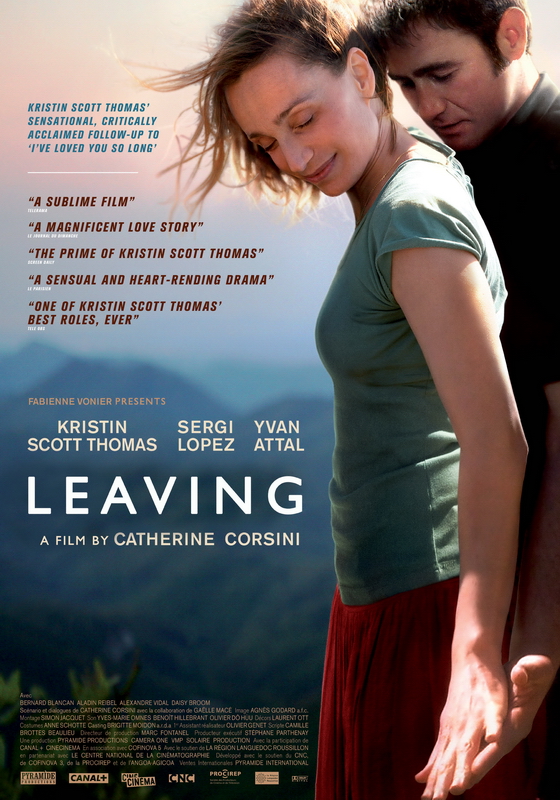
Random DVD round-up 1 - LEAVING

Kristin Scott Thomas has a cool hard beauty that has seen her cast in many a film as, well, a cool hard beauty - emotionally repressed and stolidly dutiful. How wonderful then to see her madly, wide-smilingly in love - almost fey.

In Catherine Corsini's LEAVING, Scott Thomas plays Suzanne, a middle-aged middle-class woman married to a financially successful medic and living in a beautiful house. She is rather taken for granted by her husband (Yvan Attal) and kids, and is trying to reclaim her career as a physiotherapist. She is, in many ways, wandering through life on auto-pilot with occasional outbursts where the rage erupts - as in the powerful opening scene. Suzanne's life changes when she meets and pursues a Spanish builder called Ivan (Sergi López). Their attraction is physical - for sure - but not as singularly as her husband tries to portray it. She isn't just a middle-aged woman who has discovered sex but rather, as in Lady Chatterly's Lover - a kind of freedom and self-knowledge. The second half of the film sees the erotic character study move into a sort of procedural thriller as the two lovers are forced to live cut off from the husband's money and Suzanne's children. The surprise is that it isn't Ivan who drives the narrative - neither as seducer nor as breadwinner. Pretty soon Suzanne's girlie happiness turns into a more brutal, steely survival instinct.

By putting Suzanne firmly at the centre of the film, writers Catherine Corsini and Gaëlle Macé have given Kristin Scott Thomnas a role of the kind that is rarely seen in cinema. A middle-aged woman is allowed to be multi-faceted and the driving force of the action and emotional content of the film. Scott Thomas is completely up to the task and this is further evidence of an actress at the top of her game. I also appreciate that Corsini doesn't feel the need to spin this movie out beyond a 80 minute run-time. Too many films nowadays are unnecessarily baggy. But, there is a big problem with this film - and that's the final act. The closing action is too predictable, too crude relative to what has come before, and the final scenes over the end credits, while presumably trying to be ambiguous seem rather off-tone.

LEAVING played London and Toronto 2009 and was released last year in Belgium, France, the Netherlands, Spain and Brazil. It was released earlier this year in Germany, Italy, Portugal, the UK, Argentina, Denmark, Sweden and the US.

Sunday, January 03, 2010

NOWHERE BOY - suprisingly conventional Lennon biopic

NOWHERE BOY is a beautifully written, beautifully acted, sensitively directed biopic of the young John Lennon, directed by the reknowned British artist, Sam Taylor-Wood. Set in a perfectly rendered 1950s Liverpool, the film shows a 17 year old Lennon groping toward the truth of why he lives with his Aunt Mimi rather than with his mum and dad, not to mention taking his first steps toward becoming a Beatle.


Aaron Johnson (THE THIEF LORD; ANGUS, THONGS AND PERFECT SNOGGING) is assured as the young Lennon, complete with rock-n-roll quiff and iconic Scouse accent. He pulls off both the cockey laddishness and the vulnerability. His John is witty and playful; promiscuous and arrogant; occasionally violently angry; but also desperately adrift. Kristin Scott-Thomas also gives a nuanced performance as John's Aunt Mimi - both stiff and severe in her middle-class home, but also undoubtedly very loving toward John and possessing a wicked sense of humour. (And to those reviewers criticising Scott Thomas for being too posh, Mimi really didn't have a broad Scouse accent. Indeed, Lennon later commented that he had to broaden his Scouse accent for PR purposes.)

The character that jumps off the screen is John's mum, and Mimi's younger sister, Julia. Anne-Marie Duff's Julia is so full of energy and fun that she simply sweeps you up in her love of life and rock'n'roll music. But like John you can't help but feel something is forced in such buoyancy and we're right to distrust it. Despite being remarried with two small children, Julia obviously suffers from depression and can only truly relate to men through flirtation. This extends to John and his band members, and the delicate way in which Sam Taylor-Wood and her script-writer deal with this is both honest and elegant.

The resulting film is a moving emotional drama that is interesting on its own terms, let alone because it formed an iconic musician.

NOWHERE BOY is a very good film. It reminded me a lot of Tom Ford's feature debut A SINGLE MAN, in that it was both apparently conventional in its structure and visual style but also wonderfully brave in tackling uncomfortable subjects head on, without judgement and without cliché. The conventional style is even more surprising from Taylor-Wood given the nature of her graphic art, and her bizarre short film.

NOWHERE BOY closed London 2009 and is currently on release in the UK and Australia. It will play Sundance 2010. It opens in New Zealand on March 4th; in the Netherlands on April 1st; in Russia on April 15th and in Norway on September 10th.

Thursday, February 19, 2009

CONFESSIONS OF A SHOPAHOLIC - superficial, derivative drivel

CONFESSIONS OF A SHOPAHOLIC epitomises everything that is most invidious about the romantic comedies. The plot is derivative and formulaic; the characterisation is two-dimensional; the concept asks us to suspend our disbelief to the point of absurdity. 

Isla Fisher plays Rebecca Bloomwood - a klutzy girl who funds her designer wardrobe with her credit cards and dreams of writing for a Vogue-like magazine. Chased by a debt-collector, she creates a double-life as - oh the delicious irony! - a personal finance columnist. So successful are her jargon-free columns that she lands a TV spot and the love of her charmingly rich, but hard-working boss, played by Hugh Dancy. Of course, there are stumbling blocks to happiness - but how happy the addict whose hoard of illicit goods can fund an easy conversion to the straight life?

The treatment of addiction is insultingly superficial - as is everything else about this tepid film. Worse still, it can't even boast the guilty pleasure of seeing the wardrobes of SEX AND THE CITY or THE DEVIL WEARS PRADA. Rebecca may spend like Anna Wintour but she dresses appallingly. The humour is strained - zero verbal wit offset by the odd pratfall and wilfully embarassing dance scene. Where is the genuine wit and energy of LEGALLY BLONDE or, indeed, director P J Hogan's previous hit, MY BEST FRIEND'S WEDDING?

CONFESSIONS OF A SHOPAHOLIC is on release in Russia, Thailand, Estonia, Kazakhstan, Mexico, the US, the UAE, Croatia, Turkey and the UK. It opens next week in Hong Kong, Iceland and Italy. It opens on March 6th in Greece and Finland and on March 12th in Argentina, Australia, Germany and the Netherlands. It opens on March 18th in Belgium and Spain and on March 26th in the Czech Republic, Singapore, South Korea and Norway. It opens on April 10th in April, on May 20th in France and on May 20th in Japan.

Monday, September 29, 2008

IL Y'A LONGTEMPS QUE JE T'AIME / I'VE LOVED YOU SO LONG - superb

Contemporary, provincial France. A drab, tired woman called Juliette is met by her idealistic young sister, Lea. Lea knows that Juliette has just served fifteen years for murdering her young son, but despite this, she trusts in her childhood memories and entrusts her house and her two young daughters to Juliette's care. Lea's liberal husband has his doubts, and the audience shares them. And that is the key to the success of Philippe Claudel's movie. It combines the beautifully acted character study of Juliette with the dramatic tension of a thriller. At first, the audience is concerned that Juliette will be triggered into a horrible crime against Lea's children. And then, the audience is desperate to know the motive for the original crime. It's all so carefully balanced that this movie of few concrete actions and even fewer words seems to fly by. Kudos to Kristin Scott Thomas for a genuinely brilliant performance in a difficult role, and to Philippe Claudel for crafting such three-dimensional characters. And as to the denouement, some may quibble, but I was so engrossed that I would've bought anything by that point.

IL Y'A LONGTEMPS QUE JE T'AIME played Berlin and TORONTO 2008 and was released earlier this yaer in Belgium, France, Greece, the Netherlands and Spain. It is currently on release in the UK and opens on October 24th in Israel, and the USA. It opens in Germany on November 13th.

Thursday, April 24, 2008

Martha Fiennes retrospective - CHROMOPHOBIA

"Well, I'm seeing a woman with a mustache about my parenting flaws and my residual bulimia. And I'm doing autogenic self-hypnosis to try to keep the low self esteem at bay. I'm getting back to work and - But anyway, it's just really exciting for me at the moment because I am beginning to find the real me."

Writer-director Martha Fiennes throws up a rich portrait of supremely successfully, but deceitful and narcissistic Londoners in her second feature film, CHROMOPHOBIA. Their vices vary from a sort of desperate, void-filling materialism to sexual exploitation of the worst kind. Perhaps their most over-riding flaw is their self-deception. No-one really thinks they're a bad person, do they? Their world of material ease but self-inflicted paranoia is exposed when a tabloid journalist exploits a drunken indiscretion by one of his best friends. Well, it's a savage world.

Martha Fiennes' film is beautifully rendered. The over-designed, polished interiors are spot on, as are the rather pathetic problems that obsess our protagonists. Kristin Scott Thomas is particularly good as a sexually frustrated, spend-a-holic wife. But I would have had more time for this film had it not tacked on a rather ludicrous fairy tale romance between a terminally ill "heart-of-gold" Spanish hooker (Penelope Cruz) and an earnest social worker (Rhys Ifans). These characters are cliches, although Ifans makes the best of it. I also rather disliked the final scenes. One of the key characters makes a life decision that belies their earlier moral cowardice and self-involvement. Maybe it could've happened that way. Maybe we can redeem ourselves in moments of crisis. But this turnaround rang false.

CHROMOPHOBIA closed Cannes 2005. It was released in Italy, France and Israel in 2006 and in Spain and the UK in 2007. It is available on DVD.

Friday, March 07, 2008

THE OTHER BOLEYN GIRL is strewn with cowpats from the Devil's own satanic HERD

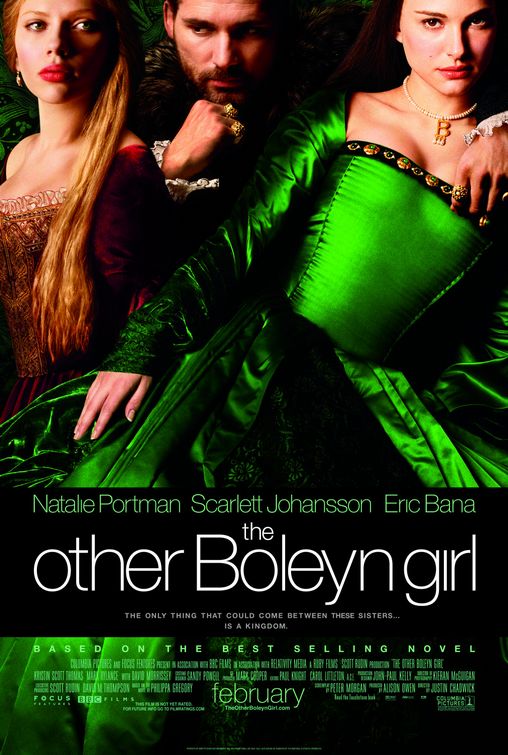
Who is Cyberman's favourite Briton? It would have to be Henry the Eighth. He killed off the Catholic Church. He killed Cardinal Wolsey. He killed Catherine Parr and Anne Boleyn. Yes our favourite Briton is definitely Henry the Eighth. Because he was an unstoppable killing machine!THE OTHER BOLEYN GIRL is an adaptation of Philippa Gregory's historical novel. She portrays the Boleyn and Howard family as eager to advance in wealth and position by pimping out their daughters to Henry VIII. First, Henry knocks up docile Mary, but then casts her aside for her more intelligent and ambitious sister Anne. Her pride piqued by her rejection at the hands of Henry Percy and her family's prior support of Mary, Anne pressures the King into divorcing his true wife, Catherine. But as Queen, Anne's position will only be safe if she can deliver Henry a son.

It's a fantastic story written in clear unpretentious English. Best of all, Gregory manages to balance our base instinctual need for trashy romance and a happy ending with a more profound depiction of a society where women were chattel, and those who made their own way were liable to be seen as abominations.

The movie, however, is problematic.

The problems start with the script. Peter (of THE QUEEN fame) takes an intellectually superior work of historical fiction and strips it of any subtlety. He leaves behind a work that is much reduced - in terms of scope, motivations, credibility and enjoyment. The novel made the relationship between the two sisters more complicated. Yes, there were jealousies and rivalries but there was also a shared commitment to success and wrongs on either side. By contrast, the film has Mary as a pantomime do-gooder heroine and Anne as a malicious little whore. (Anne's relationship with Henry Percy is so quickly skated over that we have no time to see her softer side. It's also ironic to see Anne portrayed in the first half of this film almost as maliciously as she would have been portrayed at the time. So much for historical revisionism in a post-feminist world!) The motivations of Henry VIII are rendered especially opaque and Peter Morgan creates a particularly crass scene in which Henry rapes Anne. This strikes me as a particularly lazy and insidous short-hand. The mechanics of how Anne comes to be accused of being a witch are also reduced to a crude and obvious incest charge - a theme that is handled with far more subtlety and intrigue in the novel.

Finally, the most grave charge against Peter Morgan's adaptation is slovenliness. He introduces themes only to leave them hanging in the air. A classic example is that we are introduced to Mary's husband William Carey. He sort of disappears and then before we know it William Stafford is offering to take care of her. The informed viewer will realise that Carey has died in the interval, but Peter Morgan doesn't bother passing on this information. Morgan also allows a couple of lines of jarringly anachronistic dialogue to creep into the script. So, one moment we are talking of "piss-pots". The next, we're being asked to "look on the bright side". Morgan also makes the Boleyn's mother, Lady Elizabeth, the voice of feminist dissent. This is rather patronising. I think I might have worked out the social importance of the film without having a character precis it for me.

The director and cinematographer, Justin Chadwick and Kieran McGuigan, do little better, making choices that reduce their film to a cheap bodice ripper with no self-respect. From the start, the movie is drenched in a warm honey glow - soft-focus love scenes and dappled sunlight that renders the actors faces orange in the interior scenes. This is so starkly in contrast to the aggressively modern, grimly real look of Chadwick's BLEAK HOUSE that one can only assume that the critically acclaimed BBC adaptation was a success because of fine editing and production design rather than its direction. Or maybe Chadwick was hamstrung by producers and marketing departments going for a "heritage" TV look and a simple tale of sibling rivalry?

There's little joy in front of the camera. Scarlett Johansson (Mary Boleyn) doesn't so much act as look doe-eyed and slow-witted. Natalie Portman (Anne Boleyn) is the better actress. At least, she is very good at working herself up into fits of hysteria. Her mastery of the English accent is less certain. Jim Sturgess (George Boleyn) looks uncomfortable and inadequate. David Morrissey (the Duke of Norfolk) delivers his lines in a modern style that stands out from the self-conscious affected period melodramatics of the lead actress. Accordingly, he seems mis-cast, or at least misdirected. Eric Bana (Henry VIII) is a fine actor but Peter Morgan's script doesn't offer him much opportunity to portray the complexities and gravity of Henry VIII's decisions. There is some compensation in the smaller roles. Mark Rylance (Sir Thomas Boleyn), Kristin Scott Thomas (Lady Elizabeth Boleyn) and Benedict Cumberbatch (William Carey), all do brilliantly well is largely under-written parts.

Finally, what more can one say than that this movie is a dreadful disappointment?

THE OTHER BOLEYN GIRL is on release in the US, Netherlands, Ukraine, Estonia, Latvia, Spain, Egypt, Russia, Germany and the UK. It opens later in March in Australia, South Korea and Iceland. It opens in April in France, Singapore, Belgium, Israel and Italy. It opens in May in Brazil; in August in Norway and in Finland on Septmeber 12th.

Monday, July 30, 2007

THE WALKER - the localised and global consequences of a corrupt political establishment

THE WALKER is the latest film from celebrated writer/director Paul Schrader. As a writer, Schrader gave us the definitive picture of the disenfranchised, angry young man in TAXI DRIVER. And as a director he has given us many iconic images of men who are outside of the establishment but mingle with it and luxuriate in its superficial beauty. Until, of course, they are ensnared in the seamier side of the power structure. AMERICAN GIGOLO is perhaps the apex of this style of thriller cum character exploration.

In THE WALKER we see another exploration of character. This time, the central character is a flamboyant homosexual who precariously balances his lifestyle with his position as scion of a rapaciously Republican, Virginian family. Woody Harrelson's performance as Carter Page III is yet another career-best to rival his perfomance as Larry Flint. He struts through Washington high-society wearing an ill-fitting toupe, and speaks through a near-closed mouth with a broad Southern accent - and have they done something to his nose? His observations on Washington society are rapier-subtle and very, very funny, but he manages to maintain an almost boy-ish innocence and loyalty to his friends.

These friends are rather a different breed. They are the well-heeled wives of Washington power brokers. While their husbands hush up an Enron-style scandal implicating the Vice-President, Carter "walks" them to parties and to the opera - a convenient piece of arm candy to hire. Of the three lead actresses, Lily Tomlin is unusually, ambiguously evil as the wife of a Karl-Rove-style lobbyist. Lauren Bacall is magisterial as a rich widow. And Kristin Scott Thomas gives a rather auto-pilot performance as a philandering wife who happily lets her "friend" Carter get implicated in a murder-scandal on her behalf.

Yes, the witty script and strong performances from Harrelson, Bacall and Tomlin are the highlights of this drama. But there are other strengths. I rather liked the insidious, smooth flowing camera shots that circle and permeate political society. There is a wonderful homage to the infamous AMERICAN GIGOLO scene where Richard Gere gets dressed to go out. This time, the scene is reversed. An ageing, balding Harrelson takes off his vulgar but expensive clothes and the camera hovers lovingly over trays of cuff-links and ties. Then, he takes off his toupe!

I also rather liked the unabashed references to Abu Ghraib through the photography of Carter's boyfriend Emek (Moritz Bleibtrau). I like the idea that the venality of Washington; the unquestioning xenophobia; the sacrifice of constitutional checks and balances in the name of the national interest - all this leads to the relatively localised corruption in which Carter is implicated, but also leads to the wider loss of moral integrity seen in Iraq.


THE WALKER played Berlin 2007 and goes on release in the UK on August 10th and in the UK on December 7th.

Thursday, June 14, 2007

TELL NO-ONE/NE LE DIS A PERSONNE - teeeeeee-dious "thriller"

Inside the bloated two hour run-time of TELL NO-ONE is a decent thriller screaming to get out. But sadly, as it is, this movie is over-long, poorly directed and woefully un-thrilling.

Based on a novel by Harlan Coben, the movie has been adapted and directed by the young French director Guillaume Canet. François Cluzet plays a grieving pediatrician called Alex Beck. Beck receives an email from his wife, who was apparently brutally murdered eight years previously. At the same time, the police re-open her murder case when they un-earth two bodies near Beck's country estate. Beck goes on the run from the police, seeking help from the criminal types he meets in his clinic and from his sister (Marina Hands) and her lover (Kristin Scott Thomas.) Eventually, not so much through his own cunning as other's need to talk, Beck discovers the truth.

My problems with the movie are many and various. The pacing is way too slow. The structure too meandering. Cluzot chooses to play Beck as unemotive - which makes his screen-time really dull. The deep dark secret at the centre is easy to spot if you pay attention to the huge big random bits of information that are clumsily dropped in half way through. Thereafter, the film unfolds slowly and the deep dark secret is treated simply as a plot motivator rather than explored in the depth that it deserves. Treating that particular issue as a Macguffin is especially tasteless. The denouement is even more annoying. After a supposedly tense, adult thriller we are left to wallow in sun-kissed sentimentalism that feels completely out-of-place. Frankly, this movie is a mess.

TELL NO-ONE/NE LE DIS A PERSONNE opened in the Czech Republic, Belgium, France, and Switzerland in 2006 and in Russia, the Ukraine, Israel and Turkey earlier this year. It is currently on release in the UK and the US. It opens in Sweden in August and in Finland on September 28th.

Friday, March 17, 2006

KEEPING MUM - Alleged comedy about an axe-wielding au-pair that is significantly less funny than you might think from that description

KEEPING MUM is a movie made in the “British Nanny” genre. This includes many movies which are not in fact British and do not feature British characters, or even a nanny. But you know what I mean. They are movies like Nanny McPhee, The Sound of Music or Don’t tell Mom, The Babysitter’s Dead. There is a family that is troubled – the kids are unruly, the parents in difficulty – but nothing actually dysfunctional. In walks the nanny figure, who may or may not actually be a nanny. He/she starts cooking, cleaning and sorting out the local bully, and before you know it, everything is hunky-dory again. Generally speaking, I don’t mind these movies. They plug a gap in the market for safe kiddie-friendly films, and leave you with a generally warm feeling – as if all of life’s problems could be solved with some home-made scones and a cheery tune.

However, in order to bask in the audiences collective good-will, these movies need to get two things right. First, they need to have genuinely engaging and sympathetic characters. I don’t need to find the characters plausible, I just need to be happy to spend two hours in their company. Second, there have to be some good gags.

All of which brings me round to telling you why I think KEEPING MUM is a cinematic stinker. In features a bunch of great British character actors being self-absorbed and mean, even after the Nanny arrives. We have Rowan Atkinson as a vicar who is too busy with work to pay attention to his wife, and then post-nanny, too busy with his wife to pay attention to his parishioners. His wife, played by the usually marvellous Kristin Scott Thomas, is having an affair with a lecherous golf-pro, played by Patrick Swayze. She decides to chuck in her husband almost on a whim and post-Nanny undergoes a highly ridiculous conversion into…well, that would ruin the alleged plot-twist.

The second problem is that the script does not contain enough funny material. Somewhere out there there’s probably a great film about an axe-murdering au pair, but this just isn’t it.
Even Swayze in a posing pouch doesn’t raise a titter, and while he does languish in sleaze, this isn’t as blackly funny a role as the one he took in Donnie Darko. Even when Rowan Atkinson gets transformed into a “funny” vicar, and is supposedly packing in the audiences with his side-splitting homilies, I could still not detect a joke. Sucks.

KEEPING MUM is now available on Region 2 DVD. But then again, so is CATWOMAN, but you don't see me renting that either.